
 E-Paper



Author Lakshmi Puri's new book is a love story weaved in the aesthetics and allure of the Indian sari
Author Lakshmi Murdeshwar Puri's non-fiction writing, The Sari Eternal is a tribute to the unstitched fabric through her personal and professional memories.

 Prefer HTon Google


A Banarasi weave in a jamuni (deep violet) hue holds the fickle attention of a human eye on the cover, from the moment one holds the book, The Sari Eternal by Lakshmi Murdeshwar Puri. It thus becomes the talking point upon meeting the author at her residence in Lutyens’ Delhi. It’s here that the former Assistant Secretary-General at United Nations makes an appearance in a pink and green Mysore silk sari, as if she borrows the aesthetic from Raja Ravi Varma’s paintings of Goddess Lakshmi. Mention this, and Puri relents a smile as she begins to read the opening lines of her new book: “The sari. This unstitched river of fabric that winds around my body, is not clothing — it is a second skin for me. I live it. It makes me whole aesthetically and spiritually!”
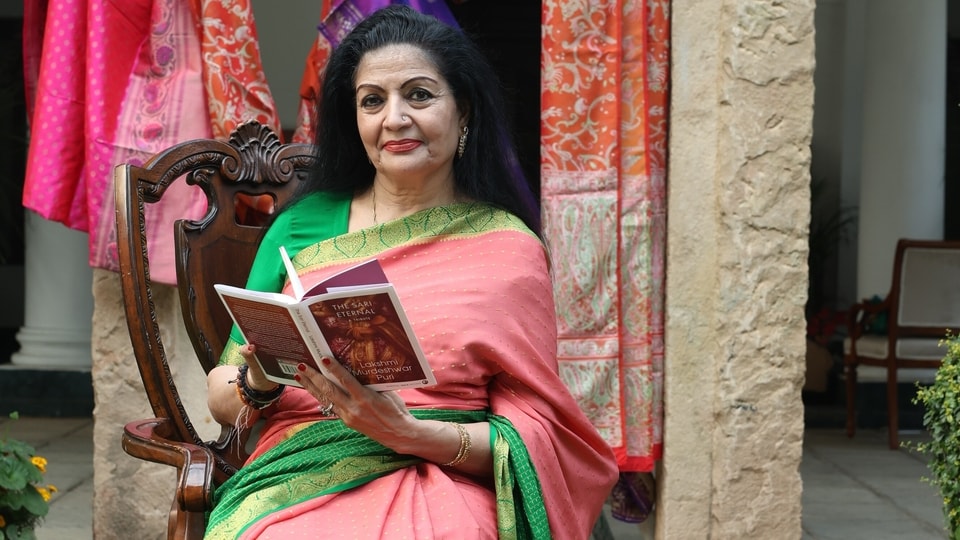
Thus unravels the tale where Puri pays a succinct yet comprehensive tribute to the garment that embodies the beauty of India’s rich textile history, but through an unconventional perspective. “When I set out to write this book, I too thought what more is there to say about sari,” shares Puri, recounting her initial inhibitions, and makes full disclosure, “I’m a lover of sari but not an expert on textiles! So this book became a love letter, a conversation, an ode to the sari and its believers – from my generation, millennials and GenZ.”
The book, which is part of the Essential India Editions, is Puri’s vision as a capsule for anyone who wants to know almost anything about a sari, as she “wanted even a non-aficionado to get to know all about it, and feel it’s worth.” Standing true to her resolve, she envisaged how the sari, as a drape, has played numerous characters starting from the historical times up till now in the contemporary era. Puri, whose “love affair” with the sari began in her childhood, grew when she was a student at Lady Shri Ram College (LSR), Delhi University, and she doesn’t dismiss the fact how GenNext is reinterpreting the sari today. All this about the six yards is accomplished in just six chapters. A remarkable feat.

But it’s not just a sari lovers’ obeisance to the various Indian weaves that would capture the interest of the readers. “It (sari) has excited my senses!” Puri reads intermittently from the book, revealing how she perceives “the touch, the feel, the sight, the taste, and the scent” as the beauty of the sari unfurls. How can one taste a sari? Is the next question. She reads from the book describing how a sari can be sweet, salty, bitter, sour and pungent.

Adding to the narrative, Puri reminisces, “Remember how the river Ganges is shown coming down through her sari in mythology. As a child, I would ask my mother, ‘Do we also climb back into heaven through her sari?’” The innocence beholds.
Casting a spell on the psyche of a sari lover, the book transposes a modern-day reader from the old to the new and vice versa while pausing briefly in one chapter where she explores the role of Bollywood and Indian cinema in this saga that reads like a seamless repository of thoughts abridge in a long essay. “Film is in my family. My first cousin Vanmala was a pioneering actor in the 40s and 50s,” shares Puri, confessing when probed: “Rekha’s sari collection has fascinated me. In different films, she has worn it in a distinct style... But I think I have an enviable collection myself and some of them from my mother’s collection too (smiles).”


