The 15th Finance Commission, which decides the sharing of resources between the Centre and states, submitted its report for the five-yearly period between 2021-22 and 2025-26 to President Ram Nath Kovind on Monday, making wide-ranging recommendations that are likely to be seminal in the area of health care, financial incentives to states based on performance, and national security.
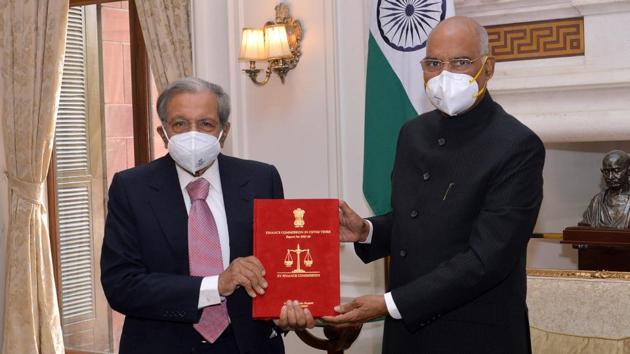
The report by the commission, headed by NK Singh, comes at a juncture when the Covid-19 pandemic has greatly strained government revenues, shrinking the resource pie, and amid a turbulent Centre-states relationship over payment of the Goods and Services Tax (GST) compensation cess.
Titled “Finance Commission in Covid Times”, the four-volume report contains, for the first time, a chapter on the health care scenario of the country, accompanied by recommendations likely to prove crucial in ramping up public-health spending in a post-pandemic era. “Over the next five years, the Centre alone should be able to spend at least 2.1% of GDP on health,” chairman NK Singh told HT in an interview on July 8.
A key term of reference by the Centre to the commission is the creation of a non-lapsable defence and internal security fund, either through allocation from the divisible pool of funds, from which resources are shared between the Centre and states, or through a cess. The report has addressed this, and several other wide-ranging proposals written into its mandate. “The commission has sought to address all its terms of references in this report to the Union government. The commission has analysed the finances of each state in great depth and has come up with state-specific considerations to address the key challenges that individual states face,” an official statement said.
The Constitution, through Articles 280 to 281, provides for finance commissions, set up every five years, as a mechanism to divide taxes and revenues vertically i.e. between the Centre and states, and horizontally, i.e. among all states, based on their levels of development, prosperity and regional needs.
{{/usCountry}}The Constitution, through Articles 280 to 281, provides for finance commissions, set up every five years, as a mechanism to divide taxes and revenues vertically i.e. between the Centre and states, and horizontally, i.e. among all states, based on their levels of development, prosperity and regional needs.
{{/usCountry}}Over the years, finance commissions have incrementally increased the share of states in resources, but also linked grants and incentives to states based on their performance in various areas, such as demography, sanitation, public health, and so on. The previous 14th Finance Commission recommended a leap in states’ share, raising it by 10 percentage points to 42%. The 15th commission has reviewed the recommendations of the 14th commission, which was one of its mandates.
According to its terms of reference set by the President, the commission has examined and recommended performance incentives for states in several areas, such as power-sector reforms, adoption of direct benefit transfers, solid waste management, and others.
Given the shrinking base, what states would get in absolute terms would matter more than the percentage share over the next five years, a senior official told HT requesting anonymity in a November 7 interview. Also, since the pie is smaller, the grants component recommended by the commission “becomes very important for states”, he said.
The recommendations, for the next five years, are unlikely to be made public anytime soon, and will possibly be tabled in the Parliament, along with an action-taken report, when finance minister Nirmala Sitharaman presents the Budget next February.
The report’s Volume I and II contain the main report. Volume III is devoted to the central government and examines key departments in greater depth, with the medium-term challenges and the road map ahead. Volume IV is devoted to the states. Members of the commission included Ajay Narayan Jha, Anoop Singh, Ashok Lahiri and Ramesh Chand, who along with chairman NK Singh and secretary to the commission, Arvind Mehta, presented the report to the president.
According to NR Bhanumurthy, vice-chancellor of the Dr BR Ambedkar School of Economics, the pandemic need not impact the “devolution formula” mainly because all states had been affected equally. “What might be impacted is the fiscal responsibility and budget management road map because the pandemic has put huge pressure on both expenditure and revenue,” he said.