Kerala health minister Veena George said on Tuesday that four confirmed infections of the rare Nipah virus have been recorded in the state, of which two turned fatal, a development that prompted the Union government to rush a team to the state.
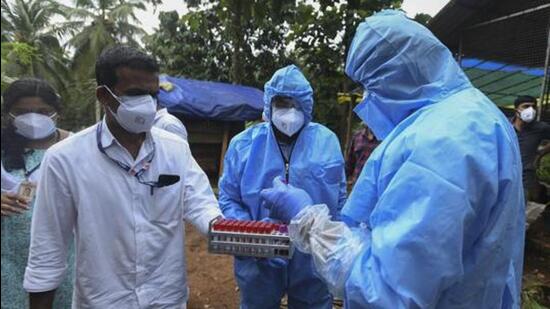
The state minister said three of the five samples that had been sent for testing to the National Institute of Virology lab in Pune came back positive, including that of a man who died on Monday. Though the sample of the man who died on August 30, considered the index case, was never sent for testing, his death is also now confirmed to have been from Nipah virus, the minister said.
This is Kerala’s fourth outbreak of Nipah, a rare viral infection that at present has no cure or vaccine. The deadly brain-damaging virus is transmitted to humans through direct contact with the bodily fluids of infected bats, pigs or other people.
The two people who have tested positive and are currently under treatment are the nine-year-old son of the man who died on August 30 and his 24-year-old brother-in-law. Two other children have tested negative so far.
Union health minister Mansukh Mandaviya told reporters in Delhi that an expert team has been sent to Kerala to assist the state government in managing the outbreak.
{{/usCountry}}Union health minister Mansukh Mandaviya told reporters in Delhi that an expert team has been sent to Kerala to assist the state government in managing the outbreak.
{{/usCountry}}The Kerala government has taken all necessary measures to tackle the outbreak, said George.
“The person who died on August 30 suffered from liver cirrhosis. He had some comorbidities. His death was seen as a result of complications from his comorbidities. But when his relatives and primary contacts showed unnatural fever and other symptoms, that’s when we began surveillance,” said George.
A contact list of over 160 high-risk individuals was drawn up by Tuesday evening with the help of grassroots health workers who had fanned out across the affected panchayats in the district. Symptomatic persons will be admitted to isolation wards at hospitals with one such ward opened at the government medical college hospital.
Drawing from past experience of tackling the deadly virus, the health department moved quickly to trace those who were in contact with the two people who died as well as the five others who are currently under treatment.
Fever surveillance was conducted on Monday and Tuesday across 90 households in the Maruthonkara and Ayancheri panchayats in Kozhikode district where the deceased lived.
“I have spoken to the health minister of Kerala, there have been reports of this virus several times this season. Cases are coming up, this virus is spread by bats. A guideline has been prepared by the health ministry regarding this so that we can take precautions,” said Union health minister Mansukh Mandaviya.
“Kerala has a well-oiled machinery as far as disease surveillance is concerned which is why the presence of viral diseases is detected in time. Also, because of timely detection, the state is also able to check the spread,” said a senior official from the National Centre for Disease Control.
The health department has formed 16 teams under various officials to oversee collection of samples as well as tracing of contacts. A control room has been opened in Kozhikode and helpline numbers for the public have been issued. Public in the district have been advised to desist from visiting relatives in hospitals and clinics.
PA Mohammed Riyas, Public Works Department minister who is in charge of the district, held meetings with local MLAs and panchayat heads to oversee surveillance and containment measures.
He told reporters later, “There is no cause for alarm. In the Maruthonkara and Ayancheri panchayats, where the families of the two deceased stay, we have conducted surveillance across 90 households to look for cases of fever. There are no major complaints there. There have been some deaths in these places in recent days and the health department is investigating the cause of these deaths. People have been generally advised to contact health officials if they fall ill. Masks are recommended.”
Nipah virus is a zoonotic virus that is transmitted from animals to humans and the natural carrier for the virus is the fruit bat (or flying fox). Infected fruit bats can spread the disease to people and other animals, according to the US-based Centre for Disease Control. Symptoms include fever, headache, cough, sore throat, vomiting and disorientation. Deaths may occur in 40-75 percent of the cases and the virus has a high mortality rate.
(with inputs from New Delhi )