Twenty years after India declared itself a nuclear weapons state following the Pokhran II tests, Prime Minister Narendra Modi has announced the completion of a survivable nuclear triad with a totally indigenous, tested and verified second strike capability in the form of strategic strike nuclear submarine (SSBN 80) INS Arihant, which successfully completed its first deterrence patrol with on-board K series of intermediate range nuclear ballistic missiles.
While the Modi government remains tight-lipped about this milestone, it’s understood that INS Arihant, fitted with submarine launched ballistic missiles (SLBMs), was on deterrence patrol for over two months to the east and far east of India and managed to avoid the prying eyes of global intelligence agencies including those belonging to India’s adversaries. With an aircraft carrier and a strategic submarine at its disposal, the Indian Navy has now become a blue water Navy with global reach and strike capability.
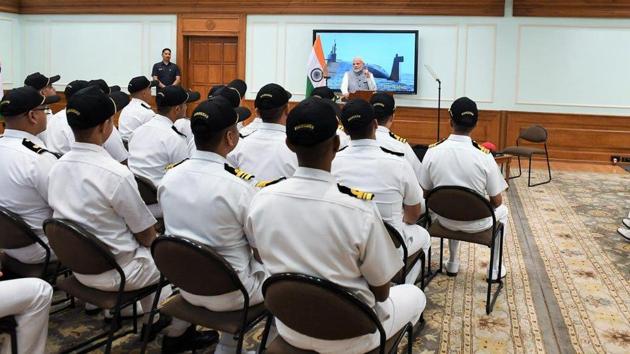
The INS Arihant crew led by captain Mukul Suranghe, a body-builder, were felicitated by PM Modi after national security advisor Ajit Doval briefed the cabinet committee on security (CCS) on India’s most potent and survivable deterrent , given its “no first use” position. The CCS meeting was attended by home minister Rajnath Singh, finance minister Arun Jaitley and defence minister Nirmala Sitharaman. Present at the felicitation were navy chief, admiral Sunil Lanba, and admiral (retd) S P S Cheema, who heads the strategic planning staff.
Top government officials told HT on condition of anonymity that the completion of the nuclear triad comes at a very significant time when nuclear weapons are back on centre-stage with US accusing Russia of reneging on the 1987 Intermediate Range Nuclear Force (INF) Treaty and both China and Pakistan adding to the nuclear arsenal. India’s other ballistic missile submarine, INS Arihant, which was launched on November 19, 2017, is currently undergoing sea trials. Both submarines are based on India’s eastern seaboard.
{{/usCountry}}Top government officials told HT on condition of anonymity that the completion of the nuclear triad comes at a very significant time when nuclear weapons are back on centre-stage with US accusing Russia of reneging on the 1987 Intermediate Range Nuclear Force (INF) Treaty and both China and Pakistan adding to the nuclear arsenal. India’s other ballistic missile submarine, INS Arihant, which was launched on November 19, 2017, is currently undergoing sea trials. Both submarines are based on India’s eastern seaboard.
{{/usCountry}}The Prime Minister’s Office (PMO) reiterated that India has put in place a robust nuclear command and control structure, effective safety assurance architecture and strict political control, under its nuclear command authority.
It remains committed to the doctrine of credible minimum deterrence and no first use, as enshrined in the decision taken by the cabinet committee on security at its meeting chaired by the then Prime Minister Atal Bihari Vajpayee on January 4, 2003.
The PM noted that the indigenous development of the SSBN and its operationalisation attest to the country’s technological prowess and the synergy and coordination among all concerned while immensely enhancing the country’s security through this pioneering effort.
PM Modi stated that the people of India aspire for a ‘Shaktimaan Bharat’ (Strong India) and building a New India. Extending his greetings to the participants and their families on the occasion of Diwali, he hoped that INS Arihant would be a harbinger of fearlessness for the country.