E-Paper



2001 disaster set off chain of decisions that reshaped Gujarat’s political leadership
The disaster hit the state at a time when the Bharatiya Janata Party (BJP) government in the state under chief minister Keshubhai Patel was already dealing with criticism over governance and internal party challenges.

 Prefer HTon Google


A powerful earthquake devastated Gujarat on Republic Day in 2001, leaving thousands dead and overwhelming the state machinery. The disaster hit the state at a time when the Bharatiya Janata Party (BJP) government in the state under chief minister Keshubhai Patel was already dealing with criticism over governance and internal party challenges. The disaster may not have created those problems, it brought them into sharper focus and set off a chain of political decisions that reshaped Gujarat’s leadership.
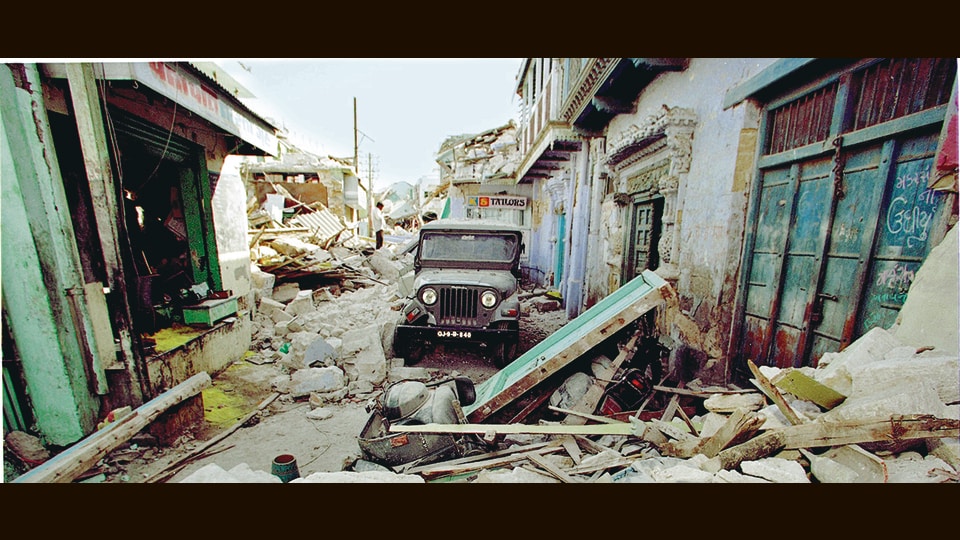
In the year preceding the earthquake, the western state had witnessed severe drought across Saurashtra, Kutch and north Gujarat. Thousands of villages were left dependent on tanker water for months. The handling of the drought drew criticism from voters as well as from a section of the ruling BJP. The discontent reflected in the local body polls held in late 2000, when the BJP lost control of a majority of district panchayats, particularly in rural areas.
Political analyst Vidyut Joshi said the organisational influence of leaders associated with Shankarsinh Vaghela camp, which had earlier broken away from the party, continued to be strong in parts of the state unit. This added to factional pressures and limited Patel’s room for manoeuvre, Joshi pointed out.
It was against this backdrop the 7.7 magnitude earthquake struck Gujarat on January 26, 2001. Kutch district suffered maximum damage, with towns like Bhuj, Bhachau and Anjar collapsing within minutes. In the first few hours, the state machinery struggled to cope with the scale of destruction. District administrations were overwhelmed and rescue equipment was limited. In several areas, survivors began rescue efforts on their own as official help took time to reach.
The initial relief phase was supported largely by voluntary organisations. Cadres of the RSS, the ideological fountainhead of BJP, along with social and religious groups, mobilised quickly. Within days, Narendra Modi, then a senior BJP functionary, rushed to Kutch. He camped at Bhachau, worked with RSS and party workers, reviewed relief operations and pressed officials to speed up rescue and rehabilitation.
Former BJP spokesperson and state finance commission chairman Yamal Vyas said Modi’s conduct during the crisis left an impression within the party. “He came in the first few days, camped there for some time and worked closely with RSS and party workers for relief and rescue work,” he said.
After the BJP lost the Sabarmati assembly bypoll in August 2001 to the Congress, Keshubhai Patel was replaced by Modi in October. “The first challenge Modi took up as chief minister was earthquake rehabilitation, where things were not progressing as expected. The way he dealt with the bureaucracy and moved work forward made it clear that a strong and efficient leader had arrived,” Vyas said.
Joshi said the years that followed under Modi marked a shift in approach. “Modi brought an industry-led development vision to Kutch. Port-led growth, privatisation of ports, logistics and overall industrial development was part of his vision... Keshubhai Patel was a man of the roots, but Modi worked with a long-term development framework,” Joshi said.