Ramdas Athawale, the minister of state for social justice and empowerment said there were no deaths reported due to manual scavenging while adding 233 persons died due to accidents while undertaking hazardous cleaning of sewer and septic tanks during the last three years and the current year.
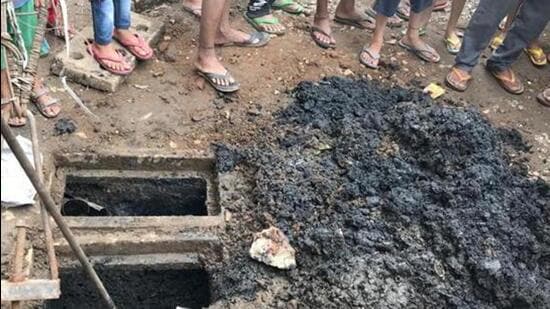
The minister was replying to a question regarding the rehabilitation of manual scavengers across the country in Lok Sabha on Tuesday.
“No death has been reported due to engaging in Manual Scavenging (which is lifting of human excreta from insanitary latrines as defined in Section 2(1) (g) of the MS Act, 2013),” said Athawale in a written reply to BJP MP Durga Das Uikey in Lok Sabha.
Also Read:Ghaziabad sewer deaths: Families of victims get ₹10 lakh ex-gratia, say they don’t want to file FIRs
In his reply, Athawale distinguished between manual scavenging and cleaning of sewer and septic tanks.
“However, 233 persons have died due to accidents while undertaking hazardous cleaning of sewer and septic tanks during the last three years and the current year. State-wise details of deaths and payment of compensation as per Hon’ble Supreme Court’s Judgment dated 27.03.2014 are given in Annexure.”
{{/usCountry}}“However, 233 persons have died due to accidents while undertaking hazardous cleaning of sewer and septic tanks during the last three years and the current year. State-wise details of deaths and payment of compensation as per Hon’ble Supreme Court’s Judgment dated 27.03.2014 are given in Annexure.”
{{/usCountry}}Manual scavenging is termed as the manual cleaning, carrying, disposing of, or handling in any manner human excreta in an insanitary latrine, according to Section 2(1) (g) of the MS Act, 2013.
The practice is banned under the Prohibition of Employment as Manual Scavengers and their Rehabilitation Act, 2013 however, activists assert that the caste-based practice still prevails.
However, activist groups expressed their dismay at the government’s denial over deaths.
Bezwada Wilson, founder of activist group Safai Karmachari Andolan, attacked the government over its alleged denial of manual scavenging deaths.
“They are playing politics with the lives of people. Everyone knows that people who are involved in such hazardous job, die of illnesses”, he said.
“Last week in Mumbai, four deaths took place and then how can he say in Parliament that no manual scavenging deaths are being reported?” said Wilson rebutting Athawale’s claims while referring to the deaths of two men in Mumbai after they allegedly inhaled toxic fumes from a sewer they had entered to clean.
The minister also clarified the funds released under the Self-Employment Scheme for Rehabilitation of Manual Scavengers (SRMS).
Over the course of the financial year 2021-22, ₹39 crore has been released to manual scavengers in comparison to ₹16.6 crore in 2020-21.
Funds amounting to ₹84.8 crore were released for scavengers in 2019-20.
The highest number of deaths of sewer and septic tank workers was in 2017 at 117 deaths where compensation was issued to the families of 87 workers.
In 2020, the lowest number of deaths was recorded, with 19 sewer and septic tank workers dying, out of which compensation was paid to the kin of 14 workers.
Meanwhile, in 2021 and 2022, 49 and 48 deaths of sewer and septic tank workers were recorded, respectively, out of which 47 and 43 workers’ families received compensation.
In April 2022, the union minister of social justice and empowerment, Virendra Kumar, notified the Rajya Sabha that the Centre had identified 58,098 manual scavengers over two surveys in 2013 and 2018. Kumar also noted that one-time cash assistance of ₹40,000 was deposited directly into the bank accounts of all the identified and eligible 58,098 manual scavengers under the SRMS scheme.