
 E-Paper



35 years after inception, Tejas Mark I design frozen
The FOC Tejas will have air-to-air refueling capability, beyond visual range Israeli Derby missiles, high angle attack expansion with a capability to match the best fighters in its light weight class in the 4 to 4.5 generation category.

 Prefer HTon Google


Thirty-five years after the inception of India’s light combat aircraft programme, the Aeronautical Development Agency (ADA) has finally frozen the design of the Tejas Mark I defence fighter with aircraft drawings submitted on December 31 and the certificate of combat readiness obtained from the Centre for Military Airworthiness and Certification (CEMILAC) under the Defence Research Development Organisation (DRDO).
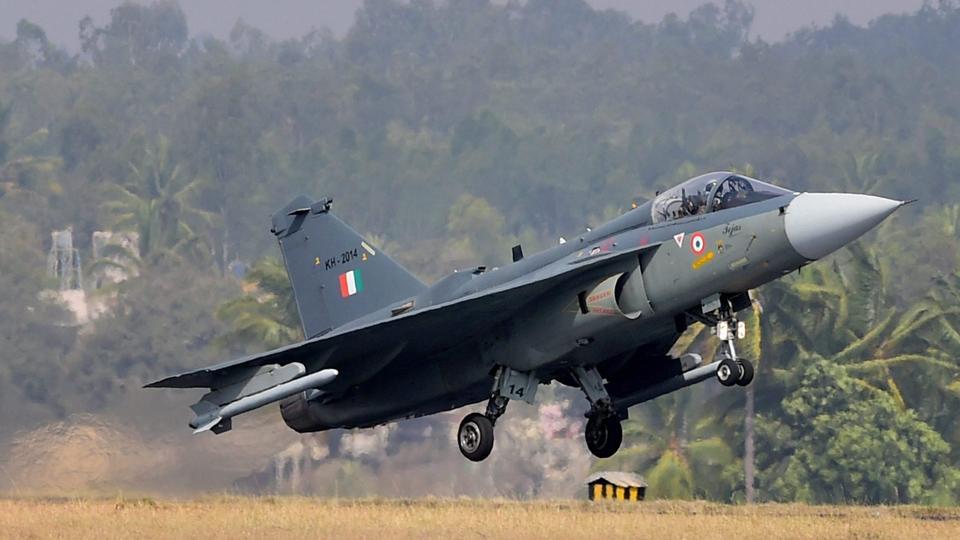
In an interview, Girish Deodhare, director, combat aircraft and ADA, said that the first Tejas in the final operational configuration (FOC) will be delivered to the Indian Air Force (IAF) in September with another 15 fighters to be delivered in the following 20 months. The deliveries will be much faster with Hindustan Aeronautics Ltd (HAL) deciding to outsource aircraft sub-assemblies to private companies such as Larsen & Toubro.
The FOC Tejas will have air-to-air refueling capability, beyond visual range Israeli Derby missiles, high angle attack expansion with a capability to match the best fighters in its light weight class in the 4 to 4.5 generation category.
From the initial order of 40 fighters from IAF, Deodhare said state-owned HAL, Bengaluru had delivered 12 fighters in combat-ready initial operational configuration (IOC) with the next four fighters to be delivered next month. The eight remaining aircraft will be in two-seater trainer configuration, which will follow the FOC fighters and also be fitted with air to air refuellers.
The IAF order under negotiation for 83 more platforms will be Tejas Mark IA, which will be fitted with state-of-the-art active electronically scanned array radar developed indigenously or ELTA, Israel, in a tie-up with HAL. ADA, Deodhare disclosed, is already testing an indigenously developed AESA radar with Tejas Mark I.
Deodhare conceded that there have been delays in the Tejas programme due to optimistic projections of time by its designers, developers and producers, and added that Tejas Mark II will be a twin-engine advanced medium combat aircraft (AMCA) with a heavier GE-414 engine as compared to the GE 404 engine of the Mark I. The twin-engine fighter will also have a naval variant. The development of the Mark II has already received a green signal from the defence minister and is set to go before the Cabinet Committee on Security (CCS) for full financial approval of development costs.
Even though the FOC Tejas will come with some deviations from the air staff qualitative requirements, 1985, the fighter will not loose any of its fighting capability and will optimally perform its duties of defending air bases under attack and Indian borders. While the turnaround time of Tejas Mark I is high as the designers focused on the development of the aircraft primarily, with only the secondary focus on maintenance and repairs, HT learns that IAF has finally been handed over initial documentation (the manual) of the fighter with the upgraded and complete documentation ready in the next two to three months. The force needs this manual for training and operating purposes.


