E-Paper



48 hours, 87 cars later, ELV seizure drive ends
Delhi's crackdown on old vehicles has been halted after 48 hours due to backlash and technical issues, prompting a request for reconsideration from officials.

 Prefer HTon Google


NEW DELHI: The city’s administration all but halted its controversial crackdown on old vehicles after just 48 hours on Thursday, citing technical glitches and logistical challenges following a significant backlash against the measure.
While a final order – targeting petrol vehicles older than 15 years and diesel vehicles older than 10 years for impounding when detected at fuelling stations — was awaited from the Commission for Air Quality Management (CAQM), enforcement teams had already stopped taking action beginning Thursday.
“Considering the difficulties faced by the citizens of Delhi, our government has written a letter to the Commission for Air Quality Management (CAQM) requesting a reconsideration of the decision to deny fuel to End-of-Life (EOL) vehicles. This decision is adversely affecting the daily lives and livelihoods of millions of families,” Delhi chief minister Rekha Gupta said in a post on X.
“Our government is fully committed to controlling air pollution and is working on long-term solutions for clean, sustainable transportation. However, while implementing any decision, it is equally essential to maintain a balance with the social and economic needs of citizens,” she said.
A transport department official speaking on condition of anonymity said, “The teams are limited and cannot be deployed at every station. Also, while there are no formal orders yet, we have reduced enforcement since Wednesday.”
The first two days of the drive saw 87 vehicles impounded. Prior to the drive, CAQM had said that there were around 6 million such vehicles still in use — but a transport department official told HT earlier this week that the actual number on the roads may be around 600,000, about 10% of the CAQM’s estimate. The remaining, this person said, are likely scrapped, de-registered and transferred out of the city with an NOC.
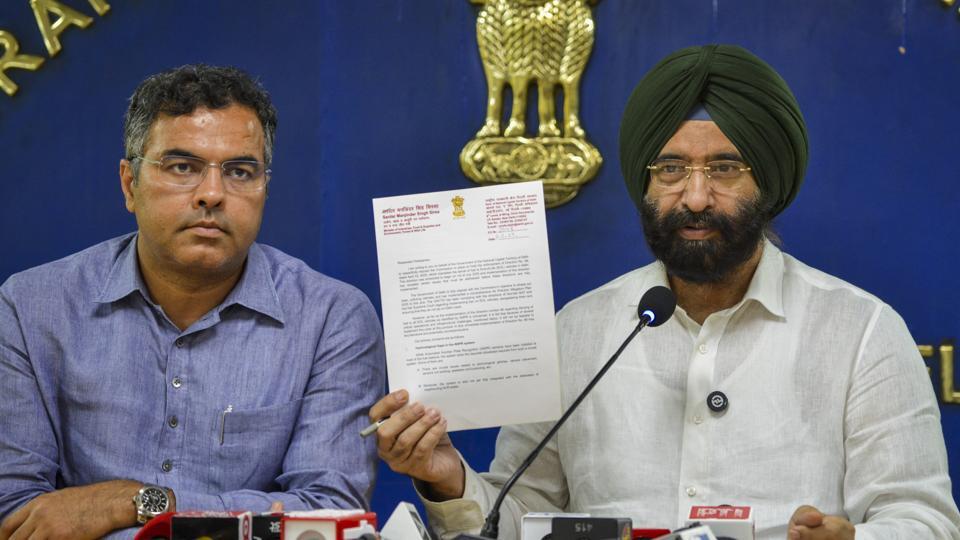
Environment minister Manjinder Singh Sirsa announced in the afternoon that Delhi had requested the CAQM to suspend enforcement against end-of-life vehicles, and blamed the previous Aam Aadmi Party government.
“We are with the public of Delhi and we will not let their vehicles get impounded and scrapped,” Sirsa said at a joint press conference with water minister Parvesh Verma. “Implementation of the orders for two days revealed certain issues that must be addressed before these directions are fully implemented.”
The ministers acknowledged what Sirsa’s letter described as “public discontent and outcry,” but attributed this anger specifically to technological failures rather than opposition to the policy itself. The government argued the public frustration stemmed from system and policy inconsistencies – including that the NCR states surrounding Delhi did not have such restrictions.
Chief minister Rekha Gupta later reinforced the government’s position on social media, appearing to accept the suspension as a response to citizen hardship rather than technical failures alone.
“In view of the difficulties being faced by the citizens of Delhi, our government has written to the Commission for Air Quality Management requesting that the decision of not providing fuel to End-of-Life vehicles be reconsidered,” Gupta said in a post on X.
The chief minister acknowledged the policy was “adversely affecting the daily lives and livelihoods of millions of families.”
“Our government is fully committed to controlling air pollution and is working on long-term solutions for clean, sustainable transport,” Gupta wrote. “But while implementing any decision, it is equally important to maintain a balance with the social and economic needs of the citizens.”
CAQM did not respond to request for comment.
Delhi government argued vehicles should be scrapped based on emission values rather than age, while launching a scathing attack on the previous Aam Aadmi Party administration for implementing what officials called an “arbitrary scrapping policy” in February 2024.
“On one hand we collect road tax for 15 years from vehicle owners, whilst on the other hand we are scrapping vehicles after 10 years,” Verma said. “This seems unfair and we are with the people of Delhi. Delhiites as well as the current government is suffering due to their poor past decisions.”
The AAP hailed Thursday’s decision, calling it a victory for the people of Delhi and questioning the government’s initial enthusiasm for enforcement.
“I would like to congratulate all the people of Delhi for raising their voices against a Tughlaqi diktat by the BJP’s Delhi government,” said AAP leader Saurabh Bharadwaj. “Because of that voice, the government of the BJP had to take back its Tughlaqi diktat.”
Bharadwaj questioned how the government could now bypass Supreme Court orders when it claimed it had no choice initially. “If they had this option of bypassing the so-called order, why did they not do it in the first place?” he said, noting that CAQM “is not a Court, it’s a body headed by Babu, appointed by Central Government.”
Senior AAP leader Atishi called it a government of U-turns. “One day they decide to seize and scrap vehicles, the next day they admit the decision was wrong, and by the third day they are busy writing letters,” she said, pointing out that no official order withdrawing the ban had been issued.
AAP leaders did not specifically respond to the government’s allegations about the February 2024 policy.
In the letter to CAQM, the government said automatic number plate recognition cameras suffered from faulty sensors and speakers while failing to identify vehicles without high-security registration plates.
“Because of the technological inconsistencies of this extremely complex system and lack of integration with neighbouring states, there is public discontent and outcry,” Sirsa wrote, warning that Delhi-only implementation would drive vehicle owners to refuel in adjacent cities like Gurugram and Faridabad, “potentially fostering an illegal cross-border market for fuel.”
Additional Commissioner of Police Dinesh Kumar Gupta said enforcement teams remained at the city’s 89fuelling stations and added that any new orders will be complied with.
“Our teams are still at fuel stations and will manage deployment as per the orders that we receive from the government,” said a transport department official, asking not to be named. “The cameras will continue to function at the fuel stations to detect end-of-life vehicles and those without pollution under control certificates.”
The vehicles remain technically illegal under Supreme Court and National Green Tribunal orders, meaning they could still face impoundment despite the enforcement suspension. The legal framework stems from earlier judicial directions aimed at reducing air pollution in the capital region.
The Commission for Air Quality Management had issued directions on April 23 ordering phased elimination of ageing vehicles across the National Capital Region. The directive set a July 1 deadline for denying fuel at Delhi stations, November 1, 2025, for five high vehicle density areas including Gurugram, Faridabad, Ghaziabad, Gautam Budh Nagar and Sonipat, and April 1, 2026, for the rest of the region.
Delhi government said it remained “fully aligned with the Commission’s objective to phase out older, polluting vehicles” and was considering alternative measures including stricter pollution certificate policies and preventive messaging to vehicle owners months before their cars reach end-of-life status.
Border fuel stations reported 10-15% sales drops during the brief enforcement period. “For the past three days, we were only playing cat and mouse with end-of-life vehicle owners,” said Delhi Petrol Dealers Association President Nishchal Singhania, welcoming the policy’s suspension. “The system already had technical glitches and no proper trial was done.”
Fuel stations confirmed they would resume normal service Friday, marking the end of one of Delhi’s shortest-lived environmental policies.