E-Paper



Odisha train tragedy: 5 railway staff under lens over alleged operation oversight
A senior railways official said assistant station master SB Mohanty and four railway workers were “under the scanner”

 Prefer HTon Google


The assistant station master of the Bahanaga Bazar railway station, and four workers employed in the signalling department of the railways are being questioned in the investigation into the train accident in Balasore on June 2, said railways and CBI officials, suggesting that they did not conduct proper tests after a maintenance operation that may have interfered with the line’s signalling system on the day of the disaster.
Also read: ‘Still haunts’: Odisha villagers observe mass tonsuring for train mishap victims
A senior railways official said assistant station master SB Mohanty and four railway workers were “under the scanner.”
“However, they will continue to perform their duties until the Commissioner of Railway Safety (CRS) comes out with its interim report,” said a senior railway official who asked not to be named.
“Interference with the electronic interlocking system could be the major cause of the incident,” said the official.
The interlocking system is the nerve-centre of the Indian Railways’ signalling apparatus. It is an interconnected system of signals, crossings and points — the three elements that comprise the signalling set-up — and ensures that trains across the railway network move seamlessly and do not come in each other’s way.
A senior CBI official aware of the investigations, said that four electrical signal maintainers were at Bahanaga Bazar for maintenance work on June 2.
“As per protocol, they were supposed to test the signal in coordination with the on-duty assistant station manager after they finished. However, they left before this,” said the CBI official.
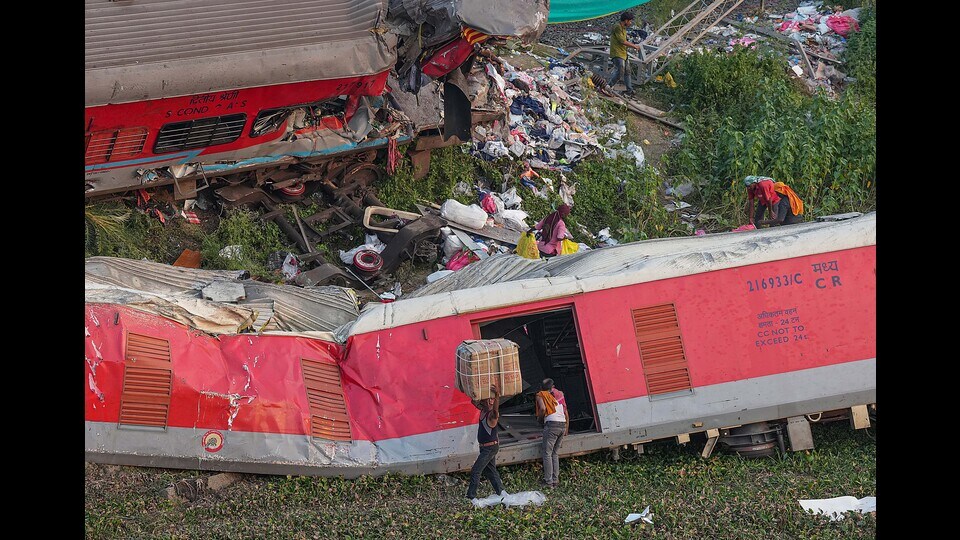
On the evening of June 2, the Coromandel Express crashed into a stationary freight train at Bahanaga Bazar station in Balasore, some of its derailed coaches then colliding with the onrushing Yeshwantpur-Howrah Express in what was India’s worst rail accident in three decades, leaving 288 dead and over 1,100 injured. There are two simultaneous probes taking place — one by CRS and the other by CBI.
A second railways official said investigators are specifically looking into charges of negligence after a manual boom barrier at the Bahanaga Bazar crossing was to be replaced with a lightweight electric barrier, ostensibly easier to operate. Since these barriers are linked to the interlocking system, the station master, during repairs, decouples the two to allow trains to keep moving.
“The signal maintainers replaced wires in the relay switches. The signal system may have been interfered with, which later led to the signal error. The signal inspector overseeing the work then informed the station master that work on the boom barrier was finished and that it had been reconnected to the main signal interlocking system. The station master should have conducted a mandatory physical verification at this point to ensure everything was working normally, but didn’t,” said the railway official.
Also read: Odisha train mishap: Assam man, who was rescued after 48 hrs, meets father
Officials of the railway board said CRS was examining whether the tampering of the system was a result of carelessness as a result of the maintenance work. “CBI is also investigating to see if it was a result of criminal negligence,” a railways official said.