
 E-Paper



5 terms a CM? ‘Sushasan Babu’ Nitish retains hold on top seat
Nitish Kumar's JD(U) thrived in Bihar elections with 85 seats, showcasing his governance appeal, especially among women, amid coalition dynamics.

 Prefer HTon Google


New Delhi/Patna
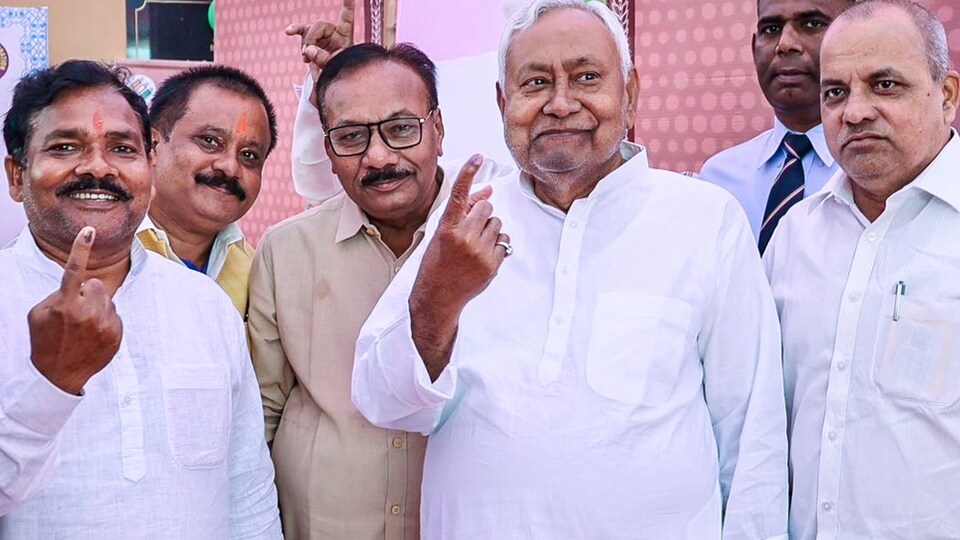
For the past two decades, the difference between being in government and opposition in Bihar has been Nitish Kumar and his Janata Dal (United), and the support base he and his party have assiduously cultivated, women and people from the so-called extreme backward classes or EBCs. Whether it is along with the dominant OBCs (other backward classes) led by the Yadavs, or with the upper castes in what is popularly called a coalition of extremes, it is Kumar who decides who governs the state.
For the past twenty years, it has been him.
The 2020 assembly elections were different. Sabotaged by the Lok Janshakti Party, which continued to be part of the larger NDA grouping at the centre, the JD(U) saw its tally in the assembly shrink to 43, its lowest since 2005. This time, it has won 85 seats almost at a strike rate of 85%, despite a muted campaign by Kumar himself, who is keeping indifferent health.
Still, partly on account of the spate of welfare schemes he announced ahead of the election -- many targeted at women -- and partly because of fears over what the NDA termed Jungle Raj (the RJD’s rule between 1990 and 2005), and the good governance (Sushasan) his government had delivered, he remained front and centre of the NDA campaign.
On ground, there was a palpable undercurrent of support for Bihar’s ‘Sushashan Babu’. The higher turnout of women voters --- 8.8 percentage points more than men; 71.6% of women voted as compared to 62.8% of men -- is directly attributed to the appeal Kumar enjoys among women, and the ₹10,000 cash handout to 14.1 million women just ahead of the election.
GOOD GOVERNANCE
Kumar’s constituency is of his own making.
“If women have emerged as a big constituency favouring him despite the caste divide, it is a result of his government’s consistent plans and policies since 2005,” says analyst Prof. NK Choudhary, who retired as head of economics department from Patna University.
“If the cycle scheme gave wings to girls and created a craving for education despite questions over the quality of schools, the reservation of 50% in panchayati raj and urban local bodies empowered women by involving them in grassroots governance,” he added. Kumar also launched the Jeevika self-help group for rural women to become economically self-reliant .
Soon after taking over as chief minister in 2005, Kumar also set out to upgrade the state’s poor infrastructure. DM Diwakar , the former director of AN Sinha Institute of Social Studies, in Patna, rattles off the areas where Kumar made a difference: roads, power, land law and order. That saw him voted back to power in 2010, and since then, he has continued to focus on infrastructure, and schemes aimed at bettering the lot of women. or a generation of voters, he symbolised governance that was measurable, not mythical, say analysts.
This year, in the run-up to elections, Kumar turned to welfarism, giving government jobs, hiking the monthly pension from ₹400 to ₹1100 and giving ₹10,000 under Mahila Rozgaar Yojana. His pre-polls direct transfers turned any anti-incumbency to pro-incumbency, Chaudhary claimed.
FRIEND TO FOE
Born in the small town of Bakhtiyarpur in 1951 in a middle-class family, Kumar was influenced by socialist leader Ram Manohar Lohia and took the plunge into politics even though he was an engineering graduate.
He entered Bihar assembly in 1985 and backed Lalu Prasad as leader of opposition in 1989. A year later, he supported Lalu Prasad’s bid for CM . In 1994, the two, fell out and in 1996, he aligned with the BJP . He was inducted as Railway Minister in the Atal Bihari Vajpayee government in 1998.
In 2000, he became chief minister of Bihar for the first time but his term was short-lived, only for seven days, as he failed to prove his majority. He became the CM again in 2005 in alliance with the BJP. He left the NDA fold twice, for four years between 2013 and 2017, and for two years between 2022 and 2024; although he remained chief minister and his supporters saw his frequent switches as political pragmatism.
“Allies accepted his policies as theirs, as they were left with no option in his company. Nitish never had to do any alterations, nor did he allow his allies to run their agenda,” said analyst Prof. Vijay Kumar of BBA Bihar University, Muzaffarpur.
POLITICAL ACUMEN
In the last half a century, a few leaders in Indian politics have mastered the art of coalition management, caste arithmetic and symbolic politics as Kumar has . The 2025 elections show why he is indispensable in Bihar politics.
Two days before the first phase of voting on November 6, Kumar reminded voters through a four-minute video that he had served the people of Bihar with “honesty” and “transformed” the state from the point where the “word Bihari was an insult” to that of “pride”. He also reminded people that his government’s approach was inclusive and working for the development of all sections of society while doing nothing for his own family, a swipe at RJD chief Lalu Yadav.
“Politically he may be unpredictable, but no one dares individually targeting him for non-performance or lack of integrity despite corruption charges flying against some of his senior cabinet colleagues. That is the strength of the CM,” Diwakar said.
As Nitish Kumar embarks on what may well be the final stretch of his storied career, his party’s good performance in Bihar assembly polls is being seen by many analysts as a “Thank you, Nitish” vote by the people of the state. Many voters say they wanted Kumar to be CM again because this could be his last election.
“The entire NDA rallied around him during campaigning and they all said that Nitish was the face. This is a clear signal that Nitish will be the CM again for the 10th time, but he cannot go on for ever,” said Choudhary.
The big challenge for the JD(U) now is to identify a successor to Kumar; its strong performance in this election -- 85 seats at a strike rate of 85% -- mean it can do so from a position of strength, but the strong performance of the BJP and other constituents of the NDA means it needs to be done soon.


