
 E-Paper



7.48mn consumers in Karnataka got ‘zero bills’ under Gruha Jyoti: Data
Data shows that since the launch of Gruha Jyothi scheme, 3.30 million customers of BESCOM (Bangalore Electricity Supply Company Limited) have benefited from zero bills

 Prefer HTon Google


Since August 1, the five electricity supply companies (Escoms) have been issuing zero bills to domestic consumers as part of the Karnataka’s ambitious Gruha Jyoti scheme and so far a total of 119 million (11,938,402) bills were generated for beneficiaries across the state. Out of this, a significant 7.48 million (7,408,769) consumers have received zero bills, while 4.52 million (4,529,663) consumers received subsidised bill, the data released by the Karnataka government stated.
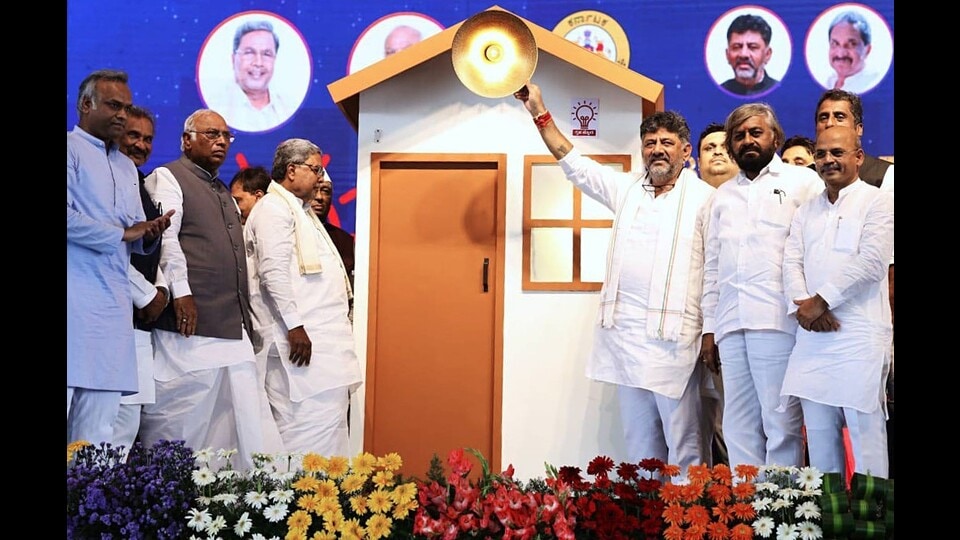
“Approximately 62.06% of these bills fall under the zero billing category, and even those receiving non-zero bills remain beneficiaries of the scheme, with the requirement to pay only for consumption beyond their entitled units,” said a senior energy department official.
As per government guidelines, along with the average power consumption from the previous year, the government would provide 10% additional units to consumers. Those consuming more than the average would get the net bill as the difference. Those exceeding the 200-unit limit will have to pay the entire electricity bill.
This means that if a consumer who has an average monthly limit of 100 units in the previous year, uses around 150 units of power in a month, then he/she would have to pay the bill for the additional 50 units.
Data shows that since the launch of Gruha Jyothi scheme, 3.30 million customers of BESCOM (Bangalore Electricity Supply Company Limited) have benefited from zero bills. The first bills were rolled out in July. BESCOM, which covers eight districts including Bengaluru has delivered zero bills to eligible beneficiaries under this scheme. So far, a total of 5.12 million customers have been billed under this scheme, out of which 3.30 million have been given subsidies and 1.81 million customers have been given zero bills, the data stated.
While many consumers have already started enjoying the benefits of this initiative, registrations for the scheme have surged in August. Between July 28 and August 15, more than 1.08 million consumers registered for the scheme, bringing the total number of registrations to 15.1 million, up from 14 million. The Energy department had previously estimated that a total of 21.4 million domestic consumers in the state would be eligible for the scheme.
Meanwhile, Bharatiya Janata Party (BJP) state president Nalin Kumar Kateel, criticised the government’s handling of power supply. He mockingly referred to the initiative as ‘kattala (darkness) bhagya’ and expressed concerns over power disruptions, saying “The government has introduced a scheme that offers zero bills and zero power supply.”
Talking to media on Friday Kateel said the introduction of conditions for the implementation of guarantee schemes that were initially announced without any such restrictions. He emphasised the government’s commitment to implementing four out of five guarantee schemes but questioned the necessity of introducing conditions for these programs.
The criticism comes as Karnataka is grappling with a surging peak power demand. Despite August being a traditionally rainy month, the electricity demand has exceeded that of recorded during the summer months of March and April. Officials attribute this surge to rising temperatures, with the state’s peak power demand reaching 16,950 MW on August 25, compared to 16,110 MW in March. In Bengaluru, the peak power demand rose to 7,981 MW on August 25, up from 7,800 MW on April 20.
To mitigate the power shortage crisis, the Karnataka government has reached out to neighbouring states for assistance in procuring electricity. The situation has been exacerbated by a prolonged dry spell, severely impacting power generation within the state. Energy minister KJ George said, “There is a remarkable increase in electricity demand, which rose from 8,000 MW in July to a staggering 16,000 MW by August. We working on resolving the power shortage at the earliest.”


