As one walks down the Central Mechanical Engineering Research Institute (CMERI) colony in West Bengal's Durgapur at night, the apparently dark roads gradually lighten up. Smart streetlights fitted with sensors can detect approaching humans. The lights get dimmer as one walks past, helping the colony to save electricity bills and reduce its carbon footprint.
Innovations like this and many others, including the country’s first machine to segregate municipal waste, are all first put to use in the colony of 250 families, mostly of scientists and research scholars.
The colony acts as a living lab for the scientists, where innovations made in the institute’s laboratory, are first tried and tested before they are finally launched for public use.
“All innovations made in the CMERI lab, some of which are first of its kind in the country, are initially put to use in the colony. This helps us to further finetune the product according to the needs of the society. Only then they are launched for public use,” said Harish Hirani, director of CSIR-CMERI, who is also a resident of the colony.
The CMERI is India’s apex research and development institute for mechanical engineering under the Council of Scientific and Industrial Research (CSIR). The Swaraj and Sonalika brand tractors, which are popular in rural India, are products of CMERI.
{{/usCountry}}The CMERI is India’s apex research and development institute for mechanical engineering under the Council of Scientific and Industrial Research (CSIR). The Swaraj and Sonalika brand tractors, which are popular in rural India, are products of CMERI.
{{/usCountry}}“The colony hasn’t produced any waste in the last two years. All the waste generated by the families, including plastic and sanitary waste, are mechanically segregated in a plant – the first of its kind in India – and then converted into biogas, manure, fuel briquettes, electricity, and road-building materials. These are used in the colony. The use of LPG has dropped. Roads and parking areas are also being constructed with recycled products,” said Amit Ganguly, a senior scientist associated with the development of the segregation plant.
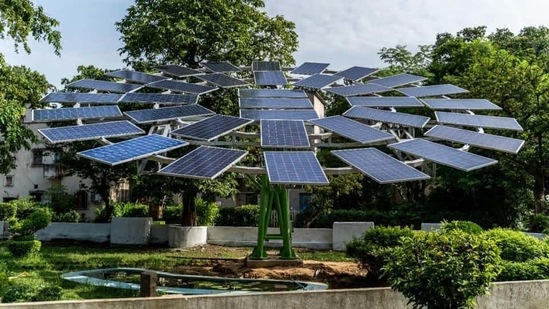
There are also huge trees in the colony with solar panels fitted onto every branch. Known as solar trees, they help to enhance the production of solar energy.
Also being tried and tested are large air purifiers to bring down pollution levels. Air purifiers, called WAYU developed by the CSIR-National Environmental Engineering Research Institute, have been installed on some roads of Delhi.
“Our laboratory products are being put to use in almost every nook and corner of the society. Starting from simple plant manure manufactured from domestic waste to air purifiers and smart-street lighting, there are many innovations that are being tried and tested in this colony-lab comprising 250 families,” said Subho Samanmta, a scientist of CMERI and a resident of the colony.
In cities, vehicle owners find it difficult to locate a parking space and have to jostle for space. The scientists of CMERI are now planning to come up with a smart parking system, wherein vehicle owners would get to know about vacant parking lots before they approach the parking area.
“We are in the process of upgrading our parking lots into smart parking spaces. Not only would the car owner receive messages on his mobile about which lots are free, and which are engaged, but he would be able to see the green lights of free parking spaces as he approaches the parking area. A red light would mean the space is not free,” said Ajoy Roy, one of the scientists.