The eight cheetahs from Namibia have acclimatised and adapted well to their new home at Kuno National Park in Madhya Pradesh in the month since their translocation, a forester said.
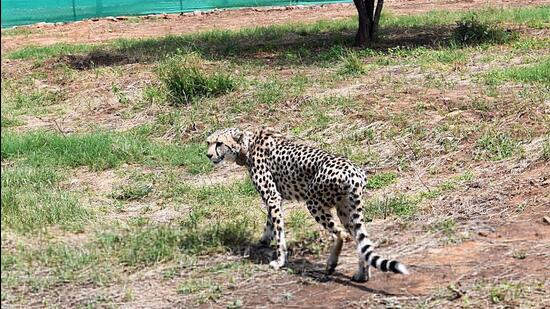
“The expert of Cheetah Conservation Fund (CCF) from Namibia, Eli Walker, said the cheetahs are very comfortable,” said JS Chauhan, principal chief conservator of forest, wildlife. “They adapted to the habitat very well. They are healthy.”
The recently constituted Cheetah Task Force will hold a virtual meeting with officials and CCF in Namibia on Monday to take decision on shifting of cheetahs from the small quarantine enclosures to the much larger, 6 sq km soft release enclosures that are free of predators, Chauhan said.
Also Read: 9-member task force to monitor cheetahs in MP’s Kuno National park
The task force, formed by the National Tiger Conservation Authority, will take a decision on shifting the cats to the bigger enclosure. “We are hopeful of shifting of them soon,” Chauhan added.
The eight cheetahs have been translocated to India on September 17 and are living in six enclosures. Two brothers, Freddy and Alton, and two sisters, Savanah and Shasha, are living in one enclosure each of 50x30 metres, while others are living in 25x25 metre quarantine enclosures. They are being fed buffalo meat by foresters.
{{/usCountry}}The eight cheetahs have been translocated to India on September 17 and are living in six enclosures. Two brothers, Freddy and Alton, and two sisters, Savanah and Shasha, are living in one enclosure each of 50x30 metres, while others are living in 25x25 metre quarantine enclosures. They are being fed buffalo meat by foresters.
{{/usCountry}}“One of the female cheetahs, Tablisi, was little uncomfortable. She was given hare and chicken as she was not eating buffalo meat. That got her adapted and now she is feeding on buffalo meat,” a forest official said, seeking anonymity.
Also Read: ‘Super Sniffer' dog squad to keep eye on cheetahs at Kuno National Park
Forest officials are carrying out some modifications in the bigger enclosure as CCF experts asked to decrease the tree density give more open spaces for the cheetahs to run, and also to increase the internal boundary of fencing that was built to keep the cheetahs away from each other, the official said.
Another reason behind the delay in shifting could be the suspected pregnancy of the female cheetah called Asha. “Asha was sent to the quarantine in August, a month before she was translocated to India, in Namibia. The veterinarians and Namibian experts suspected that she might be a pregnant due to her unusual behaviour,” another forest official said. “The pregnancy will be confirmed by the end of the October, so the experts will not take risk of shifting her.”
Meanwhile, chief scientist of the project, YV Jhala, has moved to the US and said he had no latest information on the cheetahs. NTCA officials couldn’t be contacted for comment.