
How Modi’s demonetisation move boosted the number of Aadhaar accounts
Exclusion of the poor from social schemes still remains high in many states, say activists.
Prime Minister Narendra Modi’s demonetisation move had an unexpected beneficiary — a substantial increase in Aadhaar enrolment and its linking with bank accounts, a report released on Tuesday said.
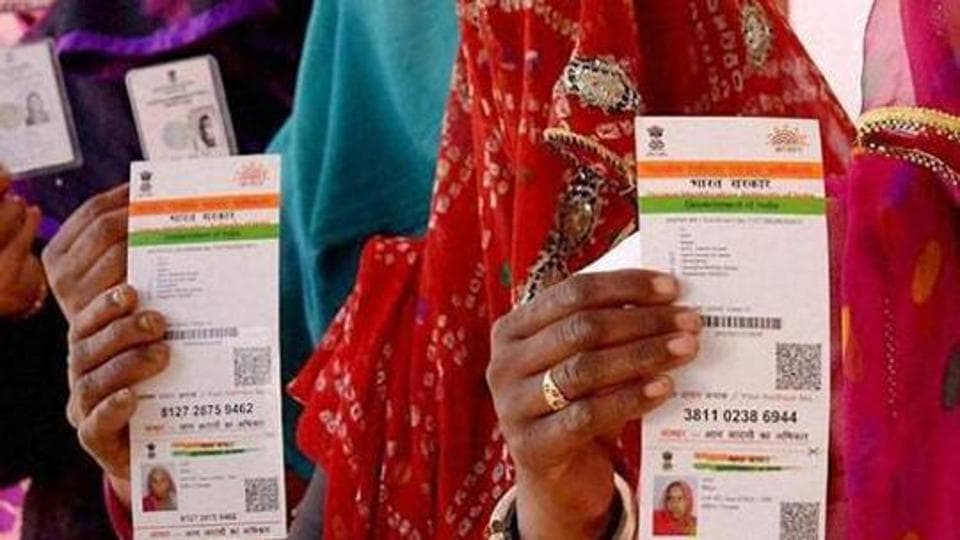
Over 1.14 billion people or 95% of India’s population now have an Aadhaar number.
Aadhaar Penetration
1.14 billion people have Aadhaar
139 million people authenticated using Aadhaar
40.7 million bank accounts opened using Aadhaar
Rs 22,006 crore disbursed through Aadhaar-based Direct Benefit Transfer (DBT)
The monthly average of bank accounts opened with Aadhaar before demonetisation last November was just 3.1 million, meaning that only 19.8 million bank accounts were seeded with Aadhaar since April 2016.
The Status of Aadhaar 2016-17 report showed that in December, 8.4 million bank accounts were linked with the 12-digit unique identification number, giving an unexpected fillip to the government’s bid to track money flow using it.
The momentum continued even after demonetisation, resulting in 47.1 million bank accounts or about half of all accounts in India being linked with Aadhaar by March 2017.
“As the government pushed for cashless economy, more people came forward to link their bank accounts with Aadhaar, especially those benefitting from government schemes,” said a senior UIDAI official, who was not willing to be named.
The notebandi period also saw an 8% increase in payment through Aadhaar-linked bridges and 6% jump in fresh enrollments for UID.
Aadhaar in major schemes
MGREGA: 79% of beneficaries
Annual budget: Rs 48,000 crore
Public Distribution System: 72% of beneficiaries
Annual subsidy: 1,38,000 crore
Subsidised LPG: 82% of beneficiaries
Subsidy: Rs 21,803 crore
National Social Assistance Programme: 51% of beneficiaries
Annual budget; Rs 8616
Money disbursed through Aadhaar: 33%
Plugging Leakages
The Economic Survey for 2016-17 said 36% and 20% of Public Distribution System (PDS) and MGNREGS funds leak from the system and can be saved by application of Aadhaar.
The report quoted the government’s Direct Benefit Transfer portal to say that Rs 14,000 crore was saved in the provision of food subsidies by removing 23.3 million fake beneficiaries and the corresponding figure for cooking gas subsidies was Rs 26,000 crore with 35 million duplicates removed.
Under DBT, the government transfers financial entitlements to beneficiaries’ Aadhaar-linked bank account. The person can withdraw money only after undergoing an Aadhaar-based online authentication using finger print or eye scan.
However, activists claim that Aadhaar has become a cause for exclusion rather than inclusion.
Reetika Khera, a development economist at IIT-Delhi, said the most appealing claims of the UIDAI was inclusion of millions of Indians but the five years of the projects suggests that it has led to “unprecedented” exclusion.
“Another early fiction was that the purpose of Aadhaar is to help welfare schemes. The truth is closer to the reverse,” wrote Ranchi-based economist Jean Dreze in a recent article.
Fakes/Duplicates Removed
23.3 million fake beneficiaries under PDS removed
35 million duplicates for cooking gas subsidy identified
8.7 million duplicates enrolled under MG-NREGA removed
Authentication failure rate in Andhra Pradesh and Telangana
17.4%: Finger Print
14.4%: Iris scan
85.9 % of total authentication failures because of biometric mismatch
10.1 % due to internet connectivity issues
His team has found thousands of poor “wrongly excluded” from NGREA workers citing discrepancies in Aadhaar in Jharkhand.
The government’s response is that exclusion because of discrepancies is minimal.
“A portion of these savings may accrue from the exclusion of genuine beneficiaries,” the report said, while highlighting Aadhaar authentication failure (17%) in Andhra Pradesh and Telangana because of biometric mismatch.
A person gets monthly quota of ration only if their fingerprint or eye-scan matches that in the UIDAI database.
These reports, while indicative, do not provide a comprehensive view of Aadhaar’s current role in India’s social protection, the report said, while suggesting a comprehensive learning agenda and more open data to understand whether and how Aadhaar can be used to provide social protection in India.
ABOUT THE AUTHORChetan ChauhanChetan Chauhan is the National Affairs Editor looking into all aspects of news and features from across India. A Chevening scholar with over three decades of experience in reporting and news management, Chetan has extensively covered all important aspects of the social sector, political economy, environment and climate change nationally and internationally. He did a journalism course at the Reuters Institute of Journalism in Oxford and Digital Media training at Nanyang Technological University in Singapore. He started as a reporter with The Statesman in 1996 and joined the Hindustan Times in 2000 in the metro bureau covering environment, crime and Delhi politics. He covered hot local news, from the Jessica Lal murder case to the rebellion of Delhi Congress MLAs against then Chief Minister Sheila Dikshit, to the replacement of toxic vehicle fuel with cleaner compressed natural gas (CNG) in the national capital. Some of his stories on air pollution became part of the Supreme Court’s landmark MC Mehta versus Government of India case in the National Capital Region (NCR), forcing the government to take corrective measures. As part of the national political bureau since 2004, he covered important central sectors such as environment, education, social justice, labour, rural development, water resources, renewable energy, agriculture, broadcasting and the Planning Commission for more than a decade producing several exclusive and investigative breaking stories. His specialisation is the environment, having covered at least a dozen United Nations global conferences on climate change, biodiversity and wildlife including climate summits in Paris, Copenhagen and Bali. He also covered India’s two five-year plans ---11th and 12th and reported on drafting and execution of right based laws such as Right to Education, Right to Information and rural job guarantee law, MG-NREGA, now being introduced in new format as VG-RAM-G Act. He has in-depth knowledge of social sector issues. He was one of the first to report on tigers vanishing from Sariska and Panna wildlife reserves in 2004 and 2008, respectively, leading to the setting up of the National Tiger Conservation Authority (NTCA) and the introduction of stringent penal provisions for poaching. He has written extensively on the rising human-animal conflict in India and the degradation of India’s biodiversity hotspots because of mining and other activities. Since 2004, Chetan has covered Parliament comprehensively and participated in training on the nuanced coverage of Parliament proceedings. He has travelled extensively across India to cover national and provincial elections since 1998, especially in the Hindi heartland states, considered India’s road to power. He writes a regular column for Hindustan Times, Ecostani, on important national politics, economy, Himalayan ecology and environmental issues. His other responsibilities include providing inputs for edits and edit page articles for the publication, apart from managing news flow from across India.Read More

E-Paper


