Cockroach Janta Party (CJP) founder Abhijeet Dipke has addressed questions over the funding of his education in the United States, saying he financed it through a combination of a scholarship from Boston University and an education loan.
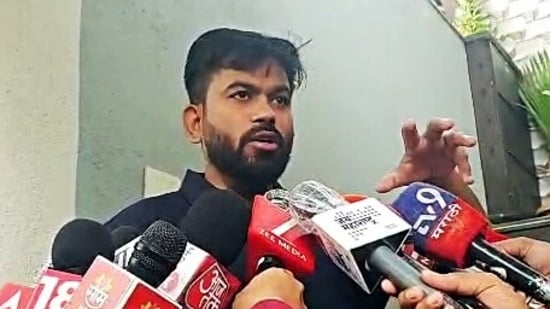
Dipke, who returned to India in June before leading one of the country's biggest protest movements, earned a Master of Science in Public Relations from the College of Communication at Boston University in Massachusetts.
Also Read | Stone-pelting by CJP protesters happened even after Parliament march violence: Officials
Dipke discusses scholarship, funding
"I have received a scholarship from Boston University for my education. I have also taken an education loan for my studies; it is still pending and has to be repaid. Everyone is free to investigate," Dipke said.
His clarification came after a Gujarat-based RTI activist sought details about how his foreign education was financed.
Dipke said he expects the Maharashtra government to withdraw FIRs and stop what he described as the harassment of students who recently protested over the alleged NEET paper leak and irregularities in examinations.
{{/usCountry}}Dipke said he expects the Maharashtra government to withdraw FIRs and stop what he described as the harassment of students who recently protested over the alleged NEET paper leak and irregularities in examinations.
{{/usCountry}}Also Read | 'CJP stands with all students': Dipke backs Jharkhand students protesting JPSC, JSSC exam irregularities
Dipke on CJP protests
Referring to the demonstrations at Delhi's Jantar Mantar, Dipke said the protests led by the CJP over the alleged NEET paper leak received widespread support from Gen Z across the country and resulted in Dharmendra Pradhan's resignation as Union education minister last week.
Dipke also said that if an FIR is registered against 15-year-old protester Ruchika Singh for remarks on Prime Minister Narendra Modi, similar action should be taken against BJP leaders and members of the party's IT cell.
Claiming that education has become unaffordable and inaccessible for ordinary people in India, Dipke said the issue required urgent attention.
He further said the organisation's responsibility had increased after the recent protests and added that the CJP team would be expanded soon.
Also Read | 'Since when is abusing a crime?': What CJP said on FIR over girl's remarks against PM Modi
Why questions on Dipke and funding
A Surat-based RTI activist has sought an investigation into the finances of Bhagwanrao Dipke, the father of Cockroach Janta Party (CJP) founder Abhijeet Dipke, questioning how a junior engineer's salary could have funded his son's higher education in the United States.
The activist, Amit Tiwari, has also approached the Election Commission of India (ECI) and the Central Board of Indirect Taxes and Customs (CBIC), raising questions over the CJP's legal status and the tax implications of the ₹1 crore legal defence fund announced by Rajya Sabha MP Kapil Sibal.
Tiwari said he had filed complaints with three different authorities, according to news agency ANI.
"I have filed a complaint at three different locations. I have complained against CJP at ECI. Regarding the ₹1 Crore fund by Kapil Sibal, I have complained to CBIC (Central Board of Indirect Taxes and Customs) that 18% GST be levied on it," Tiwari said.
He said he had also written to the Maharashtra government, seeking an inquiry into the financial assets of Bhagwanrao Dipke, whom he identified as a Junior Engineer with the Maharashtra Industrial Development Corporation (MIDC).
"I have also complained to the Maharashtra Government that Bhagwanrao Dipke was a Junior Engineer at MIDC. So, if he received a salary of ₹60,000-65,000, how was he able to afford the education of his children in the US?" he said.
Tiwari further urged the Maharashtra government to investigate whether the family's assets were disproportionate to its known sources of income.
"We have complained to the Maharashtra Government that this should be investigated and strict action should be taken if this is a case of disproportionate assets," Tiwari added.