A small hamlet in Bangladesh’s Gopalganj district is an unlikely destination for a sitting Indian Prime Minister. But the town of Orakandi is not just the birthplace of 19th century anti-caste reformist Harichand Thakur; it is the nerve centre of the nearly 10 million Matuas in the Muslim-majority nation, and roughly 35 million in India.
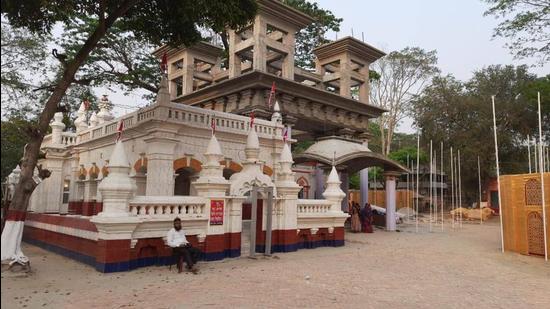
The Orakandi thakurbari is maintained by the Bangladesh Matua Mahasangha. Its counterpart in India is housed in Thakurnagar in the North 24 parganas district of West Bengal – the twin bodies mirroring the pangs of Partition that devastated the anti-caste sect and forced millions of followers to flee to India over two decades.
“After Partition, we faced many ignominies. Our ashrams were taken our and hostels closed. For almost 20 years, the movement went underground because of fundamentalists, and could revive itself only by 1970s,” said Sagar Sadhu Thakur, the secretary general of the Mahasangha.
The visit comes in the backdrop of the West Bengal assembly elections where the Matuas – most of whose members hail from the scheduled caste Namashudra community – control the fate of around 30 seats. But it is also a big moment for the Bangladesh Mahasangha, which now has expanded to 50 of the country’s districts, and are one of the largest minority communities in Bangladesh.
“We are grateful and happy that the Indian prime minister has accorded us the respect of a visit. We hope that he will accord the same support to our Indian brethren,” said Sagar Thakur. Subrata Thakur, the president of the body, said the organisation had put a fresh coat of paint on the temple and welcomed the PM.
{{/usCountry}}“We are grateful and happy that the Indian prime minister has accorded us the respect of a visit. We hope that he will accord the same support to our Indian brethren,” said Sagar Thakur. Subrata Thakur, the president of the body, said the organisation had put a fresh coat of paint on the temple and welcomed the PM.
{{/usCountry}}Born in a peasant family in 1812, Harichand Thakur quickly gained a following in erstwhile-undivided Bengal among the lower-castes as he formed edicts for salvation of the community.
His couplets in Bengali stressed on education and strong organisation as the primary modes of community empowerment. Every second couplet spoke about the importance of brotherhood and ending discrimination – similar to the teachings of other anti-caste icons such as Dr BR Ambedkar a century later. Key to the Matua sect’s working are his 12 edicts, primary among which is an order to abstain from discriminating against anyone, even animals.
“Harichand Thakur’s main aim was to unite the untouchables and the oppressed for a common cause of collective thought, and that is where the key to the liberation of spirituality lies. He wanted to establish a classless, casteless society,” said Biplab Biswas and Bipul Mandal, researchers from north Bengal. The sect has its own rituals, worshipped the Thakurs, and built a spiritual life that revolved around the 12 teachings.
Harichand’s son, Guruchand Thakur, consolidated the organisation, built groups of disciples who spread the message of anti-discrimination in villages, and established the first school for the Namashudra community in 1881 with the help of Australian clergyman CS Mead. He also lobbied the British government to provide quotas for the Namashudra community.
These gains were undone by Partition and the death of Guruchand in 1937. With communalism rising and unprecedented rioting across Bengal, the Matuas were split. One section, led by Guruchand’s grandson PR Thakur, aligned with the Congress party, moved to India and established Thakurnagar.
The other was led by Jogendranath Mandal, a key ally of Ambedkar and among the first alumni of the Namashudra school. Mandal saw that a majority of Matuas were in erstwhile east Pakistan and urged Dalit-Muslim to unite — people both faiths were peasants in the region — against the upper-caste elite. He became Pakistan’s first law minister, but a spate of riots against Matuas and other religious minorities in 1950 forced him to resign. He died in exile in India in 1968.
This was a period of intense difficulty for the Matuas. “Islamic nationalism gained in strength after the death of Jinnah and there was concerted pressure on Dalit peasants to migrate. The Indian government, too, didn’t treat them well,” said Sekhar Bandyopadhyay, professor of history at the Victoria University of Wellington, New Zealand.
In Bangladesh, too, the movement went underground as its buildings were looted and taken over, including their most important ashram in Khulna.
In 1972, Himangshupati Thakur, a descendant of Harichand Thakur, started to revive the movement. Nine years later, the sect organised their mahasammelan, or mega congregation. Today, the body organizes four major celebrations across the country that is attended by millions of people. But problems with fundamentalism remain. “Our buildings were burnt down. We have still not been able to get back possession of many spots, despite legal proceedings,” said Sagar Thakur.