
 E-Paper



Aditya-L1 takes selfie, captures stunning images of Sun and Moon en route to L1
India's Aditya-L1 space probe took a selfie and images of Earth and the Moon while on its way to Lagrange Point 1.

 Prefer HTon Google


India's maiden space-based solar probe Aditya-L1 took a selfie while on its way to Lagrange Point 1, or L1. The camera onboard Aditya-L1 captured the image of its largest payload, Visible Emission Line Coronagraph (VELC) and SUIT instruments on September 4, according to the Indian Space and Research Organisation (Isro). The camera also clicked Earth and its only natural satellite Moon on the second day of its four-month-long journey to L1.
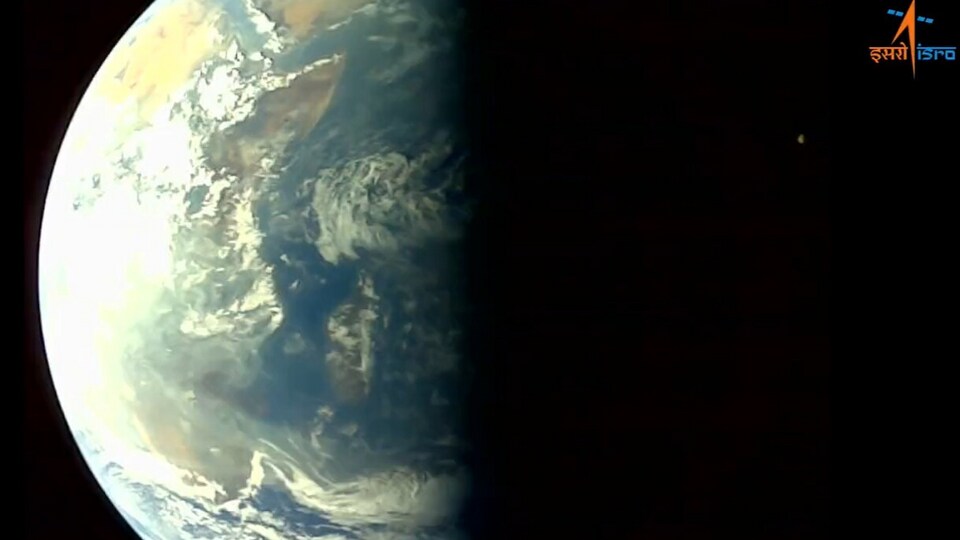
“👀Onlooker! Aditya-L1, destined for the Sun-Earth L1 point, takes a selfie and images of the Earth and the Moon,” Isro said in a post on X, formerly Twitter, as it shared the selfie and images of Earth and Moon clicked by camera onboard Adtiya-L1.
Adity-L1 blasted off on a polar launch satellite vehicle on September 2 from Sriharikota in Andhra Pradesh. On Tuesday, the spacecraft successfully performed the second Earth-bound manoeuvre, attaining an orbit of 282 km x 40225 km.
"Aditya-L1 Mission: The second Earth-bound maneuvre (EBN#2) is performed successfully from ISTRAC, Bengaluru. ISTRAC/ISRO's ground stations at Mauritius, Bengaluru and Port Blair tracked the satellite during this operation. The new orbit attained is 282 km x 40225 km," ISRO said in a post on 'X' in the early hours of Tuesday.
Aditya-L1's largest payload VELC to send 1,440 images per day: Scientists
The next Earth-bound manoeuvre is scheduled for September 10 around 2:30am IST.
Aditya-L1, which carried seven different payloads to have a detailed study of the sun, will be placed in a halo orbit around Lagrangian Point 1 (or L1), which is 1.5 million km away from the Earth in the direction of the sun. Four of of payloads will observe the light from the sun and the other three will measure in-situ parameters of the plasma and magnetic fields.
Major objectives of India’s solar mission include the study of the physics of solar corona and its heating mechanism, the solar wind acceleration, coupling and dynamics of the solar atmosphere, solar wind distribution and temperature anisotropy, and origin of Coronal Mass Ejections (CME) and flares and near-earth space weather.


