E-Paper



Number Theory: After a record-breaking March, how hot has India’s April 2022 been so far?
March 2022 was the ninth hottest March in India since 1951 by average maximum temperature, according to India Meteorological Department’s (IMD) gridded temperature dataset.

 Prefer HTon Google


March 2022 was the ninth hottest March in India since 1951 by average maximum temperature, according to India Meteorological Department’s (IMD) gridded temperature dataset. Is April just as historically abnormal as March was? The answer depends on which part of the country one is looking at.
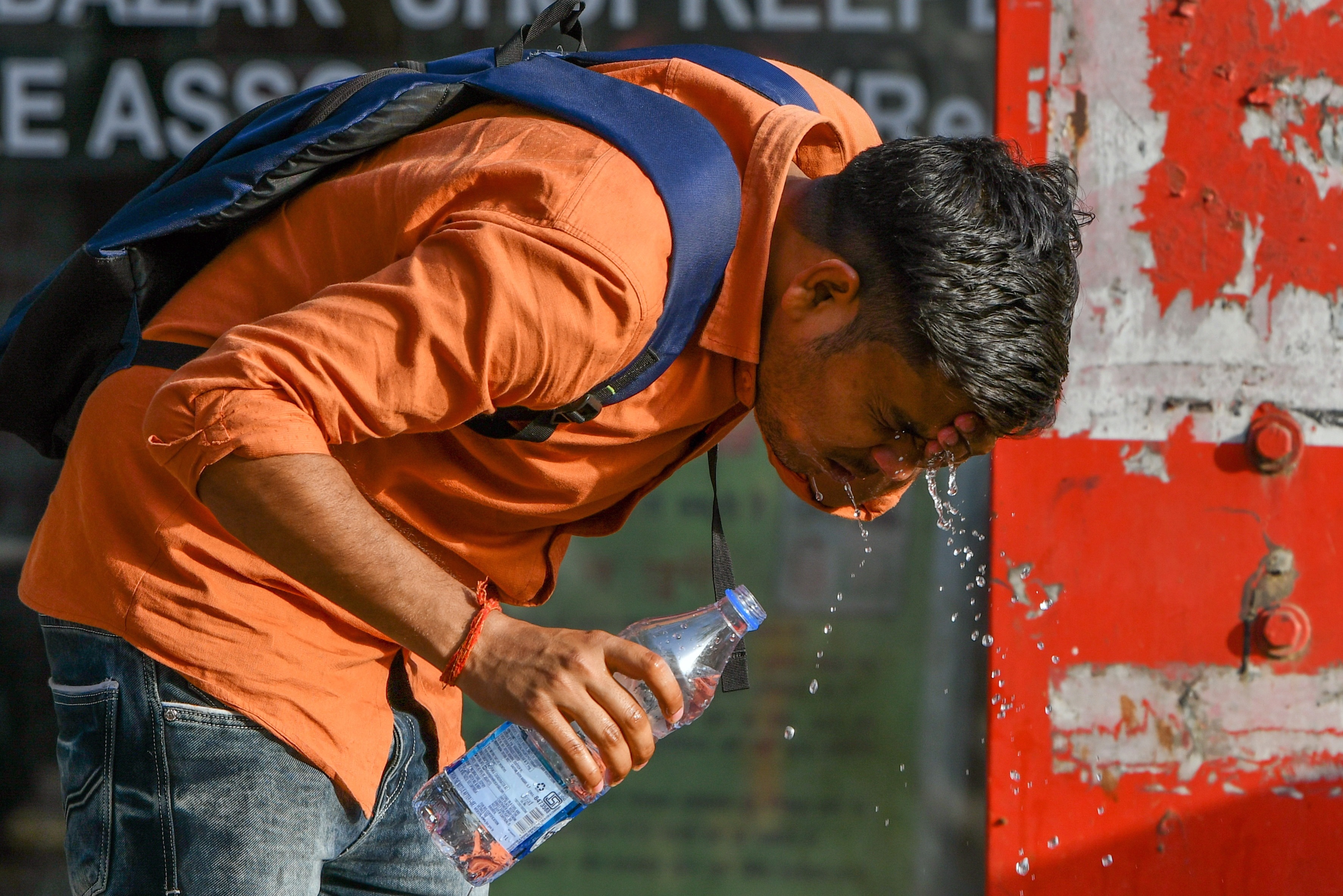
While the April 1-17 period is among the hottest for north-west India -- it is the second hottest in Delhi since 1951 -- the north-eastern and southern parts of the country have had a relatively pleasant April. The factor which has made this geographical difference is rains or lack of it in various parts of the country. Here are three charts which explain this in detail.
For country as a whole, the first half of April is not as record-breaking as March
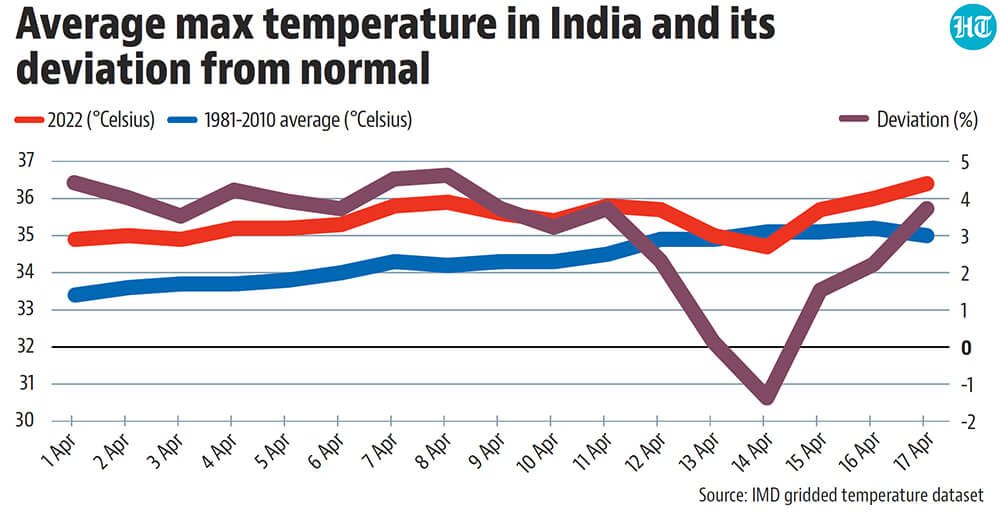
March 2022 was the ninth hottest April for India as a whole since 1951 by maximum temperature. The April 1 – April 17 period is only the 13th hottest. This is because the April temperature has deviated a less (only 1.07 degrees Celsius or 3.1%) above normal (the average temperature in the 1981-2010 period) than March did (1.41 degrees or 4.5%). To be sure, this does not mean that the first half of April was cooler in absolute terms than March. The average temperature for India in the April 1- April 17 period was 35.44 degrees, compared to 32.85 degrees in the March 1 - March 31 period. What the deviation from normal shows is that the April heat has not been as abnormal as March.
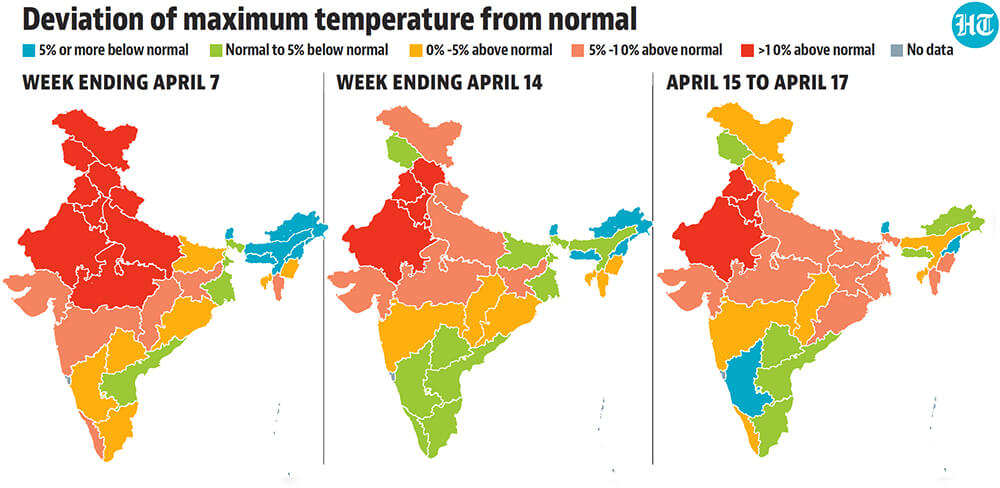
The reason for a somewhat less abnormal April is that big deviations above normal are confined this month to a smaller part of the country. The maximum March temperature this year was among the top five for the month since 1951 in 13 states. This is the case for only nine states in the April 1 - April 17 interval. This decrease in the geographic spread of abnormal maxima has come largely from north-eastern states, which were unusually hot in March. Average maximum temperature in five of eight north-eastern states – all except Manipur, Mizoram, and Tripura – is 5% to 21% less than normal so far this month.
Meanwhile, maximum temperatures have created new records in states in north-western and central India. The April 1- April 17 interval is either the hottest or second hottest this year since 1951 in seven states: Madhya Pradesh, Haryana, Punjab, Gujarat, Rajasthan, Uttar Pradesh (second hottest), and Delhi (second hottest). March was the 4th hottest or lower since 1951 in all these states except Gujarat and Rajasthan, where it was second.
April is the second hottest in Delhi since 1951 only because of the trends after April 13. Up to April 13, there were seven days when the maximum temperature for the day this year was the highest since 1951, and eleven days when it was among the top three.
To be sure, the deviation above normal decreased after the first week of April in even some other northern states, such as Himachal Pradesh, Uttarakhand, Uttar Pradesh, and Madhya Pradesh. This also happened in southern states such as Karnataka, Kerala, Tamil Nadu and Telangana, where the average maximum ended up below normal in the week ending April 14 and in the April 15- April 17 interval.
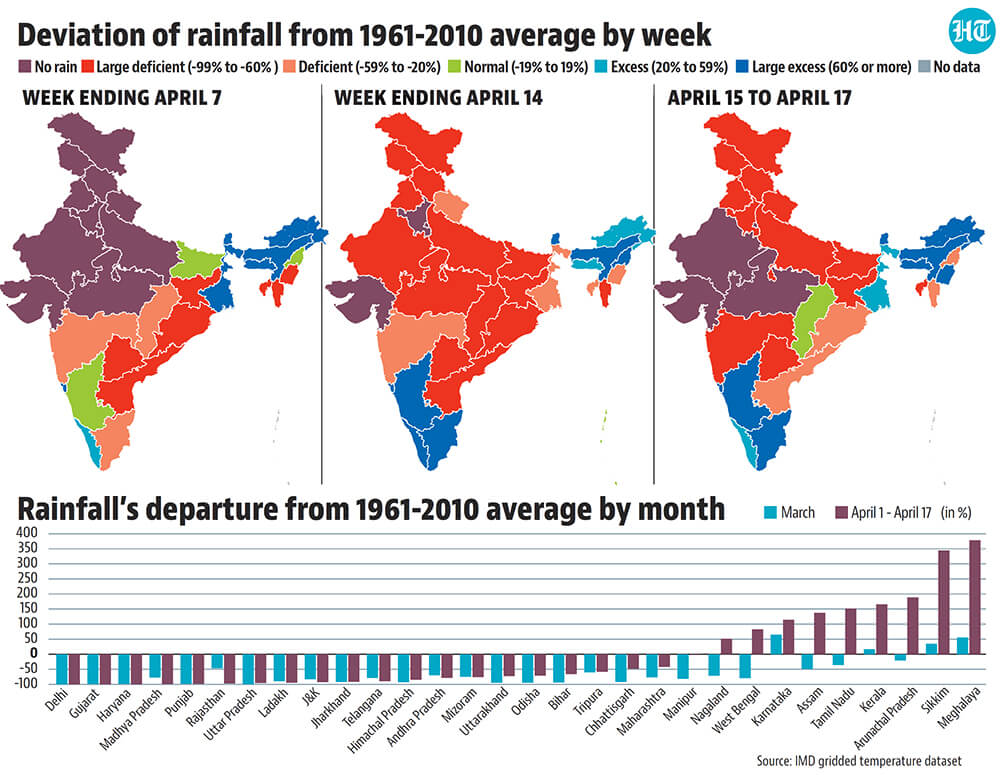
The country as a whole had received 10.6 mm rainfall in March, according to IMD’s gridded rainfall dataset, the sixth lowest since 1901. The 31.8 mm rainfall India has received this month is the 7th highest since 1901. This explains why maximum temperatures are closer to normal this month. However, the shift in temperature is not as dramatic as in rainfall because the rainfall has been geographically concentrated. While the north-eastern and southern states have received a large excess (60% or more above the 1961-2010 average) of rainfall, northern states have large deficits. But even northern states where maximum temperature has come closer to normal have a smaller deficit in rainfall than last month, largely on account of some rainfall they received after April 7. Uttar Pradesh, Madhya Pradesh, Gujarat, and all states north or west of them did not receive any rainfall in the first week of this month. Things have improved since, with only Gujarat and Delhi having not received even trace amounts of rainfall by now, although all of the states still remain large deficient (60% more below the 1961-2010 average).