
 E-Paper



After ED action, CBI arrests BRS’s K Kavitha in Tihar jail
CBI arrests K Kavitha, daughter of former Telangana CM, in Delhi excise policy corruption case involving AAP leaders.

 Prefer HTon Google


The Central Bureau of Investigation (CBI) on Thursday arrested K Kavitha, Bharat Rashtra Samithi (BRS) leader and daughter of former Telangana chief minister K Chandrasekhar Rao, in its probe on corruption in the Delhi excise policy 2021-22. Kavitha was already in jail, in custody of the Enforcement Directorate.
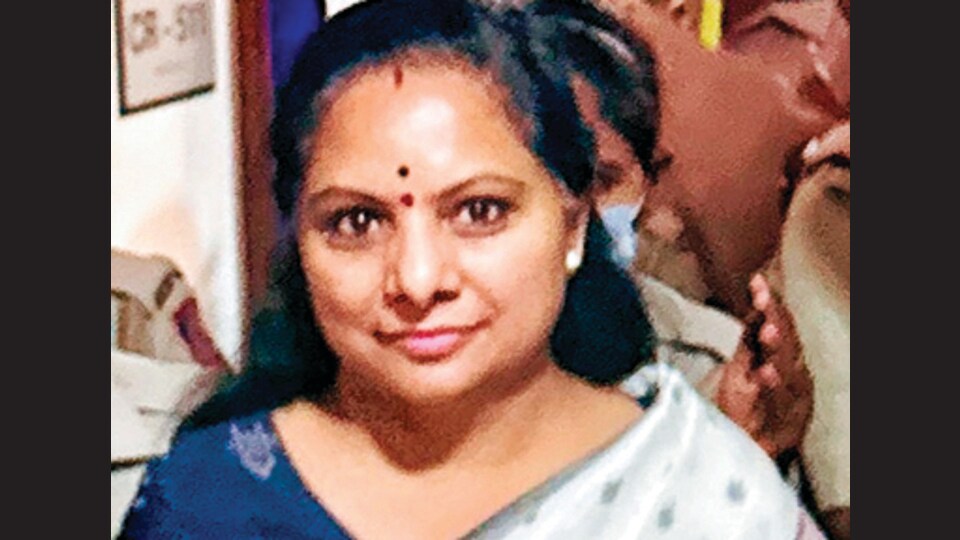
People familiar with the development said Kavitha was taken into custody around 12.40pm in Tihar under section 120 (criminal conspiracy) and section 7 of the Prevention of Corruption Act. She will be produced before a special court on Friday morning. She had been lodged inside prison since March 26, after ED arrested her on March 15.
“K Kavitha has been arrested under Prevention of Corruption Act as she was a key member in the South Group that gave ₹100 crore kickbacks to the Aam Aadmi Party (AAP) leaders in the excise policy in lieu of L1 licences in Delhi,” said a CBI officer, who didn’t want to be named. A L1 licence allows wholesale distribution of liquor in Delhi. The South group allegedly got nine out of 32 licences.
Kavitha’s lawyer, Nitesh Rana, said, “CBI has not followed the procedure of arrest in the custody. Also, any permission taken from the court has not been made available to the accused or the counsel. The procedure to arrest my client is totally illegal.”
A key charge by both the agencies is that businessman Sameer Mahendru’s Indospirits Group controlled multiple retail zones in Delhi under this policy, and advance payment of kickbacks worth ₹100 crore to the AAP leaders by the so-called South Group of which Kavitha was a member.
CBI and ED claim the South Group comprised YSR Congress member of Parliament, Magunta Srinivasulu Reddy, his son Raghav Magunta, Sarath Reddy (promoter of Aurobindo Group), K Kavitha, and Delhi-based businessman Sameer Mahendru. It was represented by Abhishek Boinpally, Arun Pillai and Butchibabu in meetings with Vijay Nair, a close aide of Delhi chief minister Arvind Kejriwal and people in the liquor trade.
Raghav Magunta and Sarath Reddy have turned approver in the case. Their testimonies, recorded under section 164 of the Code of Criminal Procedure (CrPC), were cited as key evidence by the Enforcement Directorate (ED) while arresting Delhi chief minister Arvind Kejriwal last month.
Kejriwal’s plea against his arrest is expected to be listed before the Supreme Court on April 15.
To gather evidence against Kavitha, agencies have banked on the statements of Butchibabu Gorantla, her former chartered accountant and Arun Ramchandra Pillai, who represented her interests during multiple meetings with Nair and others. While Butchibabu was arrested by the CBI in February 2023, Pillai was arrested by ED in March.
According to ED, Butchibabu, in his statement recorded before the ED officials in February 2023 said: “There was a political understanding between K Kavitha and the chief minister of Delhi (Arvind Kejriwal) and (former) deputy CM (Manish Sisodia) of Delhi. In that process, K Kavitha has also met Vijay Nair on 19th-20th March, 2021”.
According to ED, Pillai, a Hyderabad based businessman, told ED on November 11, 2022, that “there was a deal/understanding between K Kavitha and the AAP wherein in exchange of kickbacks paid to the tune of ₹100 crore, K Kavitha got access to the Delhi liquor business, specifically stakes in L1 licences — i.e. Indo Spirits”.
Pillai, according to investigators, also represented the benami investments of Kavitha.
The Delhi government’s 2021-22 excise policy aimed to revitalize the city’s flagging liquor business. It aimed to replace a sales-volume based regime with a license fee one for traders, and promised swankier stores, free of the infamous metal grilles, ultimately giving customers a better buying experience. The policy also introduced discounts and offers on the purchase of liquor, a first for Delhi.
The plan, however, came to an abrupt end, with Delhi’s lieutenant governor Vinai Kumar Saxena recommending a probe into alleged irregularities in the regime. This ultimately resulted in the policy being scrapped prematurely and being replaced by the 2020-21 regime, with AAP alleging that Saxena’s predecessor sabotaged the move with a few last-minute changes that resulted in lower-than-expected revenues.


