With its lakhs of migrant workers getting restive to come back to their homes, the Naveen Patnaik government on Sunday said that it would arrange buses to Gujarat and Maharashtra to bring back stranded migrant workers after national lockdown on coronavirus pandemic ends on May 3.
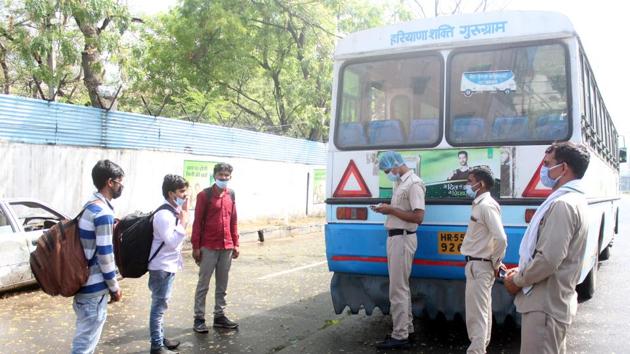
After a discussion through video-conferencing among Patnaik, his Gujarat counterpart Vijay Rupani, Maharashtra counterpart Uddhav Thackrey and union minister of petroleum and natural gas Dharmendra Pradhan today, it was decided that a coordination committee comprising two officers each from all the three states will decide on the modalities of bringing back the stranded workers by buses or any other modes of transport available.
“Registration(with the Covid portal) is mandatory for all those who wish to come back to their native places. Suitable arrangements are being made so that they can be sent to quarantine facility immediately upon their arrival,” said Patnaik. The chief minister’s office said Odisha is in talks with the governments of Maharashtra, Madhya Pradesh and Chhattisgarh so that no road tax is levied on the buses carrying the migrant labourers from Gujarat and Maharshtra to Odisha.
The decision to bring back the Odia migrant labourer comes in the wake of 70 Odia migrants working in Surat’s textile mills going on rampage on April 11 demanding salary and permission to be allowed to travel back to Odisha. At least 2 lakh Odia migrants have been working in textile mills of Surat, but majority of them live in congested rooms and have no job security. After all the textile units in Surat were closed following lockdown, many of them wished to go back to Odisha as they quickly ran out of money and food. Most of the workers in Surat are from Ganjam, the home district of Naveen Patnaik.
{{/usCountry}}The decision to bring back the Odia migrant labourer comes in the wake of 70 Odia migrants working in Surat’s textile mills going on rampage on April 11 demanding salary and permission to be allowed to travel back to Odisha. At least 2 lakh Odia migrants have been working in textile mills of Surat, but majority of them live in congested rooms and have no job security. After all the textile units in Surat were closed following lockdown, many of them wished to go back to Odisha as they quickly ran out of money and food. Most of the workers in Surat are from Ganjam, the home district of Naveen Patnaik.
{{/usCountry}}Similarly, thousands of Odia workers are stranded across Maharashtra after lockdown was announced. But some like Mahesh Jena, a 20-year-old casual worker in an iron foundry of Sangli-Miraj had arrived in his home district of Jajpur after cycling over 1700 km.
A day earlier, the Odisha government allowed intra-state movement of labourers who are stranded in the state due to Coronavirus lockdown. Around 86,000 workers, including 16,000 from within Odisha, are being accommodated in 2,610 camps in various districts in the state.
The migrant workers who arrive in Odisha from Gujarat and other states from May 4 onwards would be housed in quarantine centres that the government is quickly putting up in around 7,000 panchayats. The quarantine centres would have 2 lakh beds which would be scaled up to 5 lakh as more and more people come back.
But the government’s decision that all such migrant workers would have to give out their Aadhar number while filling up an online portal for registration was slammed by Citizens’ Action Group on Covid-19, a civil society group of the state.
The CAG members said most of the migrants working in informal sectors may not have an Aadhar card or be carrying it. “We are witnessing an unprecedented humanitarian crisis and in such a situation, our approach should be one of making things easy for the most vulnerable sections of the society. Making Aadhar mandatory for registration doesn’t serve that approach well. Hence the government should look for other options such as voter ID card, driving license or a post-registration authentication by the Panchayat,” said Manas Ranjan Mishra, convenor of the group.
The CAG also raised concerns about online registration being only source of mapping data on stranded people or workers. “Looking at the exploitative nature of the networks through which migrants seek work and travel, it is important that all steps are taken to ensure that the stranded workers are able to register themselves without any hindrance or coercion caused by people and groups that operate these networks. So offline registration should also be allowed,” the group suggested.
In another development, the state government appointed over 20 senior IAS officers as Covid-19 observers to various districts as Odisha prepared for return of around 5 lakh migrants from other States. Several other IAS officers were also assigned specific responsibilitirs such as implementation of social distancing guidelines, management and welfare of stranded Odias in other States, IEC activities, registration of Odia returnees and procurement of essential medical equipment and supplies.