
 E-Paper



After Patidars and Dalits, Gujarat farmers may add to govt’s headache
Farmers in Gujarat are planning huge rallies across communities and districts to protest what they see as an existential threat after President Pranab Mukherjee’s assent last week to the Gujarat land acquisition bill, which in one stroke made many lose ancestral lands they held for generations.


Farmers in Gujarat are planning huge rallies across communities and districts to protest what they see as an existential threat after President Pranab Mukherjee’s assent last week to the Gujarat land acquisition bill, which in one stroke made many lose ancestral lands they held for generations.
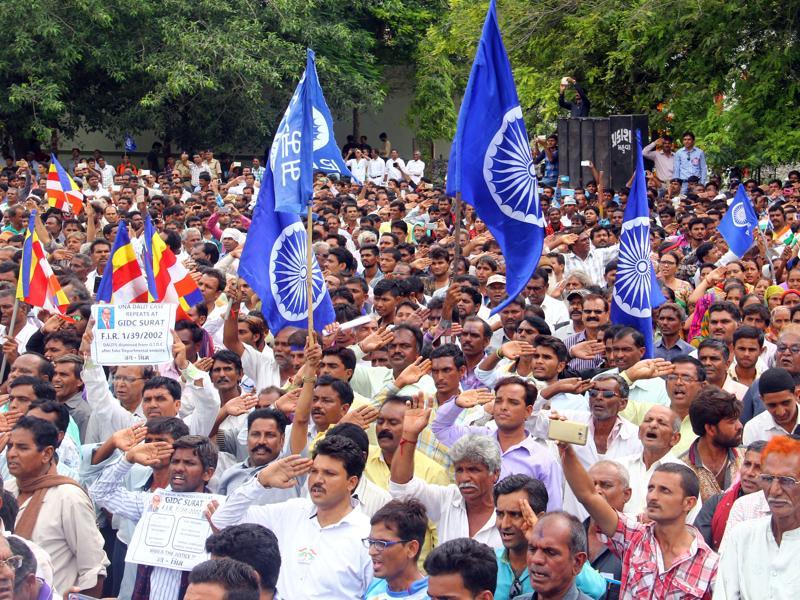
“The state government has attempted to bring the same anti-farmer laws through the back door — of the Raj Bhavan,” Jayesh Patel, president of the Gujarat Khedut Samaj, the apex body representing farmers’ organisations in the state, told Hindustan Times.
Patel was referring to the central land acquisition amendment bill of the National Democratic Alliance government that Congress vice-president Rahul Gandhi derailed with his “suit-boot ki sarkar” jibe.
Like the national bill, the Gujarat bill has a provision wherein farmers holding lands near coastal areas, highways and railways can no longer claim ownership to them — these lands are “deemed” as acquired by the government for development and industry.
“What are these farmers to do? Die without a single protest?” a furious Hemant Fitter, a former spokesperson of Keshubhai Patel’s Gujarat Parivartan Party, says. “We will get no compensation for these lands — in national (or the state’s ) interest. Very soon there will be no green land in Gujarat at all.”
Sagar Rabari, the secretary of the Khedut Samaj, minces no words.
“If the government of Gujarat does not immediately withdraw the bill (slated to come into effect on Monday), farmers across castes and religions will unite to oppose it and the results will not be in the interest of the government or the society at large,” Rabari says.
Read | At Una rally attended by Kanhaiya, Dalits warn of fresh protests
The anger has been simmering beneath the surface for months, if not years, and the latest bill is only the last straw that seems to have broken the camel’s back. For not only does this bill do away with the safeguards of consent and social impact assessment that are provided for in the United Progressive Alliance’s Land Acquisition Bill of 2013 that the Centre failed to amend, Gujarat’s farmers are also under the additional burdens of earlier state acts.
Gujarat’s 2009 Special Investment Region Act, aimed at creating industrial hubs, authorised the government to acquire land from farmers without notice or compensation.
Jayesh Patel says the Irrigation Act of 2013 is much more burdensome. It established a volumetric system of water distribution to farmers whereby, Patel alleges, farmers are firstly not supplied adequate water and if they draw water from their own rivers through lift irrigation or canalisation they are immediately arrested for depleting the water supply to industry.
“Excessive commitment to capitalism in Gujarat is systematically destroying farmers and making criminals out of them. I do not think any other state treats its farmers so despicably. Farmers are simply dying and at this rate soon Gujarat will be left with no agriculture at all,” Patel says.
The pity, Fitter says, is south Gujarat is still lush and green and produces some of the finest wheat, cotton, groundnuts, rice and other cash crops. “Farmers are being crushed under the weight of industry and capitalism. Our green fields will soon be a concrete jungle at this rate,” he says.
Rabari says, “At the root of all the social churning in the country today is the issue of agriculture, farmers, farming and ultimately land ownership. If farmers’ interests are neglected there will be huge consequences”.
There is a formal support to this planned agitation by Hardik Patel’s Patidar Anamat Andolan Samiti, the OBC Ekta Manch and the Dalit Adhikar Sangathan, which just concluded a march from Ahmedabad to Una in Gir Somnath district where four Dalits were brutally assaulted for skinning a dead cow, apart from the Gujarat Khedut Samaj.
All these organisations have issued a joint statement, warning of a major unrest in the state.
Read | Dalits head for Una to attend mega rally against atrocities
In 2014, farmers from south Gujarat tasted some limited success in forcing a rollback by the state government when they jammed the Surat-Mumbai highway in April that year with a 15-km queue of tractors and refused to cede way to traffic on the busy highway.
Under the Gujarat tenancy and land ceiling acts, 42 villages near the coastal region were to be completely taken over for a proposed port. The peaceful jamming of the highway unnerved the government enough to roll back its decision and return the lands to the farmers.
“We had decided then that we would die before we gave up or gave in. The situation is the same now. We will die but before that, we will fight,” Maganbhai Patel, a farmer from Ambetha village in Surat district whose lands were among those forcibly acquired, says.
The Gujarat model may come unstuck for the third time since last August’s Patidar and last month’s Dalit uprisings.
“They only want to talk of a golden Gujarat. But beneath the golden surface, the green Gujarat is turning to dust, farmers are committing suicide in large numbers. They are selling their land in distress. They have nowhere to go,” says Jayesh Patel.
Kishor Desai studied accountancy but now tills his father’s land out of commitment to the family tradition. But now he is determined his sons will not settle on the land. “In any case, at the rate government is going with regard to farmers. I do not think there will be any land left for them by the time they grow up. I am going to educate my sons to become working professionals.”
The Khedut Samaj is now undertaking an exercise to formally organise farmers district by district and “educate” them about their woes that are plenty – lack of adequate electricity, diversion of water to industry, no agricultural subsidies and low procurement prices.
One presumes that the farmers would be aware of these perils but Patel says their lack of education is such that they treat these issues as “fate” and need to be informed that these are man — or rather the government-made perils — that are contributing to their distress. The agitation will begin next week after the Raksha Bandhan holidays are over.
Patel has a crisp answer when he is asked if the divergent ideologies, as well the contradictions of various castes and religions, of the four organisations that have joined hands, will pose a problem. “Beyond ideology, there is something called survival. That very survival is at stake in a regime that is crushing farmers under the weight of industry and capitalism. Survival is now our new ideology.”
The new chief minister, Vijay Rupani, then, has a tough road ahead of him.


