The Uttarakhand forest department has developed an ethnobotanical garden at Haldwani over one acre of land to showcase ecological and environmental knowledge in Mahabharata and grown 37 plant species mentioned in the epic.
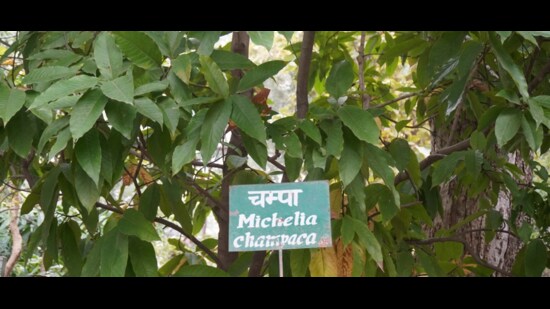
Chief conservator of forests Sanjeev Chaturvedi said the “Mahabharata Vatika” has plant species mentioned in 18 sections of Mahabharata. He added the plants include Khair (Acacia catechu), Kovidar (Bauhinia variegata), Bargad (Ficus benghalensis), Peepal (Ficus religiosa), Dhak (Butea monosperma), Harsringar (Nyctanthes arbor-tristis), Baheda (Terminalia bellirica), Aam (Mangifera indica), Kala Sirs (Albizia lebbeck).
Chaturvedi said the garden was developed after a lot of research. He referred to the Sanskrit names of the 37 species mentioned in the epic, their scientific names, and the number of shlokas (hymns) in which a particular plant species has been mentioned. Mahabharata, whose authorship is ascribed to the sage Vyasa, has 100,000 shlokas and 18 sections
Chaturvedi said the garden displays the wealth of ecological and environmental knowledge and wisdom in the epic. “The garden underscores the importance of forests as per the great epic. There is a portion of Mahabharata called Vana Parva/Aranya Parva [the book of forest]. This great epic has hymns on the importance of planting trees, creating water bodies, protecting tigers, and light for plants”
He said the garden has been developed to link religion and history with the environment and its conservation. “This garden demonstrates how Bhishma Pitamah lying on a bed of arrows explained the importance of wildlife and plants to Yudhishthira. The message of tiger conservation has also been conveyed in Mahabharata.”
{{/usCountry}}He said the garden has been developed to link religion and history with the environment and its conservation. “This garden demonstrates how Bhishma Pitamah lying on a bed of arrows explained the importance of wildlife and plants to Yudhishthira. The message of tiger conservation has also been conveyed in Mahabharata.”
{{/usCountry}}He cited the Udyoga Parva and said it says without forests, tigers are killed, and without tigers, forests are destroyed. “Thus, tigers protect the forest, and the forest safeguards tigers. This profound wisdom highlights the mutual dependence between tigers and forests, a concept central to modern conservation efforts.”
Chaturvedi said Bhishma tells Yudhishthira in Mahabharata’s Anushasana Parva that the one who plants trees uplifts both the ancestors and the descendants along with their lineage. “Therefore, one must plant trees.” Chaturvedi said these teachings emphasise the spiritual and ecological importance of planting trees, portraying them as a legacy that connects past, present, and future generations. “Mahabharata beautifully emphasises the interdependence of nature, wildlife, and human values. The mention of the Shami [Prosopis cineraria] tree in the epic highlights its cultural and historical significance.”
He cited Mahabharata and said the Pandavas hid Arjuna’s Gandiva bow and other weapons in white cloth on a Shami tree near the Yamuna in Viratnagar during their exile. “On Vijayadashami, these weapons were retrieved, and the Pandavas went to battle against the Kauravas. They worshipped Goddess Durga and the Shami tree. Even today, people exchange Shami leaves on Vijayadashami to wish each other prosperity and well-being.”
Chaturvedi said the epic highlights an ancient understanding of the role of light in sustaining plant life. “This reflects an early recognition of natural processes that modern science later identified as photosynthesis.”
The state forest department this year also set up “Ramayana Vatika” in Haldwani with plant species mentioned in Valmiki’s Ramayana and associated with Lord Rama in six major forest types. Of around 139 species mentioned, around 70 have been grown in “Ramayan Vatika”. Chaturvedi said Lord Ram came across four types of forests—Chitrakoot (tropical deciduous), Dandakarnanya (tropical deciduous ), Panchavati (tropical dry deciduous ), and Kishkindha (dry and moist deciduous)—during his journey from Ayodhya to Sri Lanka. “Ashok Vatika [evergreen] is associated with Sita while Dronagiri [alpine forest] is associated with Lord Hanuman.”