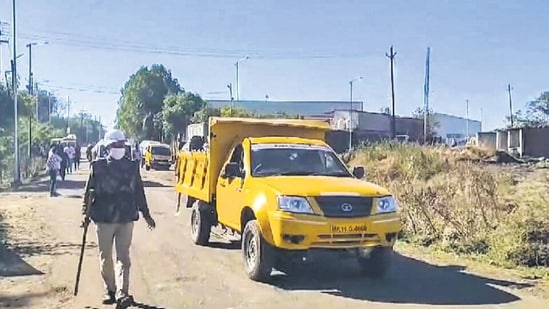
The disposal of toxic waste from the Union Carbide plant was put on hold on Saturday, the Madhya Pradesh government said, after irate locals pelted stones at an incineration unit in Pithampur area of Dhar district early in the morning in protest against the disposal being carried out in the district.
The government is also set to approach the Madhya Pradesh high court to seek more time to carry out the task, chief secretary Anurag Jain said.
“The government has put everything on hold and will now move forward in this matter only after taking the local people into confidence,” Jain said.
At around 10am on Saturday, a mob of around 150 people pelted stones at the incineration unit’s entrance and vandalised the vehicles. The incident took place a day after the district administration issued prohibitory orders under section 163 of Bharatiya Nagarik Surakhsa Sanhita (BNSS) in a 100m radius of the waste disposal unit.
Also Read | Bhopal’s toxic waste: A 40-year journey
“A probe has been launched to identify the accused involved in the matter,” Pithampur police station inspector Om Prakash Ahir told news agency PTI.
{{/usCountry}}“A probe has been launched to identify the accused involved in the matter,” Pithampur police station inspector Om Prakash Ahir told news agency PTI.
{{/usCountry}}“A few people in the city are spreading rumours that containers have been opened - labourers have fainted,” Pithampur sub-divisional magistrate Pramod Singh Gurjar said.
“Nothing has happened. Everything is under the administration’s control...There is peace everywhere. We have issued orders under BNSS 163 for the area in the radius of 100 metres of the site and we expect people to follow that...”
Also Read | Bhopal gas tragedy: Toxic waste must be disposed of after discussions with experts, says Mahajan
The 337 tonnes of waste was shifted to Pithampur in 12 sealed container trucks on Wednesday, with authorities providing a green corridor for the trucks to move without any trouble.
The Madhya Pradesh high court, which had on December 3 pulled up the state government for the 40-year delay in disposing of the waste and set a four-week deadline to transport it to a disposal site, is expected to hear the matter next on January 6.
The residents in Pithampur, however, have expressed apprehension that the disposal could lead to health problems in the area.
“The state government will request the high court for some time in this matter as the locals are fearful of this. The court will be informed about the current circumstances and we are hopeful that the court will hear our plea,” Jain said on Saturday.
On Friday night, chief minister Mohan Yadav said, “We will not tolerate any kind of harm to the public.”
“In compliance with the Supreme Court’s instructions and the high court’s order, the Union Carbide’s waste has been transported to Pithampur on the instructions of the hon’ble court. We have only done the transportation complying the safety parameters in line with the petitions and orders of the court,” he said, adding that the government will apprise the high court of the situation and only proceed “in compliance with the court’s order”.
On the intervening night of December 2-3, 1984, methyl isocyanate (MIC) gas leaked from the Union Carbide pesticide factory in Bhopal, killing at least 5,479 people and leaving thousands with serious and long-lasting health issues in Bhopal.