
 E-Paper



Anil Ambani files undertaking in Supreme Court, says he will not leave India
On February 4, the court expressed concern over the pace of investigation by the CBI and the ED into allegations of siphoning of public funds

 Prefer HTon Google


Two weeks after the Supreme Court pulled up central agencies for the delay in probing an alleged massive bank fraud involving Reliance Communications and the group entities, former promoter Anil Ambani on Thursday filed an affidavit undertaking not to leave the country without the court’s prior permission and asserting that he was not involved in the day-to-day affairs of the companies under investigation.
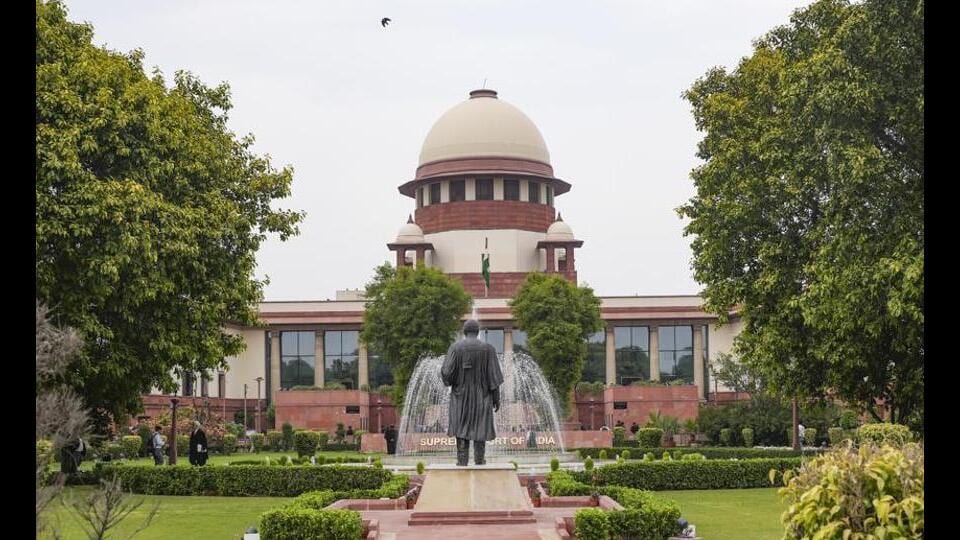
In his affidavit filed before a bench headed by Chief Justice of India Surya Kant, Ambani stated that his role in the concerned companies had been “that of a Non-Executive Director only” and that he was “not involved in the day-to-day management or operational affairs of the said companies.”
The affidavit comes in the wake of the court’s February 4 order in which it expressed concern over the pace of investigation by the Central Bureau of Investigation (CBI) and the Enforcement Directorate (ED) into allegations of large-scale siphoning of public funds. At the time, the court had directed the Centre and agencies to take all preventive steps to ensure that Ambani does not leave the country, even as his counsel, senior advocate Mukul Rohatgi, had given an assurance that he would not travel abroad without prior leave.
Reiterating that assurance formally on oath, Ambani said he had not left India since July 2025, when the present investigations commenced, and had no intention of travelling abroad. “In the event any requirement of foreign travel arises, I shall seek prior leave and permission of this Hon’ble Court before undertaking any such travel,” he undertook.
He submitted that he was summoned by the ED on February 26 and would appear and join the investigation on the said date. Stating that he has been “fully cooperating with the investigating agencies,” Ambani said he continues to extend complete cooperation and that there was no question of evading the process of law.
“Any cooperation extended or material furnished is appropriately understood in the context of matters already under consideration, and is not subsequently viewed in isolation thereof,” added the affidavit, referring to the ongoing examination under Section 50 of the Prevention of Money Laundering Act (PMLA), 2002.
He asserted that in view of his conduct and undertakings, it was evident that he was not a flight risk and had “no intention, whatsoever, to evade the process of law.” The affidavit, he said, was being filed “to ensure clarity, completeness, and procedural transparency in the judicial record.”
On February 4, the Supreme Court had come down heavily on the CBI and ED over what it termed an “unexplained delay” in probing allegations of fraud running into tens of thousands of crores involving public sector banks and financial institutions. The court had emphasised that the scale and nature of the alleged offences warranted a far more rigorous and comprehensive probe, including multiple preliminary enquiries and regular cases rather than a single FIR.
The bench had observed that procedural objections, such as the requirement of a sanction, could not be allowed to stall an investigation where there was material indicating siphoning of funds and possible collusion. It also directed the agencies to act “fairly, swiftly and without any fear or favour,” and to take all preventive measures to ensure that the investigation is not frustrated.
The proceedings arise from a public interest litigation filed by retired bureaucrat EAS Sarma, and argued through advocates Prashant Bhushan and Pranav Sachdeva, seeking a court-monitored probe into alleged fraud involving various Reliance Group entities.
In an affidavit earlier before the court, the ED had disclosed large-scale defaults by multiple entities. It stated that Reliance Home Finance Ltd allegedly defaulted on loans worth ₹7,523.46 crore from 33 lenders, while Reliance Commercial Finance Ltd defaulted on loans of ₹8,226.05 crore from 21 lenders. In the case of Reliance Communications (RCOM) and its group companies, outstanding dues of over ₹40,000 crore were cited as forming part of the alleged proceeds of crime.
The ED has registered three Enforcement Case Information Reports (ECIRs) so far in connection with the matter and has made arrests. The CBI has been directed to examine institutional complicity and take the investigation to its logical conclusion.
The Supreme Court has made it clear that it will continue to closely monitor the probe. The matter is expected to be listed again on March 10 after the agencies file detailed status reports, with the court reiterating that nothing should be allowed to hamper the investigation.



