It could take another 6-8 weeks to bring the natural gas well in Assam’s Baghjan, which had a blowout on May 27 and caught fire weeks later, completely under control, Oil India Limited (OIL) stated on Tuesday.
“We are in the process of bringing in a snubbing unit from Canada for the job. It will take them 3-4 weeks to reach the site and another 3-4 weeks to complete the operation,” CMD Sushil Chandra Mishra told journalists during an online press conference on the occasion of OIL’s 61st annual general meeting.
Four weeks ago, Assam industries minister Chandra Mohan Patowary had also told the state assembly that it would take 6-8 weeks for the snubbing team to arrive and bring the well under control.
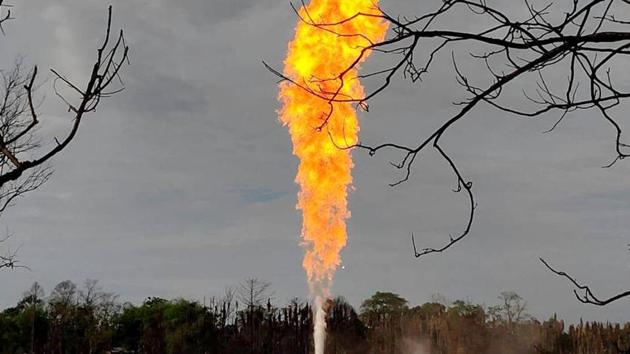
The gas well in Tinsukia district had a blow out (uncontrolled release of oil or gas) during a work over operation. It caught fire on June 9 killing two firefighters. Another engineer died at the site this month due to electrocution.
While the well was capped August, the fire at the wellhead had not been doused till this month.
{{/usCountry}}While the well was capped August, the fire at the wellhead had not been doused till this month.
{{/usCountry}}“About two weeks back, we have been able to douse the fire at the wellhead and divert the gas for production. Now things are coming under control,” Mishra said.
Though the fire at the wellhead has been doused and a portion of the released gas has been diverted for production, the unused gas directed to a flare pit near the well is still blazing.
Efforts are now on to ‘kill’ the well by snubbing-a process to install or remove tubular from a well while it remains pressurized (alive). This technique is used when it is not possible or desired to kill a well using a mud-sludge called ‘kill fluid’, a technique which was tried unsuccessfully earlier.
Mishra informed that OIL has suffered Rs 6 cr in losses because of the blowout at the well and a total loss of Rs 179 cr due to forced closure at other oil and gas wells in the area by various organizations.
The company has also spent around Rs 70 cr on foreign experts who had reached the site in June and have tried to bring the well under control for the past four months without complete success.
Replying to a query on the damage to the ecology near Baghjan, which is located close to the Maguri Motapung Wetland and the Dibru Saikhowa National Park, Mishra said that there had been no major harm.
“Studies by various agencies have revealed no major harm to the ecology and environment of the area. There has been some impact on the area near the well and that can be addressed only after the well is brought under control,” he said.
The blowout and subsequent fire had damaged over a dozen houses in the vicinity and uprooted nearly 7,000 local residents-some of whom are still staying in relief camps.
Mishra informed that OIL has already paid an interim amount as compensation to some of the affected families and once the district administration completes its survey, will compensate others as well.