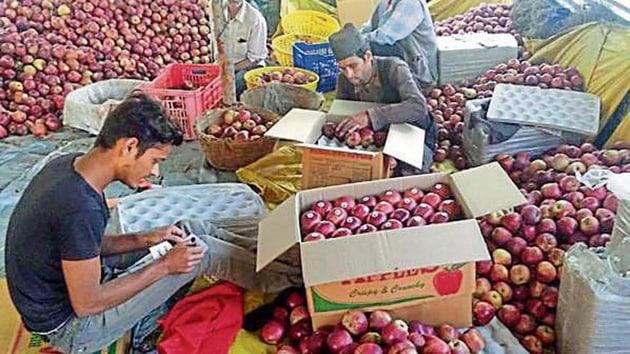
Last week, an apple orchardist in Himachal Pradesh got an SOS call from his fruit commission agent at Asia’s biggest fruit and vegetable market in Azadpur, Delhi, saying: “Don’t send the produce, there are no buyers.” That was for the first time in four decades that such a call was made.
HT file
{{^htLoading}} {{/htLoading}}
This time, the market for monsoon fruits, such as apple, watermelon, pomegranate, banana, pears, plums and litchi, bears a deserted look. “There are very few buyers this year. Most of them are local retailers. Big buyers from outside Delhi have not come,” said a commission agent, off-loading a truck full of watermelons. “I’m yet to sell the produce I got three days ago,” he said, pointing to the open storage with thousands of cartons.
{{^usCountry}}{{/usCountry}}
In the nearby apple-selling zone, a trader told a commission agent that buyers in Gujarat, Maharashtra, Karnataka, the upmarket states, have asked him not to send an apple box costing more than Rs 1,000. A box of apple weighs 25-30 kg and the cost of transporting a box from Shimla to Delhi is about Rs 200.
{{^htLoading}} {{/htLoading}}
{{^usCountry}}
The smaller grade apple, which forms 80% of the total produce, is getting a lower buying price.
{{/usCountry}}
{{#usCountry}}
The smaller grade apple, which forms 80% of the total produce, is getting a lower buying price.
{{/usCountry}}
Double whammy for traders
Traders who used to invest heavily by financing smaller traders have lost money since the November 2016 demonetisation. “We don’t have extra cash to invest in the risky business,” one such trader said.
The fruit and vegetable wholesale trade in India largely runs on credit from a week to a few months. There is risk involved in the business as the buyer can refuse to clear the debt, citing losses. Most traders are prepared that 5% of the credit will never come back but the last few years have been bad with creditors defaulting on up to 30%, the traders said.
{{^htLoading}} {{/htLoading}}
Two mid-level traders said they are yet to recover Rs 10 crore each from buyers of the last apple trading season (July to November). They are not the only ones. Many in Azadpur and in other fruit and vegetables markets in the country are yet to get their money back, causing the cash crunch.
The double whammy this year is that the demand for fruits among retail buyers is not encouraging despite lower prices. “The wholesale price of watermelon is 30-40% less than what it was last year but demand is weak,” said a commission agent.
Slowdown takes toll
For all fruits, there are two distinctive markets. The better quality fruit fetches good price in more developed Gujarat, Maharashtra, Karnataka, Tamil Nadu, Punjab and Kerala, while the lower-grade fruit goes to markets in Uttar Pradesh, Bihar, West Bengal, Odisha, Madhya Pradesh and the North-East. Traders say that the slowing down of demand is more in the lucrative western and south Indian markets, which of late have been hit by floods, than in the poorer states, bringing down the overall prices.
{{^htLoading}} {{/htLoading}}
The sentiment in Azadpur shows that the slowdown has hit the horticulture produce worse than what the agriculture ministry’s data shows. Agmarknet.gov.in shows the price range for a quintal of apple at Azadpur is Rs 3,000 to Rs 5,000 (about Rs 800 to Rs 1,500 per box) for large apples. This season, only 5% of the total produce so far is of large size because of the heat wave and less rainfall in summer. The lower grades are selling at half the price.
Chetan Chauhan is the National Affairs Editor looking into all aspects of news and features from across India. A Chevening scholar with over three decades of experience in reporting and news management, Chetan has extensively covered all important aspects of the social sector, political economy, environment and climate change nationally and internationally. He did a journalism course at the Reuters Institute of Journalism in Oxford and Digital Media training at Nanyang Technological University in Singapore. He started as a reporter with The Statesman in 1996 and joined the Hindustan Times in 2000 in the metro bureau covering environment, crime and Delhi politics. He covered hot local news, from the Jessica Lal murder case to the rebellion of Delhi Congress MLAs against then Chief Minister Sheila Dikshit, to the replacement of toxic vehicle fuel with cleaner compressed natural gas (CNG) in the national capital. Some of his stories on air pollution became part of the Supreme Court’s landmark MC Mehta versus Government of India case in the National Capital Region (NCR), forcing the government to take corrective measures. As part of the national political bureau since 2004, he covered important central sectors such as environment, education, social justice, labour, rural development, water resources, renewable energy, agriculture, broadcasting and the Planning Commission for more than a decade producing several exclusive and investigative breaking stories. His specialisation is the environment, having covered at least a dozen United Nations global conferences on climate change, biodiversity and wildlife including climate summits in Paris, Copenhagen and Bali. He also covered India’s two five-year plans ---11th and 12th and reported on drafting and execution of right based laws such as Right to Education, Right to Information and rural job guarantee law, MG-NREGA, now being introduced in new format as VG-RAM-G Act. He has in-depth knowledge of social sector issues. He was one of the first to report on tigers vanishing from Sariska and Panna wildlife reserves in 2004 and 2008, respectively, leading to the setting up of the National Tiger Conservation Authority (NTCA) and the introduction of stringent penal provisions for poaching. He has written extensively on the rising human-animal conflict in India and the degradation of India’s biodiversity hotspots because of mining and other activities. Since 2004, Chetan has covered Parliament comprehensively and participated in training on the nuanced coverage of Parliament proceedings. He has travelled extensively across India to cover national and provincial elections since 1998, especially in the Hindi heartland states, considered India’s road to power. He writes a regular column for Hindustan Times, Ecostani, on important national politics, economy, Himalayan ecology and environmental issues. His other responsibilities include providing inputs for edits and edit page articles for the publication, apart from managing news flow from across India.
Get Latest News, breaking headlines, and top India News, and today real-time updates from across the nation. Stay informed on politics, government policies, crime, Today Weather, and major developments on Hindustan Times
Get Latest News, breaking headlines, and top India News, and today real-time updates from across the nation. Stay informed on politics, government policies, crime, Today Weather, and major developments on Hindustan Times