Two Indian Army pilots pushed their single-engine Cheetal helicopter to its limits to evacuate an injured mountaineer near the Nun-Kun peaks in Ladakh’s Zanskar range, landing at 18,600 feet with just one skid barely touching the treacherous snow-clad slope, officials aware of the matter said on Sunday.
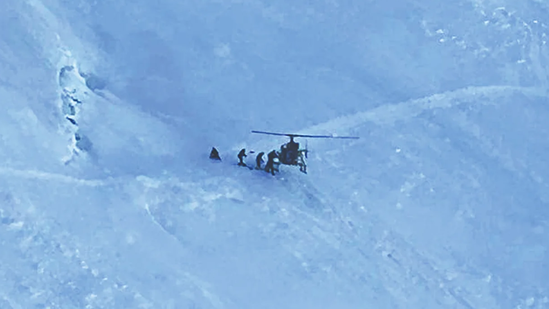
The pilots braved extreme weather and unforgiving terrain to evacuate the injured junior commissioned officer on Saturday but, despite their efforts, the soldier succumbed to his injuries at an Army hospital in Kargil, the officials said.
The Leh-based HQs 14 Corps called it a “daring high-altitude casualty evacuation” while sharing mission details.
“Indian Army Aviation pilots evacuated a casualty from an extremely challenging slope with no landing space and strong winds. With the helicopter lightened by removing non-essential equipment and carrying limited fuel, the aviators executed the evacuation with exceptional precision, courage and determination, including a critical landing with one skid touching the slope,” the Corps HQs said.
Also Read | Indian Army’s Cheetal helicopters keep flying in Ladakh amid failure probe
The mission was undertaken during the last available landing window of the day, highlighting the skill and courage of the Army Aviation Corps, officials added.
{{/usCountry}}The mission was undertaken during the last available landing window of the day, highlighting the skill and courage of the Army Aviation Corps, officials added.
{{/usCountry}}The development came three months after a Cheetal crashed near Leh’s Tangtse area on May 20. The two pilots—a lieutenant colonel and a major—and the third occupant, Major General Sachin Mehta, General Officer Commanding of the Karu-based 3 Infantry Division, miraculously survived the crash with minor injuries.
Also Read | Six decades old & irreplaceable: Why Cheetah, Cheetal & Chetak continue to fly
Equipped with a modern and fuel-efficient TM333–2M2 engine, the Cheetal features an automatic back-up engine control system. The Cheetal project began about 25 years ago to enhance high-altitude operational capabilities, improve maintainability, and provide a mid-life upgrade for safe and reliable operations.
The Leh-based HQs 14 Corps, responsible for operations in the sector, operates around 25 Cheetals, a re-engined version of the workhorse Cheetah helicopter.
The Army is looking at a swift replacement of its ageing Cheetah and Chetak fleets, helicopters that were designed six decades ago. A string of crashes has led to scrutiny of the choppers’ safety record.
The Army will begin phasing out the fleets in a year or two and replace them with new light utility helicopters (LUHs) over the next eight to 10 years, as part of the Army Aviation Corps’ drive to modernise its capabilities. The planned two-pronged replacement approach involves inducting locally produced LUHs and leasing similar choppers as a stopgap to meet critical requirements. The Army needs around 250 new helicopters.
Also Read | Army rescues 2 South Korean mountaineers in Ladakh; 1 dies
Hindustan Aeronautics Limited (HAL) licence-produced 625 Cheetah and Chetak choppers for use across defence services. It no longer builds them but is responsible for their maintenance and repair. In 1970, HAL signed an agreement with French aerospace firm Aerospatiale to produce Cheetahs, eight years after it partnered with another French firm, Sud-Aviation (now Airbus), to manufacture Chetaks.