
 E-Paper



Army conducts high-altitude airborne exercise in eastern Ladakh
NEW DELHI The Indian Army on Monday launched airborne drills in eastern Ladakh to validate and showcase its rapid response capabilities in high altitudes even as India and China are locked in a standoff along the Line of Actual Control (LAC) in the sensitive sector


The Indian Army on Monday launched airborne drills in eastern Ladakh to validate and showcase its rapid response capabilities in high altitudes even as India and China are locked in a standoff along the Line of Actual Control (LAC) in the sensitive sector.
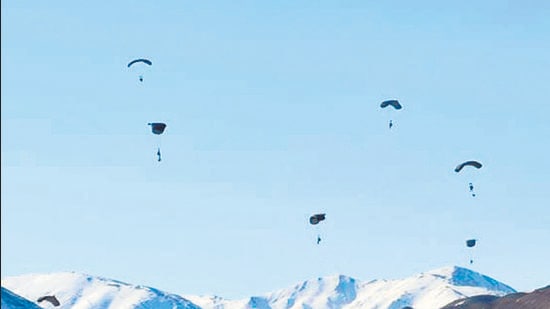
The exercise includes inter-theatre movement of troops and equipment, precision stand-off drops, rapid grouping and ability to capture designated targets with speed and surprise, officials familiar with the development said on condition of anonymity.
An airborne brigade, called Shatrujeet, comprising the army’s finest paratroopers is the centrepiece of the three-day high-altitude combat manoeuvres that saw soldiers being inserted into a drop zone at an altitude of more than 14,000 feet on the opening day, said one of the officials cited above.
“Acclimatised troops along with specialist vehicles and missile detachments were transported (to the exercise area) via US-origin C-130J special operations aircraft and Soviet-origin AN-32 medium transport planes from five different mounting bases to validate inter-theatre move, precision drops and capture of designated objectives,” said a second official, adding the drop was particularly challenging as it took place in minus 20-degree conditions.
Experts said the timing of the exercise was significant as it was being staged three weeks after the 13th round of military talks between India and China to cool tensions in Ladakh reached an impasse on October 10, with the People’s Liberation Army (PLA) not agreeing to suggestions made by the Indian Army.
Other elements of the exercise include integrated battle drills by airborne forces, mechanised columns and attack helicopters, the second official said,
The Indian Army is clearly demonstrating its combat capabilities to China with the high-altitude exercise, said former Northern Army commander Lieutenant General BS Jaswal (retd).
“India stood up to China after the border row erupted, and now the army is sending a message that PLA should not underestimate Indian military capabilities. Such drills have been conducted in the past but on a smaller scale,” Jaswal added.
The high-intensity manoeuvres also come in the backdrop of PLA scaling up its military activities in the east. It has intensified patrolling in sensitive areas across LAC in Arunachal Pradesh after the lingering standoff with India began last year in the Ladakh sector.
PLA has also ramped up area domination patrols for surveillance and orientation of newly inducted troops with a noticeable increase in visits by senior PLA officers to forward areas to supervise the military activities in the eastern sector, as previously reported by HT.
The sectors across which the Indian Army has detected increased PLA activity in Arunachal Pradesh include Lungro La, Zimithang and Bum La -- areas of high historical significance in the context of Chinese aggression in the eastern sector -- and counter measures have been taken to boost India’s readiness to handle any contingency.
The October 10 military dialogue in Ladakh took place more than two months after the last round of talks that led to disengagement of forward deployed troops from Gogra, or Patrolling Point-17A, in early August.
Despite two rounds of disengagement at friction points this year, the two armies still have 50,000 to 60,000 troops each deployed in Ladakh. Outstanding problems at Hot Springs and Depsang are yet to be resolved.
The Indian Army’s patrolling activity has been affected in Hot Springs (PP-15) and PLA’s forward presence in Depsang has also hindered access of Indian soldiers to routes including the ones leading to PP-10, 11, 11-A, 12 and 13.
There is no end in sight to the standoff, with army chief General Manoj Mukund Naravane stating on October 9 that if PLA is there to stay in the Ladakh theatre so is the Indian Army.


