E-Paper



Assam flips plan on eco-sensitive zone around Kaziranga, cites serious concerns
Assam said the proposed ESZ would have directly impacted about 500,000 people, including a significant population of STs, SCs and economically weaker sections

 Prefer HTon Google


GUWAHATI: The Assam government has decided to reverse an ambitious plan for an eco-sensitive zone (ESZ) encompassing Kaziranga National Park and Tiger Reserve (KNPTR), home to the largest population of the endangered one-horned rhino, and seven other protected areas (PAs) around it.
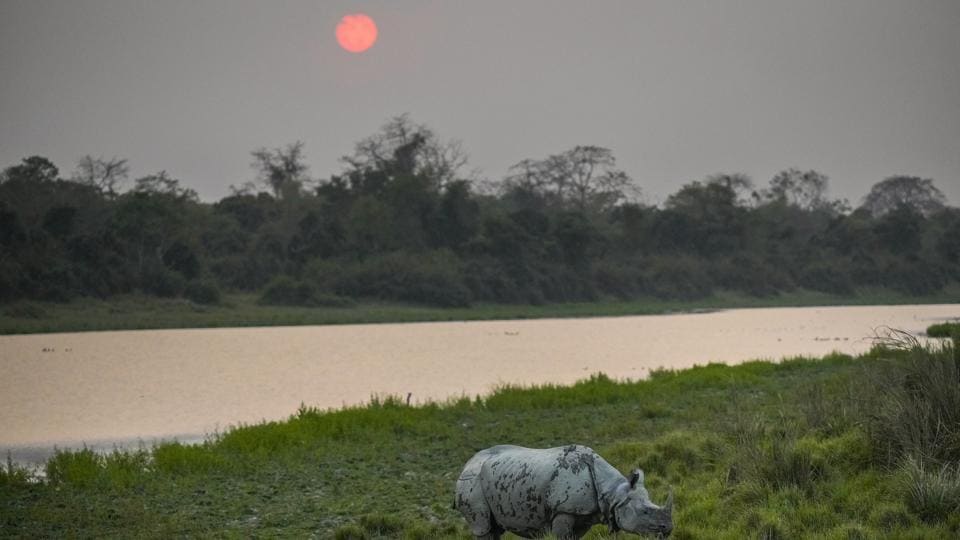
The Assam government on Tuesday wrote to the union ministry of environment, forest and climate change withdrawing the proposal to set up the ESZ on account of unresolved boundary issues, unsettled community rights and potential for socio-economic distress as reasons.
“In view of these serious concerns and the likely human suffering such an all-encompassing ESZ would cause, the state government has taken a considered decision to withdraw the proposal for an integrated ESZ covering all eight protected areas,” Assam chief secretary Ravi Kota said in his letter to the union environment ministry’s secretary Tanmay Kumar.
In a proposal in May last year, the state government proposed a 3,600 sq km integrated ESZ spanning around KNPTR and the wildlife sanctuaries of Laokhowa, Bura Chapori, Nambor-Doigrung, Nambor, Garampani, East Karbi Anglong and the proposed North Karbi Anglong wildlife sanctuary. It would would have covered nearly 340 villages across five districts.
ESZs act as a “shock absorber” for the protected areas and prevent encroachment, illegal mining, construction, and other activities that could harm the environment and wildlife.
“It is important to highlight that several additions to KNPTR are still in the proposed stage, with boundaries yet to be finalized-some pending since 1985. Moreover, the rights of the local communities residing in these areas including all the above eight PAs remain unsettled,” Kota explained in his letter.
HT has reviewed a copy of the letter.
The chief secretary said the proposed ESZ would have directly impacted about 500,000 people, including a significant population of Scheduled Tribes, Scheduled Castes, and economically weaker sections many of who depend on agriculture, tea estates (spread across 80 sq km and employing over 25,000 workers), and other rural livelihoods.
“The area also contains centuries-old villages and critical public infrastructure, such as schools, colleges, hospitals, drinking water and irrigation facilities, rural markets, industries including operating services of Numaligarh Refinery Limited, and national highways (NH-37 and NH-39),” Kota said.
“Implementing such a vast, integrated ESZ without resolving these fundamental boundary and community issues would severely obstruct development, lead to population displacement, and create long-term socio-economic distress for already vulnerable communities,” he added.
Kota said the Assam government would submit separate ESZ proposals for each of the eight protected areas and additions of KNPTR individually based on the specific ecological, demographic, and socio-economic context of each case.
“In view of above, you are kindly requested to treat the integrated ESZ proposal submitted earlier as withdrawn in the larger interest of the people and the region’s sustainable development,” the letter said. The government’s move has stunned environmental activists.
“This decision is going to trigger a negative impact on overall wildlife conservation efforts in Assam. Although the state government has taken this shocking decision, I feel it has to go through National Board of Wildlife and the apex court for final results which may not be so easy as anticipated by the state government,” said Bibhab Talukdar, secretary general and chief executive officer of Aaranyak, one of the largest wildlife NGOs of northeast.