
 E-Paper



At Kanker encounter site, signs of a fierce last stand
29 Maoists killed in fierce encounter with security forces in Chhattisgarh's Kanker district. Significant blow to rebels, biggest in 8 years. Villages near site tense and mourning.

 Prefer HTon Google


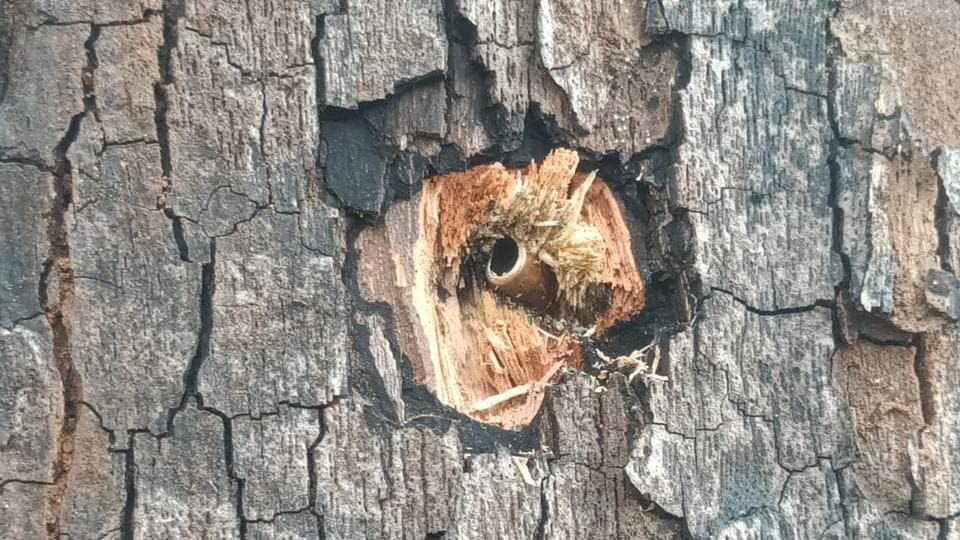
Shells of bullets, both on the ground and lodged in trees; a grenade from an under barrel grenade launcher; shoes and bloodstained clothes left behind in a hurry—the spot of the encounter that left 29 Maoists dead in Chhattisgarh’s Kanker district on Tuesday is strewn with signs of the fierce exchange between the insurgents and security forces that raged for over four hours. The exchange of fire marked the most significant single incident blow to the rebels in eight years and the biggest ever in Chhattisgarh.
60 kilometres away from the nearest town of Pakhanjur, and 30 kilometres away from the nearest motorable road, the place of the encounter can only be reached after crossing a river, just past Chhottebetiya, and then two hills, through a forest full of dense shrubbery. The closest village is Hindur, five kilometres away, with two others, Kalpar and Hapatola, nearby.
As HT reached the spot at 4 pm on Thursday afternoon, curious villagers from Hidur were present, emerging out of their homes for the first time after hunkering down for over 48 hours. “We heard gunshots that lasted for four hours, and the intermittent sound of bombs. Everyone rushed inside their homes. We did not come out because for two days the security forces carried out a combing operation,” said Som, a resident of Hidur.
In the village of Kalpar, there was a sense of mourning, with a 17 year old girl from the village among those killed by security forces. Family members that HT spoke to said that they would soon go to Kanker to collect her body, and had identified her from the photographs that the police have released. The Chhattisgarh police had by Thursday identified 27 of the 29 killed, including two divisional commanders Shankar Rao and Lalita Marawi. “She joined the party(Maoists) two years ago and was too young to die. We stopped her many times but she was obstinate. Even the Maoists sent her back because she was too young but she would run away from home and join the rebels,” he said.
In the forests around the spot, there are signs that this has hitherto been a Maoist citadel. Hung on trees every few kilometres are Maoist banners, and in some clearings, red pillars that are memorials to slain cadre. Another villager who was at the spot of the encounter said that while the cadre often spent time in the area, they had been surrounded on Tuesday. “They couldn’t escape from the hill they were on,” the villager, requesting anonymity said.
The encounter took place in the tri-junction of Kanker, Narayanpur (in Chhattisgarh) and Gadchiroli (adjoining Maharashtra). Inspector general of police (Bastar range) Sunderaj P on Wednesday said that the encounter is a big dent for the North Bastar division.“The division is known as safe haven of Maoists.. they have been collecting illegal levy in the area. After this encounter , the Maoists have faced a major loss,” said the IG.
He said that there were around 110 armed cadres of Maoists in this division and now “around 80 are left”.
Another resident of Kalpar said that he was nearly caught in the cross-fire and stopped by the police on Tuesday. “I had gone to Chhotebetiya for some work and was returning around 3 om when I heard the sound of gunfire. Suddenly, a team of security forces came upon me and asked me to reroute them to where the encounter was taking place. I walked with them for a bit, and then they asked me to leave,” he said.
-kW0H-U20214218012MgB-250x250%40HT-Web.jpg)


