New Delhi: India sharply criticised Pakistan on Saturday for attempting to inject “unwarranted references” into the International Glacier Conference in Tajikistan, marking the first time the two nations have publicly clashed over the Indus Water Treaty at an international forum over the issue.
The confrontation unfolded at the High-Level International Conference on Glaciers’ Preservation, where minister of state for environment Kirti Vardhan Singh accused Pakistan of misusing the scientific platform to raise issues beyond its scope.
“India strongly objects and condemns Pakistan’s attempt to use the International Glacier Conference to bring in unwarranted references to issues which do not fall within the purview of the forum,” Singh said during his address at the plenary session.
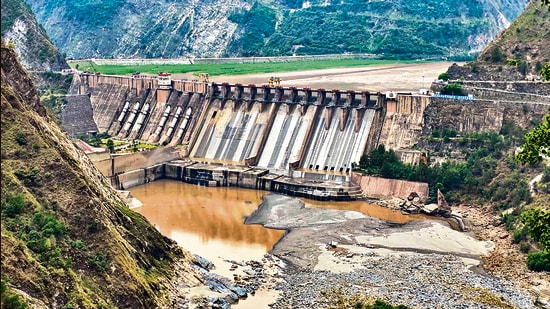
The diplomatic spat comes after India decided on April 23 to keep the 1960 Indus Waters Treaty in abeyance following a terrorist attack in Kashmir’s Pahalgam. Singh argued that fundamental changes since the treaty’s execution—including technological advancement, demographic shifts, climate change, and persistent cross-border terrorism—necessitate reassessment of obligations.
“The treaty’s preamble says it is concluded in the spirit of goodwill and friendship. However, the unrelenting cross-border terrorism from Pakistan interferes with our ability to implement the treaty as per its provisions,” Singh said, adding that Pakistan itself violates the treaty while blaming India for breaches.
{{/usCountry}}“The treaty’s preamble says it is concluded in the spirit of goodwill and friendship. However, the unrelenting cross-border terrorism from Pakistan interferes with our ability to implement the treaty as per its provisions,” Singh said, adding that Pakistan itself violates the treaty while blaming India for breaches.
{{/usCountry}}Pakistani Prime Minister Shehbaz Sharif had fired the opening salvo on Friday, declaring his country would not allow India to cross “red lines” by holding the treaty in abeyance and “endangering millions of lives for narrow political gains.” Dawn newspaper quoted Sharif calling India’s decision “unilateral and illegal.”
The dispute gains urgency from emerging scientific evidence that climate change is fundamentally altering the Indus basin’s hydrology. HT had reported on May 3 that recent research shows western tributaries like the Indus, Kabul, Jhelum and Chenab are fed by glaciers with substantially more stored water than eastern tributaries including the Beas, Ravi and Sutlej — that are in India’s share – could have their flow diminished.
Crucially, glacial melt accelerates faster in the Western Himalayas that feed eastern rivers compared to the Upper Indus basin. This east-west disparity challenges core assumptions of the treaty, which allocated rivers based on historically stable flow patterns.
“From an entirely scientific perspective, water-sharing practices need revisiting given climate change can alter flow and increase downstream disasters,” said Anil Kulkarni, distinguished visiting scientist and glaciologist from the Indian Institute of Science said in the May 3 report.
Singh, in his remarks at the UN event, emphasised that glacial retreat represents an immediate reality with far-reaching implications for water security, biodiversity and billions of livelihoods. The Himalayan glaciers feed critical rivers including the Ganga, Brahmaputra and Indus.
India is responding through strategic initiatives under the National Mission for Sustaining the Himalayan Ecosystem, a key component of the National Action Plan on Climate Change, Singh said. The country has established a Centre for Cryosphere and Climate Change Studies to advance glacial research and monitoring.
The Indian Space Research Organisation leads systematic monitoring using advanced remote sensing and Geographic Information System technologies. Research efforts coordinate across national institutions including the National Centre for Polar and Ocean Research, National Institute of Hydrology, Wadia Institute of Himalayan Geology, and G.B. Pant National Institute of Himalayan Environment, the minister explained.
“India has strengthened disaster preparedness in the Himalayan region through improved early warning systems and Glacial Lake Outburst Flood (GLOF) risk mapping, coordinated by the National Disaster Management Authority (NDMA). Regional cooperation was underscored as vital for strengthening resilience, improving data-sharing frameworks, and fostering coordinated responses to the challenges facing mountain ecosystems,” Singh informed.
Singh stressed India’s commitment to the principle of Common but Differentiated Responsibilities and Respective Capabilities (CBDR–RC) in international climate action, noting that while South Asia contributes minimally to global cumulative emissions, it remains highly vulnerable to climate change impacts.