
Sign in

Auroras sighted in Leh: How a solar storm led to this rare phenomena

A severe geomagnetic storm hit the earth on Thursday, creating celestial lightshows farther south than usual

Updated on: Oct 12, 2024, 07:49:02 IST
Share
Share via
  • facebook
  • twitter
  • linkedin
  • whatsapp
Copy link
  • copy link

In a rare and unexpected display, auroras lit up the night sky in Leh, Ladakh after a severe geomagnetic storm hit earth on Thursday.
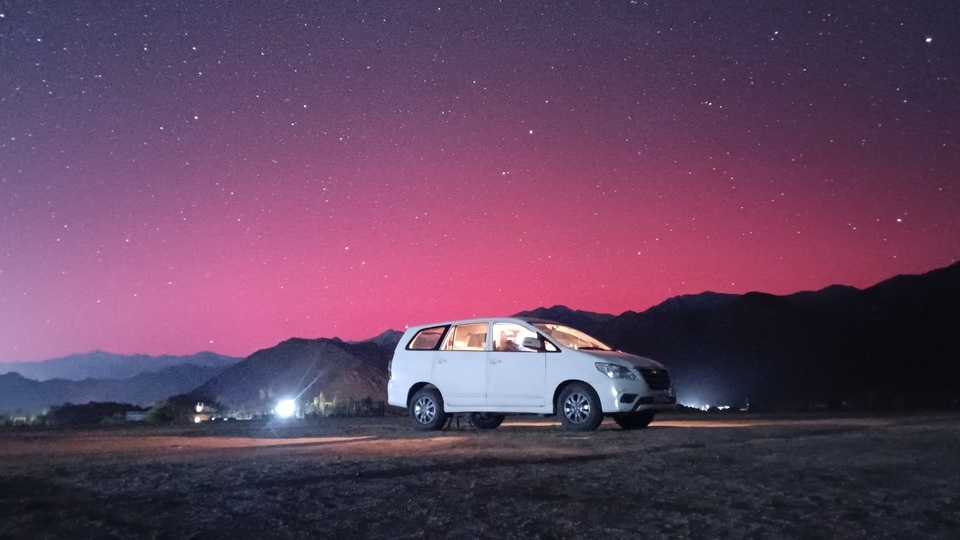
A red aurora captured  from Stakna, outside Leh. (Dorje Angchuk/X)
A red aurora captured from Stakna, outside Leh. (Dorje Angchuk/X)

The auroras were seen at India’s highest observatory in Hanle. The auroras are typically witnessed farther up in higher latitudes. However, the intensity and frequency of solar storms this year have allowed the lights to capture the night sky much farther down in lower latitudes.
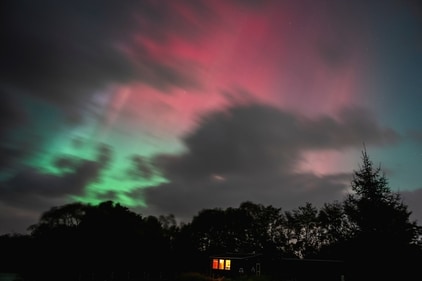
Northern Lights seen over Haraldsted Lake, near Ringsted, Denmark October 10, 2024. (via REUTERS)

Also Read: Hurricane Milton eye spotted from space, how does eye determine intensity of storm

Sightings of the aurora were also reported in New Mexico and Alabama in the southern parts of the United States, according to news agency Associated Press.
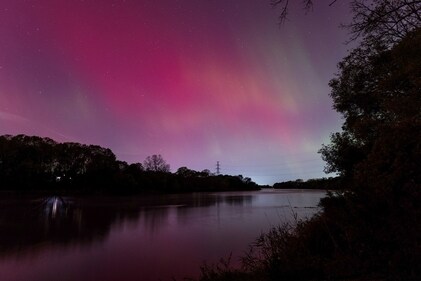
Aurora Borealis illuminate the sky in Haldimand County,Ontario, Canada, October 10, 2024. (REUTERS/Carlos Osorio)

The ‘aurora borealis’ or northern lights as they are commonly referred to are huge bursts of energy called ‘coronal mass ejections’ interacting with gases in the Earth's atmosphere-blue and purple from nitrogen, green and red from oxygen.

In Leh, red auroral transmissions were captured on telescopes used by the Indian department of science and technology.

These auroras were all a result of a solar, geomagnetic storm which emerged from a solar flare on October 9 that travelled 1.5 million miles per hour.

Also Read: UN like 'old company', not keeping up but occupying space: Jaishankar

The National Oceanic and Atmospheric Administration (NOAA) classified the storm as G4 - which signals severe conditions that could potentially disrupt power grids and satellite operations, reported AP.

Solar activity peaks in cycles of 11 years, reaching their solar maximum once per cycle, which is due in 2025, and the effects of which are likely to be felt till 2026.
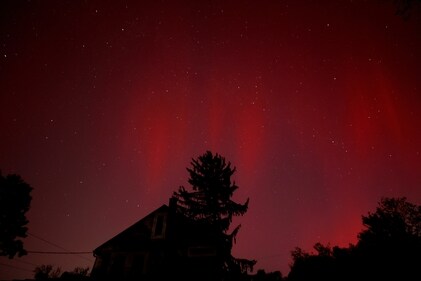
The Aurora borealis appears over a darkened neighborhood still without electricity nearly two weeks after Hurricane Helene (REUTERS)

That signifies that the earth is in for several more intense solar storms and rare sightings of the auroras.

Though the vibrant display is awe-inspiring, it can cause its fair share of disruptions as well, such as interference with high frequency radio communication, impacts on satellite navigation, power shutdowns etc.

  • HT News Desk
    ABOUT THE AUTHOR
    HT News Desk

    Follow the latest breaking news, major developments and agenda-setting stories from India and around the world with the newsdesk at Hindustan Times. Operating round the clock, the desk brings together experienced editors, reporters and correspondents to deliver fast, accurate and contextual reporting across subjects that influence public policy, governance, business, society and international affairs. The HT News Desk covers politics, elections, government policies, the economy, business and markets, science and technology, the environment, law and order, infrastructure, education, climate issues and geopolitics, while closely tracking developments across states, institutions and global capitals. The team also leads coverage of major breaking news events, policy announcements, court proceedings, natural disasters, public emergencies and significant international developments. Reports published by the newsdesk are based on information gathered from reporters on the ground, official statements, government agencies, court records, regulatory filings, recognised institutions and other authoritative sources. Stories undergo editorial scrutiny and verification processes to ensure accuracy, fairness and relevance, and are updated as events evolve and additional information becomes available. Whether covering a key political decision in New Delhi, an economic policy shift affecting millions, a landmark court ruling or a major global event, the HT News Desk aims to provide readers with reliable, fact-based journalism that delivers not only the latest developments but also the context and analysis needed to understand their wider implications.Read More

Follow India news real-time updates and the latest news covered on Hindustan Times, featuring today's critical updates on Sonam Wangchuk Hunger Strike LIVE and more across India.