The Centre has set up a committee to draft the final agreement for a “permanent political solution” to the four-decade-old Gorkha issue in north Bengal, with Union home minister Amit Shah assuring community leaders that the solution will be within the Constitution, people aware of the developments said on Saturday.
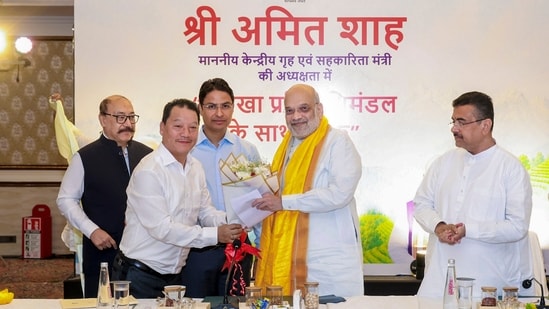
Shah held a high-level meeting with the West Bengal government and Gorkha community leaders at Sukna in the Darjeeling foothills on Saturday. The meeting, held on the third and final day of Shah’s visit to the state, was attended by intelligence and security brass and stakeholders.
“Held a meeting with Gorkha Member of Parliament, MLAs, and prominent Political Leaders along with CM of West Bengal in Siliguri today. Discussed the long-pending aspirations and genuine concerns of the Gorkha people and a practical roadmap forward. Reiterated that under the leadership of PM Modi, the government is firmly committed to addressing these issues. Further assured them that every possible effort will be made to address their legitimate aspirations within the framework of the Constitution,” Shah said in a post on X.
“The Ministry of Home Affairs, Government of India, has constituted a high-level Committee under the chairmanship of former deputy National Security Advisor and interlocutor Pankaj Kumar Singh to prepare the comprehensive framework for a ‘Permanent Political Solution’ with regards to Gorkha issues under the aegis of Constitution of India. This decisive step represents a major and long-awaited breakthrough in resolving this critical pending matter,” Shah added.
{{/usCountry}}“The Ministry of Home Affairs, Government of India, has constituted a high-level Committee under the chairmanship of former deputy National Security Advisor and interlocutor Pankaj Kumar Singh to prepare the comprehensive framework for a ‘Permanent Political Solution’ with regards to Gorkha issues under the aegis of Constitution of India. This decisive step represents a major and long-awaited breakthrough in resolving this critical pending matter,” Shah added.
{{/usCountry}}Since the 1980s, the Darjeeling hills have witnessed violent movements demanding a separate state for the Gorkhas. The 1988 accord between the Centre, West Bengal government and Gorkha National Liberation Front (GNLF) led to the creation of the Darjeeling Gorkha Hill Council (DGHC) following a violent agitation for a separate state of Gorkhaland.
“Union home minister Amit Shah, after hearing all sides in the meeting, concluded by drawing a roadmap towards finding a permanent political solution. A committee, headed by Singh, has been set up which will draft the final agreement,” Raju Bista, BJP MP from Darjeeling, told reporters after the meeting.
“This is a historic day for the Gorkhas and Darjeeling. In 1988 the Gorkha accord was signed on this day. And fortunately, a meeting was held today between the Union home minister and the representatives of the Gorkha community,” he said.
Before every Lok Sabha and assembly election in the state, the Gorkha issue often becomes a political flashpoint. In April this year, ahead of the assembly polls, TMC chief Mamata Banerjee had alleged that the Centre was trying to divide the state, while Shah had said the BJP would resolve the Gorkha issue within the constitutional framework and without dividing West Bengal.
“The Union minister was briefed about the pain and deprivation of the people living in the hills, Dooars and Terai regions, their struggle of over 40 years and the sacrifices. More than 2000 people have been martyred. Our women and daughters were raped,” Bista added.
Siliguri corridor security
Shah also reviewed security measures in the strategically important Siliguri corridor, which connects the Northeast with the rest of the country and is bordered by Nepal, Bhutan and Bangladesh.
During the review meeting, Shah asked CM Suvendu Adhikari to explore opening more Sainik schools in north Bengal and increase the number of senior NCC cadets in the region.
He also urged the state government to strengthen Civil Defence and Home Guards institutions in the corridor. The meeting was attended by senior officials of the Union and state governments.
A government spokesperson said the meeting reviewed measures to strengthen security in the corridor and recommendations of Multi Agency Centre’s Standing Focus Group on Siliguri Corridor.