
 E-Paper



Violence beyond ethnic strife as militants fish in Manipur’s troubled waters
HT’s conversations with multiple stakeholders in the state show that far from heading towards a resolution, the situation is only becoming more challenging.

 Prefer HTon Google


For over eight months, Manipur has been aflame. When the violence first began on May 3, the fault-lines were distinctly ethnic in nature, pitting Manipur’s most numerically dominant communities against each other. The Meiteis, largely clustered around the Imphal Valley versus the tribal Kukis, who live in the hill districts that surround the valley. In all this time, the state administration has failed to quell the attacks and the arson that have left at least 200 people dead and 50,000 displaced. And yet, eight months into the clashes, Manipur’s violence has grown beyond the ethnic. Increasingly, underground militant groups have regained support they had lost, rearmed themselves, launched attacks on security forces, and engaged in rampant extortion.
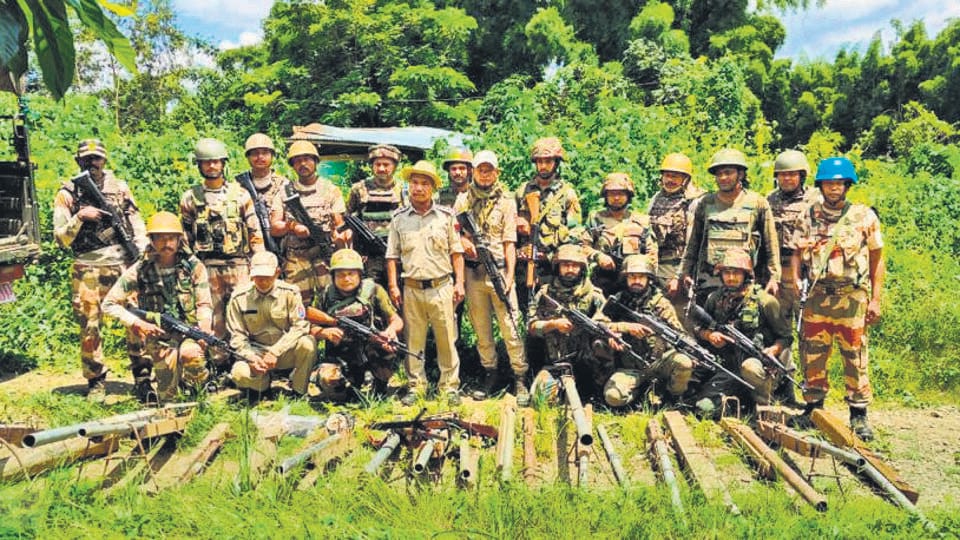
HT’s conversations with multiple stakeholders in the state, from officers in the security establishment to people in both the Imphal valley and hill districts, show that far from heading towards a resolution, the situation is only becoming more challenging. There’s a near-total absence of any functional administration; the private militias have become de facto governments in areas under their control; gun running and drug trafficking, the two old malaises of the area, are back; and a refugee crisis set off by events across the border in Myanmar has only complicated matters.
It’s no longer Kuki vs Meitei; it’s now every man for himself.
Causes and profits
A senior police officer based in Manipur said that as the violence has gone on, militant groups have grown in strength, and in no small part because of growing extortion. “We have information that militants are extorting money, food items, even vehicles. They need a large supply of food , so they come into urban settlements, and ask shopkeepers to part with these items. There has also been a case when a militant group asked an automobile dealer to give them three Maruti cars. If the victims do not acquiesce, they are taken at gunpoint,” the officer added, asking not to be named.
Read Here: Govt team continues peace talks with Manipur group
But while extortion is a resource-gathering exercise for some groups, it is the raison d’etre for others.
Typically, given how much influence militant groups now wield, there are very few police complaints. HT has accessed one complaint dated December 8, when a man informed the police that his 21-year-old son was kidnapped from a hostel room of the DM College of Science in Imphal, and a ransom demand of ₹15 lakh made. The police managed to rescue the 21-year-old, and eight members of the valley-based Maoist militant group- Kanglipal Communist Party (People’s War Group), that has been collaborating with Meitei groups since ethnic violence began in the state, were arrested.
With the state government almost non-existent, KCP (PWG) wasn’t the only one looking to profit.
In January alone, the police have arrested at least nine people, including from proscribed groups like KCP (Noyon), People’s Liberation Army(PLA), People’s Revolutionary Party of Kangleipak (PPEPAK), Kanglei Yawol Kunna Lup (KYKL) and National Revolutionary Front of Manipur (NRFM) for extortion.
Read Here: Meitei leaders harden stance with new pledge to ‘protect’ integrity of Manipur
The officer said that even “common criminals” are engaged in extortion, and that such groups are now well armed because of the proliferation of arms looted from government armouries. Of the 5,682 arms and nearly 650,000 pieces of different ammunition looted by mobs that have laid siege to security installations since May, only 1,647 arms and around 23,000 pieces of ammunition have been recovered until January 15. “Street criminals are extorting money from shopkeepers, traders, even auto rickshaw drivers because of this weaponisation,” the official added.
Civilians and soldiers
Security officials said that when the violence first broke out in May, they had to contend with angry mobs of civilians that were carrying out the attacks, driving communities they saw as the enemy away from homes, engaging in arson, and attacking each other. There were armed Kuki and Meitei groups in operation, and as villages came under attack, residents organised themselves into armed “village defence volunteers”, creating camps and barracks of their own.
That has changed — and how!
Security forces are now having to contend with trained militants using sophisticated weapons. In January, there have been at least two incidents of militants using rocket propelled grenades (RPGs) to attack security forces in Moreh. An officer of the Assam Rifles, posted at a buffer zone — areas that lie on the boundary of Kuki and Meitei inhabitations and manned by security agencies — said, “Civilians cannot fire an RPG without training. Civilians cannot shoot guns with the precision that we are seeing in Moreh. Underground militant groups have joined the violence on both sides. It is evident that there are trained snipers.”
Read Here: Has not found time to visit Manipur: Cong slams PM after his statehood day wishes
The Assam Rifles officer, who spoke on condition of anonymity, added that there was increasing evidence that insurgent groups such as PLA, KYKL thus far hiding in Myanmar have joined hands with proscribed outfits inside the state. On January 19, Manipur’s security adviser Kuldiep Singh told reporters that Kuki militants from Myanmar could be involved in attacks on the Manipur Commandos on December 30, when two officers in Moreh were shot dead and over two dozen security force personnel injured in targeted attacks by militants and village defence volunteers.
“There were intelligence reports about PDF insurgents from Moreh and their reinforcements from Burma (Myanmar) who could attack police officers,” Singh told reporters at his office.
The Assam Rifles officer said, “In the case where four men from Bishnupur were killed while collecting firewood from an abandoned Kuki village at the Bishnupur-Churachandpur border on January 10, they were first attacked with bombs and later shot dead by snipers from across a hill.”
A serving police officer who asked not to be named said some of these militants are from proscribed groups who had surrendered under the Suspension of Operations (SoO) pact signed between militant groups, Centre and the state in 2008 that mandated that they had to stay confined to their camps. For instance, a police remand note dated November 7 , seen by HT shows that two men, Lhunkhosei Chongloi, 30, and Satgougin Hangsing, 28, were arrested for the kidnapping and murder of two Meitei boys. The remand note alleged that they are both members of the Kuki Revolutionary Army (United), one of the outfits that was part of the SoO pact.
Read Here: Meiteis, Kukis demand action from govt amid heightened violence in Manipur
The state government has only itself to blame for this — on March 10, it unilaterally withdrew from the tripartite agreement.
State support vs popular support
Perhaps the key, and the most challenging aspect, of the vexed security scenario that now prevails is that in the vacuum a missing state has left behind, there is widespread support for radical outfits or militant groups, increasingly being seen as community guardians. On Wednesday for instance, when the Arambai Tenggol (AT), a controversial and armed radical Meitei group, called a meeting of Meitei legislators in Imphal (36 MLAs attended), shopkeepers in the town areas of Imphal shut their businesses down in support. At around 9.30am, 500 AT members, surrounded by thousands of Meitei civilians marched towards Kangla Fort in an unencumbered show of strength.
After the meeting, AT members told a gathering at the women’s market in Imphal that the MLAs and MPs had signed off on the outfit’s demands — the abrogation of the SoO agreement with Kuki militants, deportation of Myanmar refugees to Mizoram or to Myanmar, implementation of a National Register of Citizens with 1951 as the base year, erecting a fence along the border with Myanmar, replacing Assam Rifles with another central government force, and removal of Kuki immigrants from the Scheduled Tribe List.
“AT has gained massive support in the valley because they protect Meitei villages by sending volunteers. The group has become so politically relevant that those who attended Wednesday’s meeting were Meiteis from rival political parties and not just the government,” the serving police officer mentioned above said.
Editorial: Letting Manipur slip into anarchy
It is support such as this that is making it difficult for security forces to recover looted weapons, getting human intelligence that could stop attacks, or even finding witnesses when a case is registered.
Most of the recoveries of looted arms that police have made so far were found in villages, buried.
“Everyone knows about the location of the looted arms but only a few come forward with information about the case. People not willingly sharing the location of hidden weapons also shows they are keeping it for their safety in these clashes,” the officer said.
“In places like the North-East or Jammu and Kashmir, the best intelligence that forces thrive on is human intelligence. Civilians are not coming forward to help the security forces like they should. This is why despite 13 people killed by gunmen outside a village in Saibol on December 4, the police cannot find any eye-witnesses to build a case. The forces are divided too. The Meiteis are against Assam Rifles, and Kukis are battling Manipur police commandos,” this person added.
Over the last month, at least two Manipur police commandos have been killed and over two dozen police, BSF and Assam Rifles personnel have been injured in attacks launched by both Meitei and Kuki groups. While Manipur police commandos have been attacked in Moreh, Assam Rifles personnel have been targeted in valley districts like Imphal and Thoubal.
Read Here: Amid the violence, a search for Manipur’s missing
On Thursday, the Assam Rifles said in a statement that it had recovered six improvised explosive devices (IEDs), and 11 AK 47 cases from a forest in Moreh. “The militants have experts who make IEDs and countrymade mortars . They are using it to attack the commandos,” a senior CRPF officer said on condition of anonymity.
In fact, so dire is the situation, that on January 17 day, the Manipur government wrote to ministry of home affairs (MHA), requesting for air support so their troops in Moreh can be evacuated after gunbattles. In Tengnoupal, village volunteer groups openly threated violence against police commandos. On January 2, a statement issued by them said, “Deploying and stationing of combined forces of Meitei militants and police commandos in Moreh in unacceptable. We are compelled to retaliate against them. The volunteers will fight back against the state sponsored terrorists till the last drop of our blood.”
Another aspect of the situation has roiled the conflict. The state continues to deal with a drug smuggling problem. Last month at a press briefing in Imphal, chief minister N Biren Singh claimed the conflict was also being engineered by drug mafia groups. Over the past month alone, the Manipur government has destroyed at least 90 acres of poppy plantations.
“Drug smuggling has not stopped even in these clashes. Everyone is using the situation in Manipur to their advantage,” said a police officer.
Even five Manipur police commandos were arrested for transporting drugs from Myanmar in a police vehicle on January 15.
Put together, Manipur now stares at an even longer, harder path back to any semblance of reconciliation, than eight months ago. For it now battles not just enflamed passions that show no sign of subsiding, but organised militant attacks with sophisticated weapons, rising extortion and kidnapping, a state apparatus that is increasingly hapless in the face of militant support, and a people that have lost faith.


