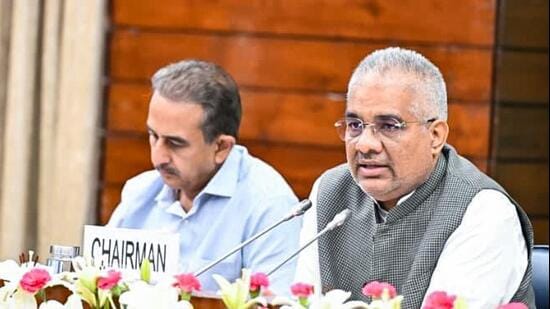
Union environment minister Bhupender Yadav chaired a meeting of the Parliamentary Consultative Committee of the Ministry of Environment, Forest and Climate Change (MoEFCC) on Wednesday -- focusing on human-wildlife conflict (HWC) and the measures required for strengthening prevention, mitigation and long-term coexistence between people and wildlife.
States including Assam, Karnataka, Kerala, Madhya Pradesh, Uttarakhand and Uttar Pradesh shared their conflict scenarios before the committee, alongside mitigation measures planned and currently in effect, officials said.
The committee, which included MoS environment Kirti Vardhan Singh, MPs and chief wildlife wardens of states, discussed conflict patterns, noting that they varied across landscapes. Focus was on species such as tigers, leopards, bears, rhinoceroses, wild boars, gaurs and primates, with location-specific management approaches discussed.
Assam shared it has formed zonal human-wildlife conflict risk reduction committees, which will prepare region-specific action plans for species such as elephants, tigers, leopards and rhinos. The plan includes early warning systems and rapid response teams.
Karnataka presented an integrated six-pillar model for predictive human-wildlife conflict management, which includes engineering interventions, AI-enabled surveillance, command centres, rapid response teams, community volunteer networks and e-Parihara digital compensation systems, it said.
Also Read:Rethinking human-wildlife conflict
{{/usCountry}}Also Read:Rethinking human-wildlife conflict
{{/usCountry}}The environment ministry, in a statement, further shared Kerala has declared human-wildlife conflict a state-specific disaster and identified 273 conflict-affected panchayats.
“MP meanwhile presented a ‘Prevention First’ model for human-wildlife conflict mitigation integrating AI-enabled surveillance, GPS tracking, drones, Gajrakshak, rapid response teams, species-specific Standard Operating Procedures, time-bound compensation and extensive community participation through Bagh Mitra, Hathi Mitra, and Eco-Development Committees,” the statement added.
Uttarakhand’s plan includes an Integrated Command and Control Centre, a 24×7 Helpline (1926), e-surveillance, GPS tracking, habitat restoration and bio-fencing.
Uttar Pradesh meanwhile shared that leopard-related incidents constitute the majority of human-wildlife conflict cases in the state.
“The State presented its strategy based on Rapid Response Teams, rescue centres (4 constructed), solar fencing, early warning systems, community volunteer programmes, scientific monitoring and strengthened conservation interventions beyond Protected Areas,” the statement read.