
 E-Paper



Cabinet clears key bills, approves census budget
Union information and broadcasting minister Ashwini Vaishnaw said the Cabinet, chaired by Prime Minister Narendra Modi, approved the proposal to conduct Census

 Prefer HTon Google


The Union Cabinet on Friday approved the budget for the upcoming census and a new economic partnership with Oman, allowed the export of coal, and cleared key bills proposing a unified national education regulator, opening up the insurance sector fully to foreign direct investment, bringing in sweeping changes to the atomic energy sector to attract private players, and renaming the national rural jobs scheme, people aware of developments said on Friday.
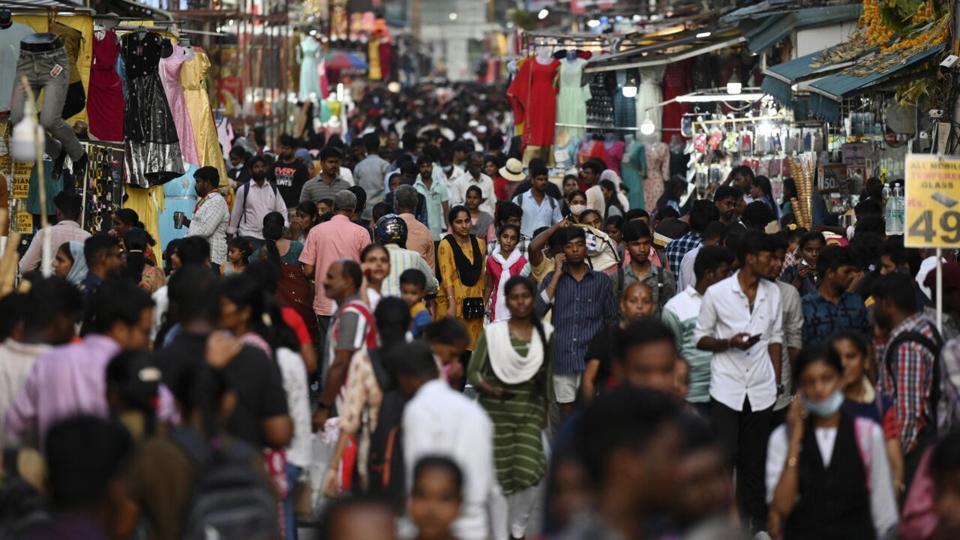
Union information and broadcasting minister Ashwini Vaishnaw said the Cabinet, chaired by Prime Minister Narendra Modi, approved the proposal to conduct the Census which will be the first digital exercise, and approved ₹11,718 crore as budget. He added that around three million enumerators will be involved in the exercise, the 16th edition of the census since Independence which will also provide an option of self enumeration to the citizens.
The decadal exercise, which was scheduled to take place in 2021, was initially postponed due to the Covid-19 pandemic. This is the first census since independence to enumerate all castes.
“The outcome of the Census 2027 will serve as the new compass for development, mirroring India’s latest population data with more accuracy. The precision in data will accelerate Modi ji’s vision of delivering the benefits of good governance and development to citizens of every demographic denomination, making the slogan of ‘Sabka Saath, Sabka Vikas’ a grand reality of New India in the Amrit Kaal,” Union home minister Amit Shah said on X.
The Cabinet also approved the introduction of several important bills.
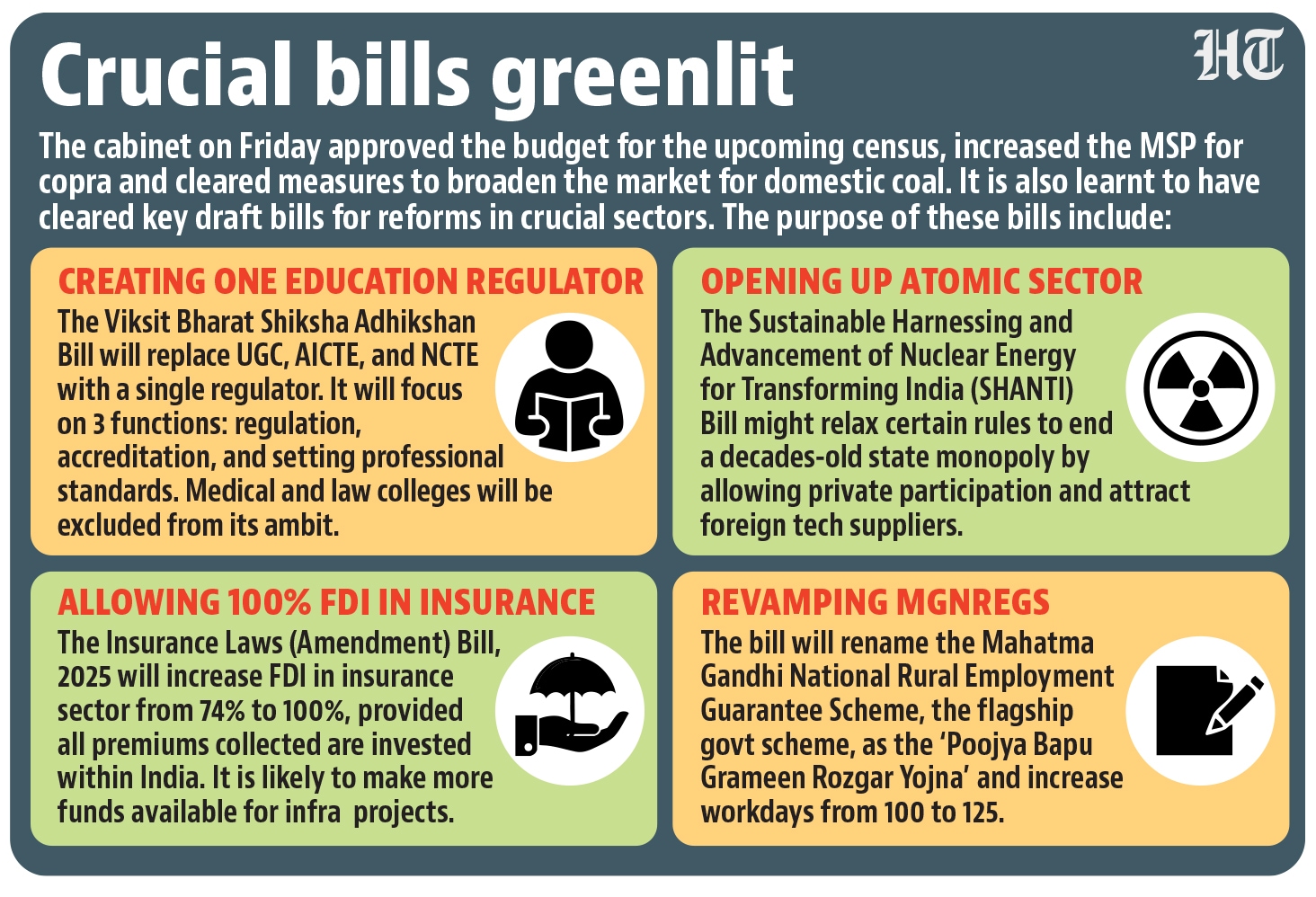
The government may introduce the Insurance Laws (Amendment) Bill, 2025 – which proposes raising foreign direct investment in the insurance sector from 74% to 100% on condition that foreign firms would invest the entire premium thus collected in the country itself – in Parliament next week, the people cited above said.
Proposed 100% FDI in the sector will give significant freedom to foreign entities in managing affairs of their firms with adequate safeguards that would be part of the rules framed in consultation with the sector regulator Insurance Regulatory and Development Authority of India (IRDAI), they said, adding that the legislation is in line with the government’s plan to deepen insurance penetration and to achieve ‘Insurance for All by 2047’.
“The insurance bill could be introduced next week, perhaps on Monday, depending on the situation,” one of the people cited above said. The session is scheduled to conclude on December 19. Besides allowing 100% FDI in the insurance sector, the government may also bring significant reforms through the bill for ease of doing business and protection of consumers. “The proposed legislation will also simplify certain procedures and rules,” the person added.
The cabinet also approved a bill to rename the Mahatma Gandhi National Rural Employment Guarantee Act to the ‘Poojya Bapu Grameen Rozgar Yojna, and hike the number of workdays from 100 to 125.
The Mahatma Gandhi National Rural Employment Guarantee Scheme, better known as MGNREGA or NREGA, is a flagship scheme of the government aimed at enhancing livelihood security of households in rural areas by providing at least 100 days of guaranteed wage employment in a year to every household whose adult members volunteer to do unskilled manual work.
The programme became a lifeline for the rural population in the aftermath of Covid19. According to the government data, currently 7813434 workers are expected on 1049150 worksites as on Friday. Last year, 308.7 crore person days of work were generated in this programme.
Enacted by Parliament in 2005, the rural employment guarantee scheme covers the entire country with the exception of districts that have 100% urban population. It was considered the showpiece of the social security legislation push by the then United Progressive Alliance government, and a key reason for the Congress’s surprisingly robust performance in the 2009 general elections. But the scheme has also garnered significant controversy over corruption, poor quality rural assets created and long delays in payments. The scheme is also at the centre of a protracted fight between the Union government and several states ruled by non-BJP parties, especially West Bengal.
The Cabinet Committee on Security also cleared a bill that sought to open up the tightly-controlled civil nuclear power sector for private participation as India eyes 100 GW atomic energy capacity by 2047, the people cited above said. The Sustainable Harnessing and Advancement of Nuclear Energy for Transforming India (SHANTI) Bill might relax some rules to end a decades-old state monopoly, news agencies reported.
In her Budget speech in February, finance minister Nirmala Sitharaman had announced plans of opening up the nuclear power sector for private sector participation.
Another bill approved by the Cabinet proposed to set up a single higher education regulator.
The proposed legislation – which was earlier christened the Higher Education Commission of India (HECI) Bill – has now been named Viksit Bharat Shiksha Adhikshan Bill, people familiar with the matter said.
The single higher education regulator – which was proposed in the new National Education Policy (NEP) – looks to replace the University Grants Commission (UGC), the All India Council for Technical Education (AICTE) and the National Council for Teacher Education (NCTE).
UGC oversees non-technical higher education, AICTE oversees technical education and NCTE regulates teachers’ education. The new regulator is likely to not have control over medical and law colleges.
Vaishnaw also said the Cabinet permitted allow coal buyers under linkages or long term contracts to export the fuel as the country’s power plants have a surplus. Power plants that have access to coal supply will be permitted to export up to 50% of their allocation and use coal flexibly across group companies.
India, the world’s second-largest coal producer, has been opening its coal sector to private players and commercial mining to meet rising energy demand and reduce import dependence.
The Union Cabinet Committee on Economic Affairs, chaired by Modi, approved the Policy for Auction of Coal Linkage for Seamless, Efficient & Transparent Utilisation (CoalSETU), according to an official statement.
The policy will allow allocation of coal linkages on an auction basis for long-term for any industrial use and export by adding a separate window named ‘CoalSETU’ in the NRS (Non-Regulated Sector) Linkage Auction Policy of 2016.
Any domestic buyer requiring coal can participate in the linkage auction, irrespective of the end use, Vaishnaw said, briefing the media about the Cabinet decision.


