E-Paper



India cautious as Bhutan, China sign pact
Bhutan’s foreign minister Tandi Dorji and China’s assistant foreign minister Wu Jianghao signed the MoU during a virtual ceremony.

 Prefer HTon Google


Bhutan and China on Thursday signed a memorandum of understanding (MoU) on a “three-step roadmap” for expediting negotiations on their boundary dispute, prompting a cautious response from India against the backdrop of the standoff on the Line of Actual Control (LAC).
“We have noted the signing of the MoU between Bhutan and China today [Thursday],” external affairs ministry spokesperson Arindam Bagchi said during a regular news briefing to a question about the MoU.
“You are aware that Bhutan and China have been holding boundary negotiations since 1984. India has similarly been holding boundary negotiations with China,” he said, without offering a response to a query on whether Bhutan kept India in the loop about the agreement with China.
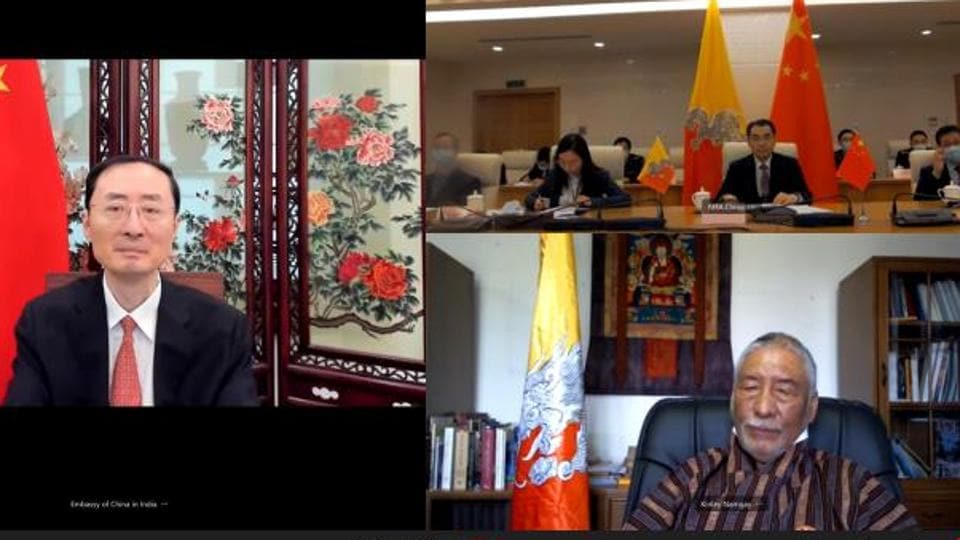
Bhutan’s foreign minister Tandi Dorji and China’s assistant foreign minister Wu Jianghao signed the MoU during a virtual ceremony earlier in the day. China’s ambassador to India, Sun Weidong, and Bhutan’s envoy to India, Maj Gen Vetsop Namgyel, also joined the event.
The agreement came four years after Indian and Chinese troops were involved in a 73-day face-off within Bhutanese territory at Doklam. That face-off began in June 2017 after India sent in its troops to prevent the construction of roads and infrastructure by Chinese troops in violation of agreements between Bhutan and China.
Given the extremely close coordination between India and Bhutan on foreign policy issues, it is unlikely that New Delhi was caught off-guard by Thursday’s development. Experts said India’s cautious response was understandable in view of the implications the MoU could have for New Delhi’s already fraught relations with Beijing because of the LAC standoff.
China does not have a diplomatic presence in Bhutan’s capital Thimphu, and the Chinese embassy in New Delhi coordinates ties between the two sides.
Following the standoff in eastern Ladakh, China claimed for the first time in July 2020 that it had a boundary dispute with Bhutan in the eastern sector, a region that borders Arunachal Pradesh, which is also claimed by Beijing. The text of the MoU was not made public by Thimpu or Beijing.
A statement from Bhutan’s foreign ministry said the MoU on the “three-step roadmap for expediting the Bhutan-China boundary negotiations” will “provide a fresh impetus to the boundary talks”.
“It is expected that the implementation of this roadmap in a spirit of goodwill, understanding and accommodation will bring the boundary negotiations to a successful conclusion that is acceptable to both sides,” the statement said.
In response to questions on the LAC standoff, Bagchi said India expects China to work towards the speedy resolution of all remaining issues in eastern Ladakh while fully abiding by bilateral agreements . The situation on the LAC was due to China’s unilateral attempts to alter the status quo, he said.