E-Paper



Prakash Raj says anti-CEC protests will continue despite crackdown: 'There is Gandhi's blood in us'
Actor-activist Prakash Raj said India is a democratic and peace-loving country and that citizens have the right to question authorities and protest.

 Prefer HTon Google


Actor-activist Prakash Raj said peaceful protests against chief election commissioner (CEC) Gyanesh Kumar and the Special Intensive Revision (SIR) of electoral rolls would continue across the country despite attempts to "suppress" them.
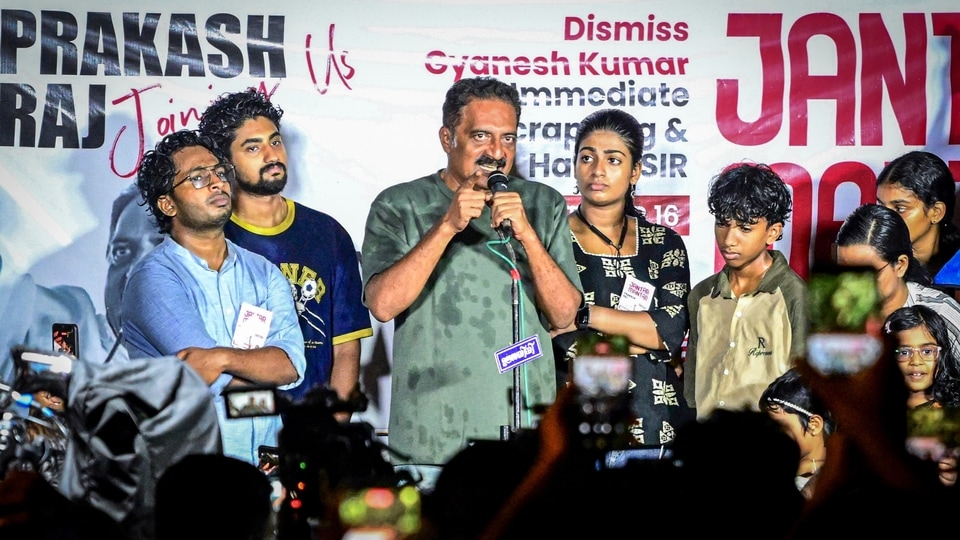
Speaking to reporters after attending a protest meet against Kumar and the SIR at Manaveeyam Veedhi in Thiruvananthapuram on Friday, he said, “There is Gandhi's blood in us. There is Ambedkar's blood in us, there is Bhagat Singh's blood in us.”
"We will continue to fight, we will continue to protest peacefully across the country, and it will prove you wrong that you can get away with this dictatorship," he said, according to news agency PTI.
Raj said the protests would draw inspiration from Mahatma Gandhi, BR Ambedkar and Bhagat Singh and asserted that attempts to stop the demonstrations would not prevent people from raising questions.
Prakash Raj questions restrictions on protests
Questioning the restrictions placed on demonstrations, Raj asked why protesters were being stopped and detained.
"We are asking questions: Gyanesh Kumar, why are you stopping us? The very fact that you are stopping us, detaining us illegally, shows something is wrong," the actor said.
He said India is a democratic and peace-loving country and that citizens have the right to question authorities and protest.
"The people of this country, the farmers of this country, the labour unions of this country, and all the student organisations will come to the streets and protest peacefully till you clear us out," he said.
Also read: AISA's Neha Bora released, CJP's Abhijeet Dipke arrested; police to file 7-8 FIRs amid anti-EC stir
Police intervene over microphone
Police intervened before the protest meeting began, leading to a brief confrontation. Police said that the organisers did not have permission to use a microphone. The intervention led to a minor tussle, after which police allowed the meeting to continue.
Asked about the intervention, Raj questioned the need for permission to hold a peaceful demonstration.
"In this country, to protest, whose permission do we need?" he asked.
He also questioned whether young people and citizens demanding answers should be treated as offenders.
"What do you mean by protest? Are they terrorists? The youth and the people of this country are doing a peaceful protest. Is that a crime in this country? It is a crime for you because we are asking difficult questions to which you don't have answers," he said.
Also read: Heavy security deployment continues across central Delhi a day after ‘Lehra Do Tiranga’ protest
Raj claims police may eventually refuse to follow orders
He also said he believed police personnel would eventually refuse to carry out orders against protesters. He argued that police officers and members of the armed forces were also citizens.
"I trust the police will get tired and tell (PM) Modi and (HM) Shah, 'We are not your workers. Please stop making us do this.' The army will stop saying, 'No, we can't do this.' They are also human beings, they are also citizens of this country," he said.
Raj said that international human rights organisations would strongly criticise the actions against protesters.
Also read: Delhi protests: UN 'concerned' over mass detentions, seeks immediate release of detainees
He also said farmers had announced they would join the agitation in support of young protesters. He also predicted that the movement could grow larger than the protest held at Jantar Mantar in Delhi.
"Let us see. It's going to be a bigger fight, a bigger protest than what you saw in Jantar Mantar," Raj added.
(With inputs from PTI)