The Central Board of Secondary Education (CBSE) on Wednesday declared the Class 12 board examination results for 2026, recording an overall pass percentage of 85.20%, down by 3.19 percentage points from last year’s 88.39%.
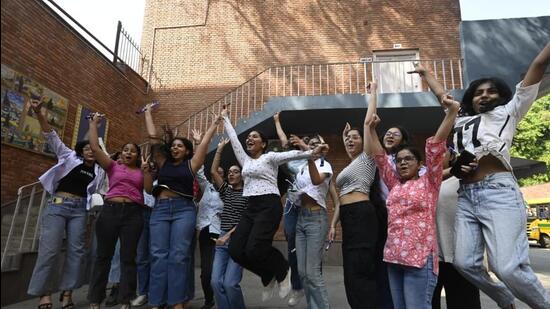
This year a total of 1.77 million students appeared for the exams, 76,000 more students than last year’s 1.69 million.
CBSE’s Class 12 pass percentage has fluctuated sharply over the past decade, from a low of 73.96% in 2017 to a pandemic-era high of 99.37% in 2021, before settling at 85.20% in 2026-- the lowest in seven years since 83.40% in 2019, and the lowest in the post-Covid period.
The decline comes in the first year of CBSE’s Online Screen Marking (OSM) system for evaluating Class 12 answer sheets. Under the new system, answer scripts were scanned and uploaded to a digital portal where teachers assessed them on computer screens, entered marks digitally and annotated responses online, while totals were auto-calculated to minimise human error. Using ÒSM, CBSE has evaluated 98,66,622 answer books.
While board officials did not respond to HT’s queries on the reasons for the decline, school principals and teachers offered differing explanations behind the downfall in pass percentage.
{{/usCountry}}While board officials did not respond to HT’s queries on the reasons for the decline, school principals and teachers offered differing explanations behind the downfall in pass percentage.
{{/usCountry}}While some blamed the OSM system, others blamed students not studying for examinations.
A principal of a Delhi-based school, requesting anonymity, alleged that the rollout was rushed and teachers were not adequately trained. “CBSE conducted only limited pilot testing in six private Delhi schools for two days. Many teachers, particularly in government schools, were not sufficiently familiar with the technology. Ideally, OSM should have been implemented next year after wider preparation,” the principal said.
However, other educators rejected suggestions that the evaluation system alone was responsible.
A Delhi government school teacher involved in Class 12 evaluation, requesting anonymity, said the process was systematic and reduced chances of calculation errors. “The lower pass percentage has more to do with how students attempted the papers than with OSM itself. Students do not take board examinations seriously and hence perform poor,” the teacher said.
Jyoti Arora, principal of Delhi-based Mount Abu School said the decline is “reflecting stricter competency-based evaluation and greater emphasis on conceptual understanding under the National Education Policy (NEP) 2020, rather than the marking system under OSM alone.”
Praneet Mungali, trustee at the Sanskriti Group of Schools, Pune, said OSM introduced greater rigour and reduced subjectivity, but cautioned that “conclusions should be drawn only after analysing trends over several years after OSM implementation.”
Dr Sanyam Bhardwaj, CBSE exam controller in a press statement said the adoption of OSM marks a paradigm shift in examination evaluation. “By leveraging technology, CBSE has not only modernised its processes but also strengthened its reputation as a globally trusted education board. This initiative ensures that students receive results that are accurate, timely, and fair, reinforcing CBSE’s vision of excellence in education.”
Also Read:CBSE 12th Result 2026: Class 12 results declared at digilocker.gov.in, direct link to check here
Girls once again outperformed boys, recording a pass percentage of 88.86% against 82.13% for boys, a difference of 6.73 percentage points. In 2025, girls recorded 91.64% against 85.70% for boys.
A total of 94,028 students (5.32%) scored 90% and above, while 17,113 students (0.97%) secured 95% and above. The number of students placed in the compartment category rose to 163,800 (9.26%), up from last year’s 129,095 (7.63%).
Kendriya Vidyalaya(s) recorded the highest pass percentage at 98.55%, followed by Jawahar Navodaya Vidyalaya(s) at 98.47%.
Regionally, Thiruvananthapuram topped the country with 95.62%, followed by Chennai (93.84%) and Bengaluru (93.19%), while Prayagraj recorded the lowest at 72.43%.
The pass percentage in foreign schools also declined to 90.50%, down from 95.01% in 2025.
“As per the earlier decision of the board to avoid unhealthy competition amongst the students, no merit list is declared by the CBSE. Also, the board does not award first, second or third divisions to its students. However, the board will issue the merit certificate to the top 0.1% of students who have scored the highest marks in the subjects. The merit certificate will be made available in the Digi-Locker of the student,” said Bhardwaj.
CBSE gives merit certificates to the top 0.1% students in each subject (English, maths, physics, history, etc.) who score the highest marks in that subject.
CBSE Class 12 examinations were conducted between February 17 and April 10, 2026.