Chief Election Commissioner (CEC) Sunil Arora on Friday categorically dismissed the demand for doing away with EVMs and bringing back ballot papers, citing orders passed by the Supreme Court in the past.
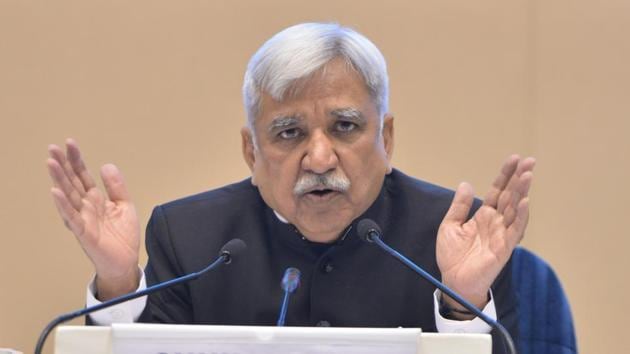
He also said assembly elections in Jammu and Kashmir will be held only after receiving a formal communation from the union ministries of home, and law and justice to that effect.
West Bengal Chief Minister Mamata Banerjee and a host of other opposition leaders, including TDP’s N Chandrababu Naidu, Farooq Abdullah of the National Conference and Maharashtra Navnirman Sena (MNS) president Raj Thackeray, have repeatedly claimed that Electronic Voting Machines could be tampered with and demanded a return to ballot papers.
“We are not going back to the era of ballot papers. The Supreme Court has more than once said that ballot papers are our past,” Arora told reporters at the Kolkata airport.
Banerjee has often said that EVMs were earlier used in developed countries like the US, UK, France and Germany but they all reverted to ballot papers.
Arora is in the city to attend events organised by the West Bengal National University of Juridical Sciences and IIM (Calcutta) on Friday and Saturday.
{{/usCountry}}Arora is in the city to attend events organised by the West Bengal National University of Juridical Sciences and IIM (Calcutta) on Friday and Saturday.
{{/usCountry}}When asked about the possibility of holding assembly elections in Jammu and Kashmir, where the House was dissolved in November last year, Arora said it could happen only after a formal communication was received from the union home ministry and the ministry of law and justice.
“We are waiting for the formal communication from the home and law ministries,” he said.
The Centre had on Monday abrogated provisions of Article 370 of the Constitution that granted special status to Jammu and Kashmir and split the state into two Union Territories.
The UT comprising Jammu and Kashmir division will have a legislative assembly like Delhi, while Ladakh will not have one like Chandigarh.
When asked whether the National Register of Citizens (NRC), a hugely contentious issue in Assam, will be implemented in West Bengal, Arora said the matter was being looked at by the Supreme Court.
“Let the Supreme Court come out with a verdict. At the moment it is for Assam. The Supreme court has not given the verdict. I cannot give a verdict and cannot forecast,” he said.
Addressing rallies during the Lok Sabha polls, Prime Minister Narendra Modi and BJP chief Amit Shah had made a strong pitch for NRC in West Bengal.
The purpose of the NRC, which is being updated in Assam under the apex court’s supervision, is to identify bonafide Indian citizens living in the state and weed out illegal migrants.
(This story has been published from a wire agency feed without modifications to the text. Only the headline has been changed.)