E-Paper



Number theory: Charts that explain NDA govt’s tax performance
The centre’s Gross Tax Revenue, as per the provisional numbers for 2022-23, is Rs.30.5 lakh crore, marginally higher than the given in the Revised Estimates.
Updated on: Jun 15, 2023, 18:20:02 IST

 Prefer HTon Google
Share via


Copy link

The charts that matter
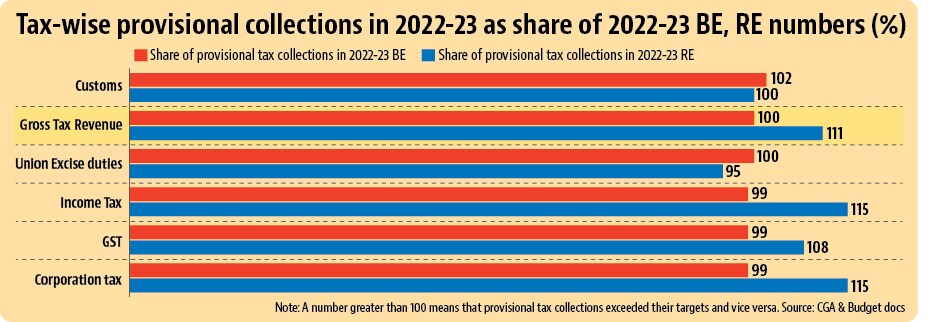
 Gross tax revenue is higher than Revised EstimatesThe centre’s Gross Tax Revenue (GTR), as per the provisional numbers for 2022-23, is Rs.30.5 lakh crore, which is marginally higher than the ₹30.4 lakh crore figure given in the Revised Estimates (RE) for 2022-23 in the 2023-24 Budget. The RE number itself was significantly higher than the ₹27.6 lakh crore GTR value in the Budget Estimates (BE) for 2022-23. To be sure, the headline GTR number hides tax-wise divergence in collections. While provisional union customs duty collections are 1.6% more than the RE number, collection for every other major tax-head is actually lower than the RE figures, although all of them, except union excise, are higher than the 2022-23 BE numbers.
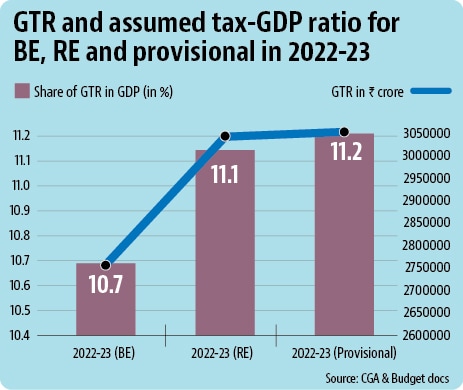
- What explains a higher-than-expected GTR?Provisional GTR numbers for 2022-23 are 10.7% higher than the BE estimate for 2022-23. What explains this windfall gain? Logically speaking, there are two things which can lead to a higher tax collection compared to BE numbers. The first is the nominal GDP -- it serves as the base for tax collections -- ending up higher than what has been assumed in the budget. The other source of higher revenues can be a higher tax-GDP ratio than what was assumed in the budget. Nominal GDP for 2022-23, as per the provisional estimates released by the National Statistical Office (NSO) on May 31, is 5.6% higher than what was assumed in the 2022-23 Budget. One of the reasons for a higher-than-expected nominal growth is just high inflation. But not all of the increase in GTR in 2022-23 is on account of higher-than-expected nominal GDP. And this is where the assumed tax-GDP ratio comes into play. BE numbers for 2022-23 assume a tax-GDP ratio of 10.7%. If one were to apply this ratio to the provisional nominal GDP value for 2022-23, GTR would come to Rs. 29.1 lakh crore, which is 4.6% lower than the provisional GTR value. Provisional numbers for GTR and nominal GDP for 2022-23 show that the tax-GDP ratio is 11.2%. So, better tax collections have also played a role in GTR ending up higher than expected.
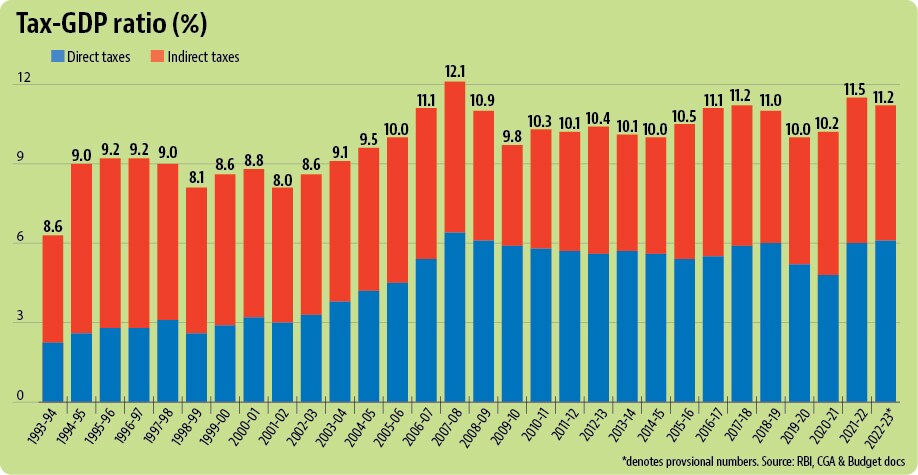
- In fact, tax-GDP ratio in the last couple of years is among the highest in recent pastA long-term comparison of the tax-GDP ratio shows that the 2022-23 provisional number is the second highest after 2007-08, the year before the 2008 Global Financial Crisis (GFC) hit India. In the post-2008 period, this ratio hovered in the range of 9.8-10.5% for almost a decade before crossing the 11% mark in 2016-17. This number fell gradually to reach 10% in 2019-20, largely a result of a sharp reduction in corporation tax rates, but has been rising since then. A break-up of tax-GDP ratio into direct and indirect tax heads shows that the recent improvements are primarily on account of a rise in direct tax-GDP ratio.
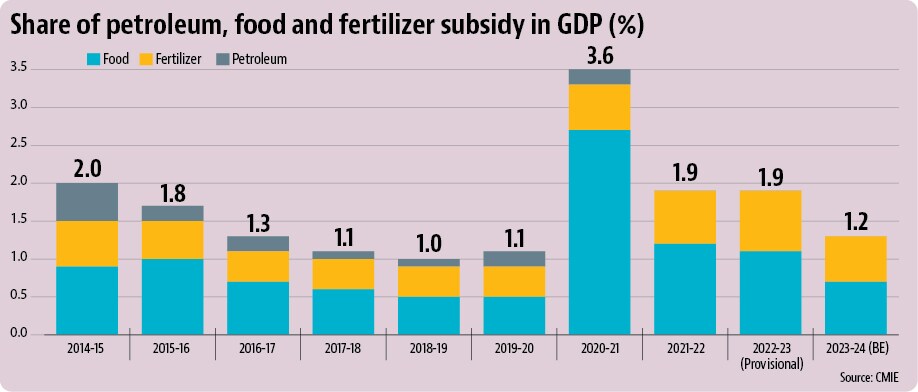
- Reduction in subsidies has also helpedSubsidies, effectively speaking, are nothing but negative taxes for a government. A comparison of subsidy data in the union budget shows that the current government has been cutting subsidies for a long time now. The share of subsidies in GDP stood at 2.1% in 2014-15, when the current government presented its first budget. This number is expected to be 1.3% according to the 2023-24 BE numbers. What explains the fall in subsidy burden of the union government? The subsidy bill consists of three major spending: food, fertiliser and petroleum. A comparison of share of each of these subsidies in GDP shows that the fertilizer and food subsidies are the biggest reason for the falling subsidy burden. To be sure, some of the reduction in food subsidy from 2022-23 to 2023-24 is on account of discontinuation of the additional food support scheme during the pandemic, which was always supposed to be a counter-cyclical policy decision.