
 E-Paper



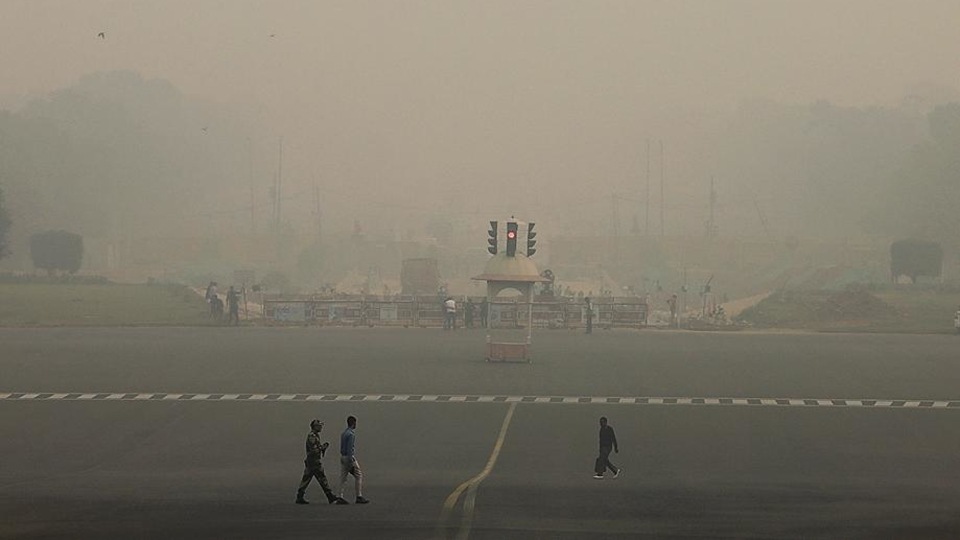
Checks on paper, Delhi chokes on toxic haze
The air quality index (AQI) was 471, according to the Central Pollution Control Board’s (CPCB) 4pm bulletin, having risen by 100 points within 48 hours.

 Prefer HTon Google


Air pollution reached the season’s worst levels on Friday as the toxic smog that has persisted for over a week thickened and emissions breached “emergency” level thresholds that would have normally led to a host of curbs like a ban on construction work, the entry of heavy vehicles, and odd-even car use limits.
Instead, this year has seen a new record for farm fires this late in the year as the enforcement of a ban on the practice collapsed, and has exposed the futility of the mainstay pollution response mechanism known as the Graded Response Action Plan (Grap) despite advance predictions that meteorological factors will exacerbate the problem.
The air quality index (AQI) was 471, according to the Central Pollution Control Board’s (CPCB) 4pm bulletin, having risen by 100 points within 48 hours. The number surpassed the 462 recorded the day after Diwali, when a double whammy of firecracker smoke and farm fires pushed up pollution levels.
Doctors urged people to stay indoors, and parents have begun keeping their children at home as the days remain particularly dangerous for those with respiratory conditions.
Like each year for nearly a decade now, man-made factors have combined with pre-winter weather conditions to create the perfect storm of conditions that has led to the crisis. “This spike in pollution is an amalgamation of many things. Delhi already saw peak pollution levels after Diwali and the high stubble count in Punjab and Haryana. Because of slow winds, the pollution load is not being eased, and more pollution is being added. All this is being recirculated in the air,” said VK Soni, head of IMD’s environment and research department.
Data from heat-sensing satellites analysed by HT show that, this year, there have been 24,694 incidents of fire recorded since November 8. This number is the highest for the second week of November since 2012, the earliest year for which data was available. The later farm fires take place, the harder it is for the smoke to be dispersed in the atmosphere since this is the time of the year when weak pre-winter winds set in over the region.
Officials in Punjab, where most of the farm fires take place, told HT earlier they are not prosecuting farmers for violating a Supreme Court-ordered ban on burning crop residue.
Authorities have also dragged their feet on factors they can control within the National Capital Region, largely as a consequence of how Grap is designed – the curbs designed for most impact do not kick in unless pollution has remained in the emergency level for 48 hours.
The subcommittee of the Commission for Air Quality Management (CAQM), a new body that now is responsible for the implementation of Grap, met on Friday and reiterated that the measures listed under the severe category will be implemented. They advised government and private offices to reduce the use of private vehicles by at least 30% by encouraging practices such as work-from-home and carpooling, and urged residents to limit outdoor activities.
“We have also asked the state pollution control boards of Delhi and NCR to closely monitor the action being taken by enforcement teams and submit reviews to the CAQM and CPCB,” said Prashant Gargava, chairperson of CAQM subcommittee for the implementation of Grap and member secretary, CPCB.
The most strict curbs under Grap are a ban on the entry of trucks, shutting down of schools, halting all construction work, and allowing cars with odd and even number plates to be driven only on alternate days. But these come into force only if the PM10 levels and PM2.5 levels have remained above emergency levels for 48 hours. Till 10pm on Friday, PM2.5 levels were above the 300ug/m3 mark (the emergency threshold) for 22 hours and PM10 levels were above 500ug/m3 mark for 20 hours.
Experts said the recurring crisis is evidence that the plan to fight air pollution simply does not work. “Grap has been in place since 2017, but we have not seen any impact of from implementing the measures listed under it. So, if these measures have not worked, it means that it has not been effective and we need to look at alternatives. It’s not just Grap, our governments need to revisit their overall approach to pollution management,” said environment issues lawyer Rahul Choudhary.
The Supreme Court is likely to discuss the issue on Saturday when it will continue hearing a plea filed by a 17-year-old Delhi student, Aditya Dubey, who has alleged that authorities have failed to protect his fundamental right to clean air and health by not controlling air pollution.
A bench, comprising Chief Justice of India NV Ramana and justices DY Chandrachud and Surya Kant, will take up the latest affidavit filed by the Union government on steps taken to reduce air pollution due to various factors, including crop residue burning.
As the crisis persists, doctors warn the air outside can leave immediate as well as lasting health impacts, particularly for people’s lungs, heart and even brain. “When we say PM 2.5 or PM 10, it’s just the particle size that we are talking -- the kind of damage depends on what creates the particle such as firecrackers, fuel combustion, stubble burning etc. The particulate matter from diesel or kerosene burning can even cause lung cancer...,” said Dr GC Khilnani, former head of pulmonology department, AIIMS, Delhi.
“What nobody talks much about and does the maximum damage is ultrafine particles of 0.1 micron or less. These penetrate the lung and reach the blood stream, and once in the blood, these can reach anywhere. Even perfectly healthy people can experience short-term symptoms such as breathing issues, sore throat or red eyes,” added Dr Khilnani,
For now, experts warned the problem is going to persist, which means the Grap’s 48-hour requirement will be met.
“As per IITM’s Decision Support System for air quality management, a significant share of pollution comes from transport-related emissions, in addition to farm fires. The Delhi government should focus on offsetting the additional load from farm fires... by imposing vehicle restrictions, ensuring that open burning of waste is prevented and inspection of all construction sites in Delhi-NCR,” said Tanushree Ganguly, programme lead, Council on Energy, Environment and Water (CEEW).
(With inputs from Abhishek Jha)


