
 E-Paper



At minus 8 degrees, Srinagar sees coldest December night in 50 years; Delhi shivers too
Some parts of Rajasthan also experienced intense cold wave conditions, with Karauli recording the lowest temperature at 4.5 degree Celsius on Sunday.


The 40-day-long period known as Chillai Kalan, marking the harshest phase of winter in Kashmir, commenced on Saturday with an unprecedented cold spell. According to the meteorological department, Srinagar experienced its coldest December night in five decades as temperatures plunged to a chilling minus 8.5 degrees Celsius.
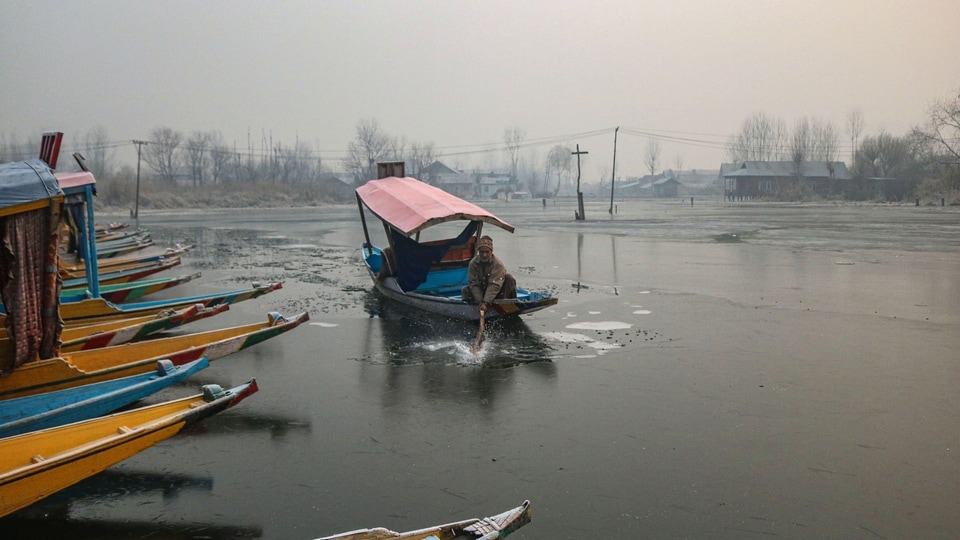
On Sunday morning, temperatures in Srinagar recorded at minus 3.2 degrees Celsius. The intensity of the cold wave was so high that the surface of Dal Lake also froze.
At minus 8.5 degrees Celsius, it was Srinagar's coldest December night since 1974, when the city recorded a low of minus 10.3 degrees Celsius, and the third coldest since 1891.
Srinagar's lowest-ever minimum temperature in this month was minus 12.8 degrees Celsius on December 13, 1934.
'Chillai Kalan' will conclude on January 31, 2025 but, even after that the cold wave conditions will continue in the valley. This is because a 20-day Chillai Khurd (small cold) and a 10-day Chillai-Bachha (baby cold) will begin after the 40-day period.
Jammu and Kashmir chief minister Omar Abdullah has also taken note of the severe cold wave conditions in the valley, cancelling his forthcoming programmes in Jammu.
In a post on X, Abdullah said that he will be stationed in Srinagar for the next week to "personally monitor" the arrangements made for the harsh winter period and the functioning of electricity and other power departments.
"I do appreciate that cancelling my programmes in Jammu will cause some inconvenience to the organisers & I regret the same. However under the circumstances this is the right thing to do & I will make it up to the people/organisations whose programmes have been affected," he added.
The chief minister, who was in Rajasthan earlier this week, will return to Srinagar on Monday morning.
Delhi, meanwhile, was covered in layers of fog on Sunday morning and recorded a minimum temperature of 8 degrees Celsius. Visuals from in and around the national capital saw people taking help of bonfires to beat the chilly weather.
Several people also took refuge in night shelter homes to survive the cold wave conditions in the city.
ALSO READ | Delhi air pollution: AQI back to ‘severe’ as cold wave continues to grip national capital | Updates
The air quality index also dropped to 'severe' in Delhi. As per the Central Pollution Control Board (CPCB), the AQI was recorded at 427 at 7 am on Sunday.
Some parts of Rajasthan also experienced intense cold wave conditions, with Karauli recording the lowest temperature at 4.5 degree Celsius on Sunday.
The India Meteorological Department said that the weather in the state was mainly dry, while some places witnessed fog.
After Karauli, Sangaria recorded a minimum temperature of 5.3 degree Celsius, Fatehpur 5.4 degrees, Churu and Alwar 6.6, Sriganganagar 7, Dholpur 7.5, and Anta 7.8 degrees Celsius.
Additionally, according to the weather department, India had the shortest duration of day on Saturday, December 21. This was marked under the winter solstice, which occurs when "the sun is directly over the Tropic of Capricorn, which is located 23.5 south of the equator and runs through Australia, Chile, southern Brazil, and northern South Africa".
The shortest day time on December 21 in Delhi was 10 hours 19 minutes, in Mumbai 10 hours 59 minutes, Chennai 11 hours 22 minutes, and Kolkata 10 hours 46 minutes, IMD said.
(with ANI inputs)


