India on Friday reacted strongly to China repeatedly raising sovereignty issues in official readouts of bilateral meetings, saying the Indian side hasn’t violated China’s sovereignty, whereas Beijing continues to illegally occupy territories in the erstwhile state of Jammu and Kashmir and has built projects in these regions.
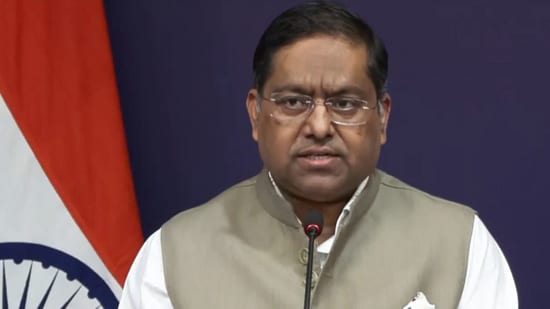
External affairs ministry spokesperson Randhir Jaiswal was responding to a Chinese readout of a meeting between external affairs minister S Jaishankar and his counterpart Wang Yi in Manila on Wednesday, which contended that the Indian leader had assured the Chinese side about respecting China’s sovereignty, including on issues such as Taiwan and Tibet. People familiar with the matter said Jaishankar had made no such comments.
Also Read | Monsoon, not India: MEA cites Pak’s advisory to rebut its ‘baseless’ flood claim
“Let me say that the external affairs minister said that when it comes to sovereignty issues, it is actually India that should be and is raising them,” Jaiswal said in response to a question at a regular media briefing.
“India does not violate China’s sovereignty in any manner and has been consistent, but China is in illegal occupation of Indian territories in Jammu and Kashmir and Ladakh since 1963, where India’s right is officially acknowledged even by China,” he said.
{{/usCountry}}“India does not violate China’s sovereignty in any manner and has been consistent, but China is in illegal occupation of Indian territories in Jammu and Kashmir and Ladakh since 1963, where India’s right is officially acknowledged even by China,” he said.
{{/usCountry}}“Also, there are Chinese projects in territories in Jammu and Kashmir that belong to India, and we object to that,” Jaiswal said, referring to projects implemented by China in Pakistan-occupied Kashmir (PoK) as part of the China-Pakistan Economic Corridor (CPEC) and in the occupied Shaksgam Valley.
India has consistently objected to CPEC as a key part of it passes through PoK. China has illegally occupied more than 43,000 sq km of Indian territory in the erstwhile state of Jammu and Kashmir, including Aksai Chin and the Shaksgam Valley. There have been recent reports of China taking up infrastructure projects in the Shaksgam Valley.
Also Read | India-backed Chabahar terminal safe, says MEA; flags safety of civilian assets
The Chinese readout issued after the meeting in Manila had sought to convey the impression that Jaishankar had assured the Chinese side on sovereignty-related matters. In a paragraph devoted to comments purportedly made by Jaishankar at his meeting with Wang, the readout said: “India’s position on such issues as Taiwan and Xizang remains unchanged. India respects China’s sovereignty and has always pursued a positive and cooperative bilateral relationship with a forward-looking approach.”
The people said the external affairs minister had not made such remarks. This was the third instance in recent months that the Chinese foreign ministry’s readouts have attributed comments to Indian leaders, including national security adviser Ajit Doval, that did not square with the Indian records of the discussions, the people said.
Also Read | Condemn such attacks, says MEA after Russian missile kills 4 Indians on vessel
The external affairs ministry had also pushed back against the Chinese readout of a meeting between Doval and Wang in New Delhi on June 22 by issuing a clarification that said the NSA had “emphasised the importance of sensitivity being consistently displayed to each other’s issues of core concern”. This, the ministry said, would be in keeping with India’s overall approach of mutual sensitivity, mutual interests and mutual respect.
During the meeting in Manila on Wednesday, Jaishankar highlighted the importance of peace and tranquillity in the border areas as a prerequisite for normal bilateral ties, and raised the Indian side’s concerns about fair access to Chinese markets, balanced trade and predictability of supply chains.