E-Paper



Civic offences to get costlier in Delhi; fine for public urination to be raised from ₹50 to ₹500
The amendments replace lower fines of as little as ₹25 with higher penalties, while removing imprisonment for minor infractions.

 Prefer HTon Google


Residents and small-scale enterprises in the Capital may soon face higher monetary penalties for civic violations, even as several minor offences are proposed to be decriminalised under the Jan Vishwas (Amendment of Provisions) Bill, 2026, tabled in Parliament on Friday.
The amendments cover the Delhi Municipal Corporation (DMC) Act, 1957, and the New Delhi Municipal Council (NDMC) Act, 1994. They replace lower fines of as little as ₹25 with higher penalties, while removing imprisonment for minor infractions.
“The aim is to rationalise outdated provisions and promote ease of living and doing business by shifting to a penalty-based system,” said an MCD official.
Also read: 22-year-old Karnal youth shot dead in US' Georgia, family seeks help to bring back body
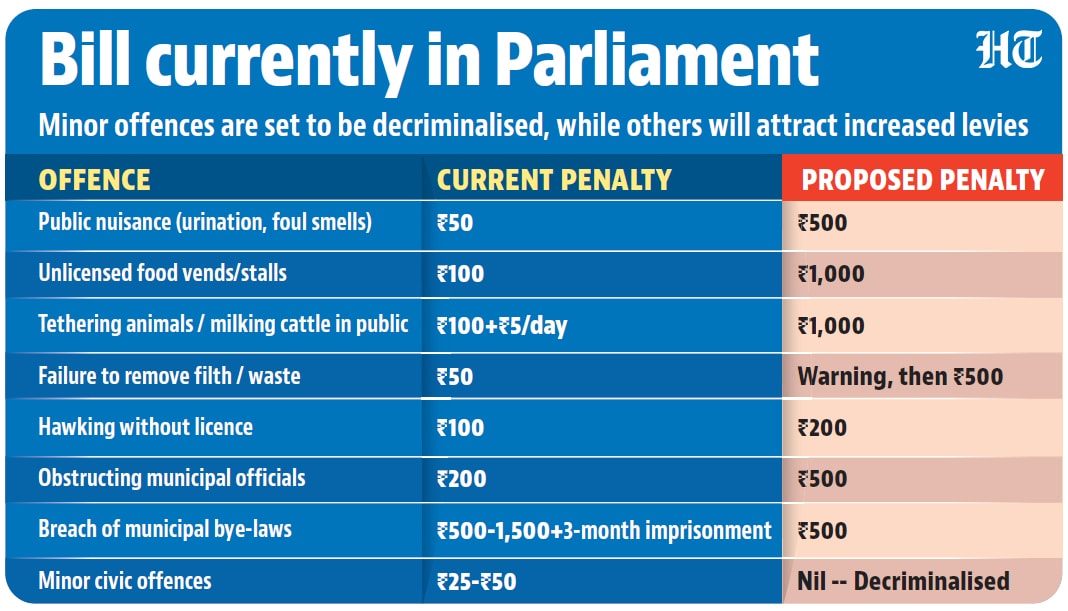
Under the DMC Act, nominal fines are proposed to be replaced with structured penalties. Failure to remove filth, currently attracting a fine of ₹50, will invite a warning for the first violation and ₹500 thereafter. Public urination or nuisance, earlier fined up to ₹50, may now attract ₹500. Penalties for other violations will also rise sharply.
For instance, the fine for letting a dog roam without a leash will increase from ₹50 to ₹1,000, while defacing a house number will also rise to ₹1,000 from ₹50.
Also read: Abducted, beaten, robbed: Delhi man's dating app meet turns into horror; 5 held
Fines for failing to vacate a dangerous structure and occupying a building without a completion certificate will both increase from ₹200 to ₹1,000. Erecting structures that obstruct streets or open roads without permission will incur penalties ranging from ₹100 to ₹5,000.
For livelihood violations
Running food vends or stalls, such as tea shops, without a licence may attract a fine of ₹1,000 under the revision, up from ₹100. Hawking or operating as a butcher, fishmonger or poultry seller without a licence will increase from ₹100 to ₹200.
Penalties for tethering animals or milking cattle on public streets will rise tenfold from ₹100 to ₹1,000, while fines for keeping animals in violation of rules will double to ₹200.
Also read: Commercial flights at Noida airport to begin in 60 days, says aviation minister
“In several cases, daily fines are proposed to be replaced with one-time penalties. For instance, using unlicensed slaughterhouses or markets, earlier attracting ₹500 plus daily fines, will now incur a flat ₹500 penalty,” said the official.
The bill also removes the provision for imprisonment for minor offences. A clause allowing up to one month’s imprisonment for municipal sweepers who leave duty without notice is proposed to be omitted. Similarly, breach of municipal bye-laws, earlier punishable with imprisonment of up to three months along with fines, will now attract a penalty of up to ₹500. Some minor offences are proposed to be fully decriminalised, by removing fines altogether. These include depositing rubbish in streets, washing clothes at unauthorised places, failure to notify vacant properties and damaging streetlights.
Several provisions related to market regulation and information compliance are also proposed for omission.
Also read: US-Iran conflict, ICE arrests and more: What are ‘No Kings’ demonstrators protesting on March 28?
Parallel changes in the NDMC Act follow a similar approach. An official note states that 145 provisions have been decriminalised, including 68 where fines or imprisonment are converted into penalties and 26 where penal clauses are removed entirely. Under NDMC rules, hawking without a licence or selling in municipal markets without permission will invite a warning for the first violation and a penalty of ₹200 thereafter. Running eateries without a licence will attract a fine of ₹1,000, and misuse of domestic water supply for commercial purposes will increase from ₹100 to ₹1,000 after the first warning.
Imprisonment provisions are also proposed to be removed under NDMC. The NDMC amendments also introduce structural reforms to property taxation by enabling the Unit Area Method (UAM) to replace the annual rental value system.
“This is aimed at reducing the upper tax rate from 30% to 20%, offering relief to property owners,” an NDMC official said.
Officials noted that by increasing penalties and removing criminal liability, the framework seeks to balance enforcement.