
 E-Paper



Cloudbursts may have triggered flash floods, landslides in Kerala: Experts
On Saturday, two landslides claimed 18 lives in Idukki and Kottayam districts. Residents of Kootickal and Kokkayar, the two worst-hit hamlets, witnessed a tragedy of such magnitude for the first time

 Prefer HTon Google


Thiruvananthapuram:
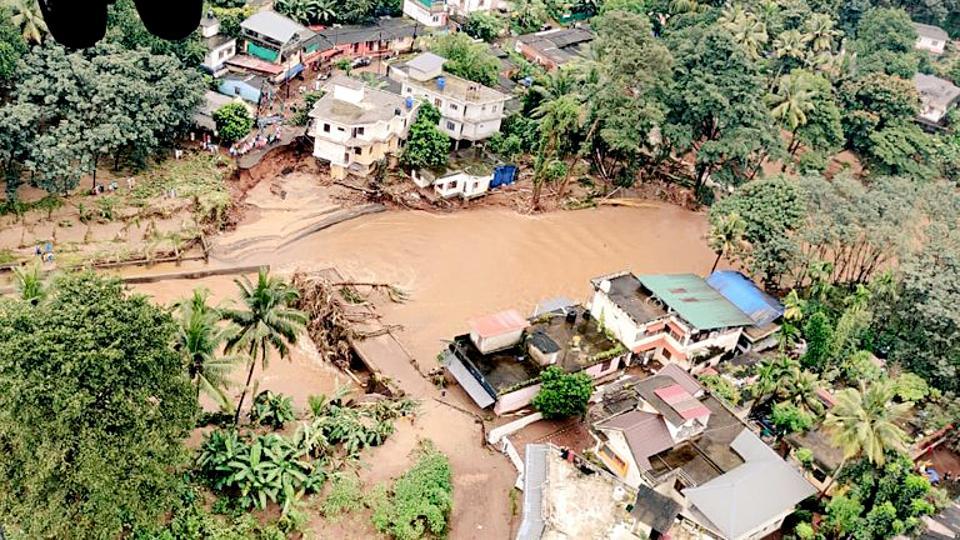
The death of 24 people in flash floods and landslides caused by heavy rains in the hilly areas of Idukki and Kottayam districts in central Kerala has once again highlighted the recurring natural disasters in the state.
Kerala has seen a series of natural disasters in the past four years, causing loss of lives and property.
In August 2018, the most severe flood of the century claimed 483 lives. A year later, 48 people died after a portion of a hill came down at Kavalappara near Nilambur in Malappuram district.
In August last year, 74 people were killed at Pettimudi in the Idukki district after a landslide decimated a settlement of tea plantation workers.
On Saturday, two landslides claimed 18 lives in Idukki and Kottayam districts. Residents of Kootickal and Kokkayar, the two worst-hit hamlets, witnessed a tragedy of such magnitude for the first time.
Though natural disasters are largely attributed to climate change, many ecologists blame human intervention as well for recurring mishaps. Many landslides were triggered by unscientific developmental work carried out in ecologically sensitive areas, experts said, lamenting that such issues come up for discussion only when a tragedy strikes.
Kerala was suffering from a man-made disaster and its impact could have been limited if the Gadgil commission’s report was implemented in earnest, said environmental scientist V S Vijayan, chairman of Thrissur-based Salim Ali Foundation, which works in the area of biodiversity conservation.
The Western Ghats Ecology Expert Panel, also known as the Gadgil Commission after its chairman, ecologist Madhav Gadgil, had in its 2011 report recommended a series of actions to conserve the Western Ghats, a Unesco heritage site that plays an important role in breaking rain clouds over the subcontinent.
When all six states in the Western Ghats region – Kerala, Tamil Nadu, Karnataka, Goa, Maharashtra and Gujarat – opposed the suggestions, another committee was constituted under former ISRO chief Kasturirangan. The second report faced objections as well.
If the remained unchanged, Kerala would witness more such mishaps, Vijayan warned.
“It is a fact nobody can stop rains or control floods. Due to climate change, such tragedies are bound to increase. We have seen heatwaves in some western counties,” Vijayan said. “But we can take measures to lower the intensity of such tragedies. Quarrying and unbridled developmental activities are still rampant in many ecologically sensitive areas of Kerala.”
Cloudbursts might have triggered torrential rains at several places in Kottayam and Idukki districts, a weather expert said.
“The pattern of the rains shows it is a cloudburst. Some of the areas in Idukki and Kottayam received more than 20 cm rainfall in 2-3 hours,” said M G Manoj, a scientist at the Advanced Centre for Atmospheric Radar Research in Cochin University of Science and Technology.
“We need long- and short-term strategies to tackle such tragedies. Usually, soil study or soil piping phenomena are not done while constructing houses,” Manoj said. “Proper geological studies are needed, at least for new dwelling units.”
“We can reduce the intensity of disasters by listening to early warnings and disseminating them to targeted audiences. We need more studies in hazard-reduction areas,” he said.
After the Kavalappara tragedy in 2019, many experts said soil piping was rampant in many areas of the state, but no serious study was done.
Soil piping and lateral spread (which occurs when the soil starts moving downhill) are more visible in Kerala these days. These two often trigger major disasters. Like cloud pattern, soil pattern is also undergoing a sea change,” said V Nandakumar, a scientist at the Thiruvananthapuram-based National Centre for Earth Science Studies.
“We cannot control rains. But we can mitigate damage triggered by extreme rains,” Nandakumar said. “Human intervention plays a key role in multiplying damages at several places.”
Recently, in north Kerala’s Kozhikode, vibrations accompanied by mysterious sounds were felt in a newly constructed house. Later, geologists and experts examined the house and found that soil piping or lateral spread might have triggered them and asked the occupants to shift from the premises.


