
 E-Paper



CM outlines agenda for GBA at inaugural meet
Chief Minister Siddaramaiah launched the Greater Bangalore Authority to decentralize governance and improve city administration amid opposition criticisms.

 Prefer HTon Google


Chief minister Siddaramaiah, at the inaugural meeting of the Greater Bangalore Authority (GBA) held at the Kempegowda Municipal Hall on Friday, laid out detailed instructions to streamline administration across the newly formed five municipal corporations of Bengaluru. The meeting was convened to chart a roadmap for the city’s administrative restructuring.
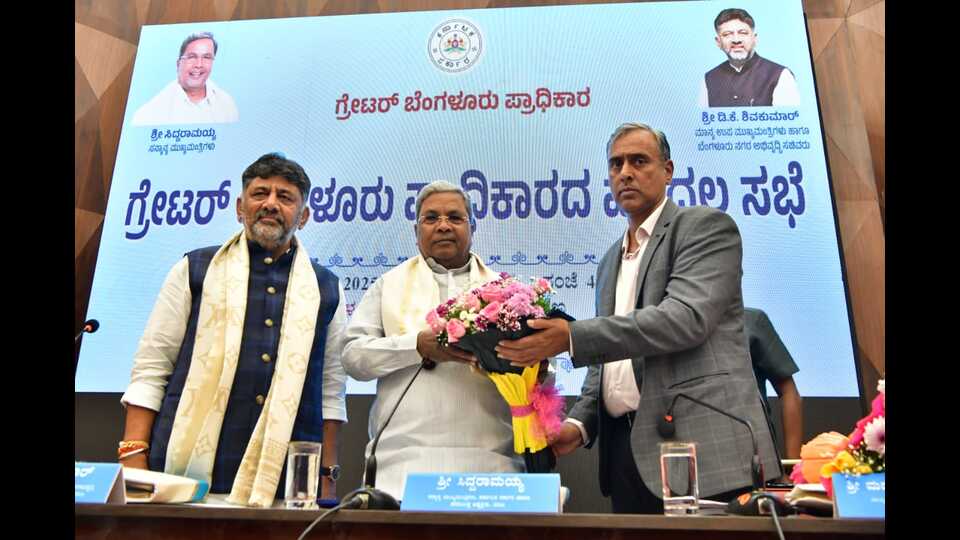
Highlighting the challenges of managing a rapidly growing metropolis, Siddaramaiah said, “Bangalore is the fastest growing city in the world. People from many countries of the world have not only invested here, but also built their lives here. Today, the population of Bangalore is about 1.40 crore. There was a discussion that proper administration of such a huge city cannot be done by just one corporation.”
The Chief Minister recalled that during his earlier tenure, a committee had been constituted to examine the feasibility of decentralising Bengaluru’s administration. “When I was the Chief Minister earlier, I had formed a committee to report on the possibilities of forming more corporations in Bangalore. The committee had also given an interim report. But no decision was taken in this regard in the subsequent governments. After we came to power, we reconstituted the committee. Now, after accepting suggestions and objections from the public, we have brought a law and formed the Greater Bangalore Authority. Now, five municipal corporations have come into existence,” he said.
The GBA, which came into force on May 15, aims to improve citizen-centric governance. Siddaramaiah said, “We have formed BGA in accordance with the wishes of democracy with the aim of providing administration that is conducive to the people and fulfills their aspirations. This will make decentralization of power possible.”
Siddaramaiah detailed the priorities for the GBA, instructing officials to ensure efficient waste management, enhance municipal revenues, reduce traffic congestion, and maintain cleanliness across the city. “We have instructed to take steps to keep Bengaluru city clean, enhance the beauty of the city and increase the income of all five municipal corporations. Roads, drains, footpaths, and parks must be developed on priority to make these corporations models of good governance,” he said.
He emphasised coordination among state and civic institutions, adding, “All the concerned departments, institutions like BDA, BWSSB, BESCOM, BMRCL, which are providing services to the citizens of Bengaluru, should work in coordination with GBA.”
Administrative efficiency was also highlighted: “Identify the place to build adequate administrative offices for the five municipal corporations and take steps for construction. The respective corporations should take steps to ensure proper garbage disposal at their level. Priority should be given to garbage disposal and cleanliness. Footpaths should be made as wide as possible. Quality should not be compromised for any reason. If officials are involved with contractors, quality work cannot be done. We have instructed that this should not be allowed.”
On improving urban transport, the Chief Minister said, “Instructions have been given to formulate and implement a plan to increase last mile connectivity on the metro line to reduce traffic congestion. Instructions have been given to the Transport Minister to review the deployment of small buses for this.”
The establishment of the GBA marks a major administrative reform intended to decentralise governance in the country’s fastest-growing urban centre. Officials said the move would allow localised decision-making and faster implementation of civic works across the newly carved zones.
However, the opposition Bharatiya Janata Party (BJP) criticised the government’s handling of the authority. BJP state president BY Vijayendra alleged, “They are conducting the meeting in secrecy, without any transparency. They talk about holding elections in December, but where is the preparation? How many officials will be appointed? What about the infrastructure? There’s no groundwork at all. They are making politically motivated announcements without any planning.”
Taking aim at the state’s handling of civic infrastructure, Vijayendra added, “The people of Bengaluru are disgusted with this government. Deputy Chief Minister D.K. Shivakumar is busy counting potholes near Prime Minister Narendra Modi’s residence and elsewhere, while Bengaluru’s citizens are struggling to find roads between potholes.”
He accused the government of failing to deliver on promises of turning Bengaluru into a “London-like city,” saying, “The government talks about London and the Prime Minister, but shouldn’t they first fix Bengaluru? The people of this city are demanding immediate action to repair roads, not empty promises.”
Vijayendra also criticised the state government for neglecting farmers affected by recent heavy rains in North Karnataka, saying, “Farmers are already in distress, and now heavy rains have worsened their situation. Yet the Agriculture and Revenue Ministers have not even visited the affected areas. If they don’t have time to visit suffering farmers, why should they remain ministers at all?”
Defending the creation of the GBA against critics, Siddaramaiah said, “Those who oppose decentralisation and do not want Bengaluru’s progress are the ones opposing this meeting. Democracy becomes stronger through dialogue and discussion. Even if there are differences, everyone must participate in the meeting, engage in discussions, and contribute to the city’s development. Everyone should work in coordination in the coming days to fulfill the objective of providing the best civic facilities and good governance to the people.”


