E-Paper



Colonel Sofiya Qureshi’s family joins Modi’s roadshow in Gujarat’s Vadodara
Colonel Qureshi’s parents, Taj Mohammad and Halima Qureshi, welcomed Modi as people lined the streets for the road show that started at Vadodara’s Harni Airport

 Prefer HTon Google


The family of Colonel Sofiya Qureshi, one of the two women military officers who held briefings on India’s cross-border strikes on terror infrastructure under Operation Sindoor, joined Prime Minister Narendra Modi’s roadshow in Gujarat’s Vadodara on Monday.
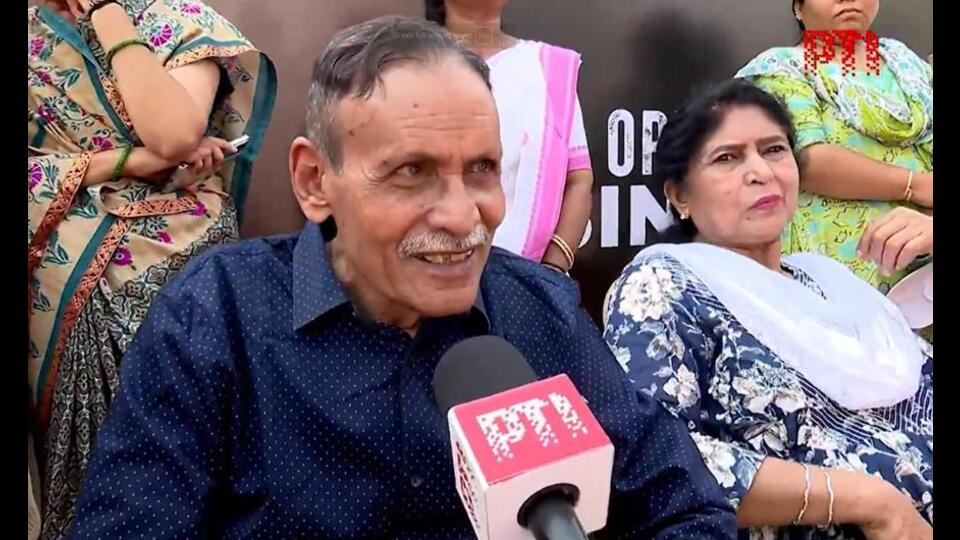
Colonel Qureshi’s parents, Taj Mohammad and Halima Qureshi, welcomed Modi as people lined the streets for the roadshow that started at Vadodara’s Harni Airport and featured cultural performances.
Colonel Qureshi’s twin, Shyna Sunsara, called the meeting with Modi a great honour and the roadshow a moment of pride. “He [Modi] has done a lot for women’s empowerment. Colonel Qureshi is my twin sister. When your sister does something for the country, it inspires me and others as well.”
Sunsar said Colonel Qureshi is no longer just her sister but that of the country. She referred to Colonel Qureshi and Wing Commander Vyomika Singh’s Operation Sindoor briefings and called them a message to the world that women are not less than anyone.
Taj Mohammad echoed Sunsara over their meeting with Modi. “Sofiya Qureshi is the daughter of the country, who only did her duty,” said Mohammad, who served in the Army’s Corps of Electronics and Mechanical Engineers and fought in the 1971 India-Pakistan War. Colonel Qureshi’s grandfather was part of the Army’s Religious Teacher cadre.
Over 50,000 people were expected to gather for another roadshow of Modi in Ahmedabad later on Monday, the first day of his two-day visit to Gujarat. Modi is scheduled to inaugurate and lay the foundation for development projects worth over ₹82,950 in Dahod, Bhuj, and Gandhinagar during his first visit to his home state after Operation Sindoor. Hoardings have been put across Ahmedabad, celebrating the armed forces’ successes in the operation.
Officials said Modi will inaugurate and lay the foundation stones for 33 development projects worth ₹53,414 crore in Bhuj, which was among the places Pakistan targeted with drones in retaliation for the cross-border strikes. These projects encompass the Kandla Port infrastructure, solar energy, power transmission, and road and building development.
In Dahod’s Kharod, Modi will launch railway, water supply, roads, buildings, urban development, and housing projects worth over ₹24,000 crore. He will inaugurate the Locomotive Manufacturing Shop built at a cost of ₹21,405 crore and the first 9000 HP locomotive engine.
Modi will inaugurate railway works worth ₹2,287 crore, including the doubling of Anand–Godhra, Mehsana–Palanpur, and Rajkot–Hadmatiya railway lines, electrification of the 107 km Sabarmati–Botad line, and gauge conversion of the Kalol–Kadi–Katosan line.
On Tuesday, Modi will inaugurate the UN Mehta Institute of Cardiology and Research Centre in Gandhinagar and over 22,000 housing units constructed under the Pradhan Mantri Awas Yojana at the cost of ₹1,006 crore. He will lay the foundation stones, including for a new 1800-bed inpatient with an outpatient department in Ahmedabad, including a 500-bed infectious disease unit.
Modi will distribute cheques worth ₹2,731 crore to 17 municipal corporations and ₹569 crore to 149 municipalities under the Swarnim Jayanti Mukhyamantri Shaheri Vikas Yojana for infrastructure projects.