Droupadi Murmu has been elected the 15th President of India as per the results announced on Thursday. The elections for the President were held on July 18. According to the results, Murmu has secured 676,803 out of the 1,056,980 valid votes (in terms of value) which were polled. Because presidential polls follow an electoral college system, the number of votes for a given ballot differs across states and the parliament and legislative assembles. Murmu led by 232,400 votes over her
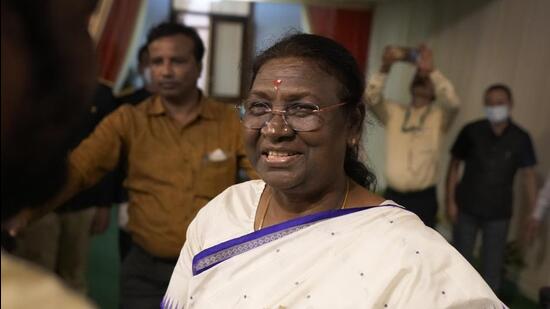
Droupadi Murmu has been elected the 15th President of India as per the results announced on Thursday. The elections for the President were held on July 18. According to the results, Murmu has secured 676,803 out of the 1,056,980 valid votes (in terms of value) which were polled. Because presidential polls follow an electoral college system, the number of votes for a given ballot differs across states and the parliament and legislative assembles. Murmu led by 232,400 votes over her rival Yashwant Sinha in the round where votes of MPs were counted. In the round where votes from legislative assemblies were counted Murmu’s lead over Sinha was 64,226 votes.
How does Murmu’s victory compare to her predecessors? HT has analysed past presidential election results to answer this question.
A comfortable win, but not the largest
Murmu’s victory margin over Sinha, in terms of vote share, stands at 28.06%. While this is a comfortable victory margin indeed, it is not among the highest in the recent past. In 2002, APJ Abdul Kalam was elected to the president’s post with a vote share of almost 90%. Kalam, who was seen as having led India’s missile and nuclear weapons programme, enjoyed the support of almost all political parties except the Communists. The latter put up Lakshmi Sahgal, a former freedom fighter who was also a member of Subhash Chandra Bose’s Indian National Army. Sahgal managed to get 10% of the votes. Presidential elections after 2002 have not seen a broader consensus even though the winning candidate has managed to get around two-thirds of the total votes.
But earlier Presidents have had much bigger vote shares and victory margins
The record for highest ever vote share for a presidential candidate is held by Rajendra Prasad when he contested for his second term in 1957. Prasad’s vote share was an overwhelming 99% and much higher than the 84% vote share he had when he contested the elections for the first time in 1952. Prasad’s record of highest vote share is followed by Sarvapalli Radhakrishnan and K R Narayanan who had vote shares of 98% and 95% when they successfully contested the elections in 1962 and 1997 respectively.
VV Giri who became the president in 1969 is the only President who was elected to office with a vote share of less than 50%. Giri’s election took place the peak of factional struggle in the Congress party, and his candidature was supported by Indira Gandhi against Neelam Sanjeeva Reddy who was the candidate put up by the old-guard of the Congress, also referred to as the Syndicate. Reddy’s vote share of 37.5% is the highest ever for a runner-up candidate in the presidential elections. Reddy was elected as the president without even a contest in 1977.
Presidential elections have become bipolar in the recent past
A look at number of candidates shows that the presidential elections have become less competitive. In the 10 presidential elections held from 1952 to 1992, only three had two candidates or less. In the elections from 1997 onwards, there have never been more than two candidates in the presidential elections. To be sure, even when there have been more than two candidates, their presence has been largely cosmetic, except in the 1969 elections when CD Deshmukh polled more than 10% votes as the third ranked candidate.
One Subscription.
Get 360° coverage—from daily headlines
to 100 year archives.
Archives
HT App & Website