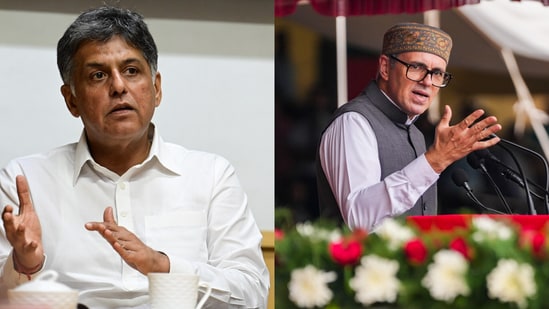
Congress Lok Sabha MP Manish Tewari on Saturday backed Jammu and Kashmir chief minister Omar Abdullah’s criticism of the Union territory’s governance, calling the dual administration system “structurally built for failure.”
Manish Tewari supports Omar Abdullah’s critique of J&K’s governance, calling the dual administration system “structurally built for failure." (HT/PTI )
{{^htLoading}} {{/htLoading}}
During his first Independence Day speech since returning as chief minister, Abdullah made one of his sharpest remarks on the non-restoration of statehood to Jammu and Kashmir.
{{^usCountry}}{{/usCountry}}
He described the dual governance system as structured “not for success” but “for failure” and, for the first time, addressed his government’s decisions that remain stalled with the Raj Bhavan.
Taking to X (formerly Twitter), Manish Tewari wrote, “I can empathise with Omar Abdullah. As an MP from a Union Territory with just a Municipal Corporation and not even a legislative assembly, unlike Jammu & Kashmir, Puducherry, or even the NCT of Delhi, this system of diarchy is systemically and structurally built for failure and not success. It is a completely unworkable model of governance.”
{{^htLoading}} {{/htLoading}}
{{^usCountry}}
At Bakshi Stadium, Abdullah announced a signature campaign demanding the restoration of statehood to Jammu and Kashmir and questioned the prolonged delay. He said well-wishers had assured him of significant change, but admitted his hope was beginning to wane.
{{/usCountry}}
{{#usCountry}}
At Bakshi Stadium, Abdullah announced a signature campaign demanding the restoration of statehood to Jammu and Kashmir and questioned the prolonged delay. He said well-wishers had assured him of significant change, but admitted his hope was beginning to wane.
{{/usCountry}}
“We waited impatiently for that speech,” he said, referring to Prime Minister Narendra Modi’s Independence Day address.
“I was even told that the documents are being prepared… We waited. It did not happen. The truth is that the ray of light has started to fade,” he added.
However, Abdullah stressed that he is not “helpless” and refused to accept the status quo.
Reacting to CJI BR Gavai's reference to the Pahalgam attack in statehood deliberations, Omar Abdullah called it “unfortunate” and directly challenged the notion of allowing terror to dictate the region’s political future.
{{^htLoading}} {{/htLoading}}
“Will the killers of Pahalgam and their masters in the neighbouring country decide whether we will be a state?” he asked.
“Every time we are close to statehood, they will do something to sabotage it. Is this fair? Why are we being punished for a crime in which we had no role?” he added.
Follow the latest breaking news, major developments and agenda-setting stories from India and around the world with the newsdesk at Hindustan Times. Operating round the clock, the desk brings together experienced editors, reporters and correspondents to deliver fast, accurate and contextual reporting across subjects that influence public policy, governance, business, society and international affairs. The HT News Desk covers politics, elections, government policies, the economy, business and markets, science and technology, the environment, law and order, infrastructure, education, climate issues and geopolitics, while closely tracking developments across states, institutions and global capitals. The team also leads coverage of major breaking news events, policy announcements, court proceedings, natural disasters, public emergencies and significant international developments. Reports published by the newsdesk are based on information gathered from reporters on the ground, official statements, government agencies, court records, regulatory filings, recognised institutions and other authoritative sources. Stories undergo editorial scrutiny and verification processes to ensure accuracy, fairness and relevance, and are updated as events evolve and additional information becomes available. Whether covering a key political decision in New Delhi, an economic policy shift affecting millions, a landmark court ruling or a major global event, the HT News Desk aims to provide readers with reliable, fact-based journalism that delivers not only the latest developments but also the context and analysis needed to understand their wider implications.
Get Latest News, breaking headlines, and top India News, and today real-time updates from across the nation. Stay informed on politics, government policies, crime, Today Weather, and major developments on Hindustan Times
Get Latest News, breaking headlines, and top India News, and today real-time updates from across the nation. Stay informed on politics, government policies, crime, Today Weather, and major developments on Hindustan Times
Home/India News/Congress MP Manish Tewari ‘empathises' with CM Omar Abdullah after J&K statehood remark
{{^htLoading}}
Advertisement
{{/htLoading}}
SHARE THIS ARTICLE ON
{{#usCountry}}{{/usCountry}}
Notifications
Get breaking alerts directly from the newsroom
Notifications are on!You'll be notified when news breaks